

INTRAPLATE EARTHQUAKES · REELFOOT RIFT · MISSISSIPPI VALLEY · CENTRAL UNITED STATES
The New Madrid Seismic Zone is one of North America’s most important intraplate earthquake regions. Hidden beneath the Mississippi River Valley, its buried faults produced the powerful 1811–1812 New Madrid earthquake sequence and continue to generate earthquakes far from any modern plate boundary.
Unlike California’s
San Andreas Fault
or the offshore
Cascadia Subduction Zone
,
New Madrid lies deep inside the North American Plate.
Its earthquakes expose an uncomfortable geological reality: tectonic plates are not perfectly rigid blocks. Ancient rifts, buried faults and crustal scars can remain weak for hundreds of millions of years, allowing modern stresses to reactivate structures that appear dormant at the surface.

Most of the world’s largest and most frequent earthquakes occur along plate boundaries. Subduction zones, transform faults, collision belts and continental rifts repeatedly release stress where tectonic plates interact.
The New Madrid Seismic Zone does not fit that familiar pattern.
It lies within the continental interior of North America, hundreds of kilometers from the nearest active plate margin. Yet the region contains an active network of buried faults capable of generating damaging earthquakes.
The zone became internationally famous after a remarkable series of earthquakes struck between December 1811 and February 1812. The strongest shocks:
- Were felt across much of the eastern United States.
- Triggered widespread liquefaction.
- Produced sand blows and ground deformation.
- Damaged riverbanks and forests.
- Temporarily disrupted sections of the Mississippi River.
- Created or enlarged lakes and wetlands.
- Generated thousands of aftershocks.
Today, the New Madrid region remains seismically active. Most earthquakes are small, but their distribution reveals a persistent fault system beneath the Mississippi Embayment.
New Madrid Seismic Zone: Quick Facts
Location
The central Mississippi River Valley, centered near southeastern Missouri, northeastern Arkansas, western Tennessee and western Kentucky.
Fault type
A complex intraplate fault network rather than one single surface fault.
Ancient structure
The New Madrid faults are associated with the buried Reelfoot Rift.
Historic sequence
Several very large earthquakes struck between December 1811 and February 1812.
Main hazards
Strong shaking, liquefaction, sand blows, landslides, bridge damage and infrastructure disruption.
Why shaking travels far
Old continental crust transmits seismic waves more efficiently than much of the fractured crust in western North America.
What Is the New Madrid Seismic Zone?
The New Madrid Seismic Zone, commonly abbreviated NMSZ, is a region of concentrated earthquake activity in the central United States.
It is not one continuous fault exposed at the surface. Instead, it consists of several buried fault segments arranged in a complex pattern beneath the Mississippi Embayment.
The most active seismic trends extend through or near:
- Southeastern Missouri.
- Northeastern Arkansas.
- Western Tennessee.
- Western Kentucky.
- Southern Illinois.
Earthquake effects can extend much farther, potentially affecting parts of:
- Mississippi.
- Indiana.
- Alabama.
- Ohio.
- Louisiana.
- Other central and eastern states.
The zone takes its name from New Madrid, Missouri, a Mississippi River town near the area strongly affected by the 1811–1812 earthquake sequence.
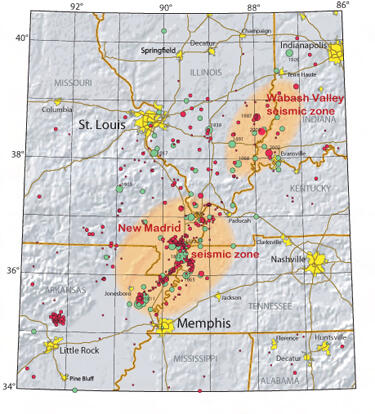
Where Is the New Madrid Seismic Zone Located?
The zone lies beneath the northern Mississippi Embayment, a broad lowland filled with river sediment.
Its earthquake pattern forms several intersecting trends rather than a single straight line.
The active region includes areas around:
- New Madrid, Missouri.
- Caruthersville, Missouri.
- Blytheville, Arkansas.
- Dyersburg, Tennessee.
- Tiptonville, Tennessee.
- Reelfoot Lake.
Why the Mississippi River Valley matters
Thick layers of unconsolidated river sediment cover much of the fault system.
These sediments can:
- Hide the underlying faults.
- Amplify some forms of ground motion.
- Increase liquefaction potential.
- Obscure surface evidence of ancient ruptures.
- Complicate estimates of exact fault geometry.

What Are Intraplate Earthquakes?
Intraplate earthquakes occur inside a tectonic plate rather than along an active plate boundary.
They are generally less frequent than earthquakes at subduction zones, transform boundaries and active rifts. However, they can still be destructive.
Why plate interiors are not perfectly stable
Continental interiors contain geological structures inherited from earlier tectonic events, including:
- Failed rifts.
- Ancient collision zones.
- Buried faults.
- Crustal sutures.
- Igneous intrusions.
- Zones of fractured basement rock.
These weaknesses may be reactivated when modern stresses are transmitted through the plate.
Where does the stress come from?
Stress inside North America may reflect a combination of:
- Forces acting along plate boundaries.
- Ridge push from the Atlantic Ocean.
- Resistance along western plate margins.
- Gravitational loading and unloading.
- Crustal density contrasts.
- Local fault orientation.
The Reelfoot Rift: New Madrid’s Ancient Geological Foundation
The New Madrid Seismic Zone is associated with the Reelfoot Rift, a buried zone of stretched and faulted crust beneath the Mississippi Embayment.
The rift formed hundreds of millions of years ago when tectonic forces attempted to split the North American continent.
The breakup failed before a new ocean basin formed, leaving behind:
- Normal faults.
- Thinned crust.
- Fractured basement rocks.
- Deep sedimentary basins.
- Zones of mechanical weakness.
What is a failed rift?
A failed rift is a continental rupture system that began to open but stopped before creating a mature plate boundary.
Failed rifts can remain embedded within continents for immense periods of time.
Examples of ancient failed rifts occur beneath many continental interiors, but only some are seismically active today.
Is the Reelfoot Rift opening again?
No evidence suggests that the central United States is currently splitting into a new ocean.
The old rift is being reactivated under a different modern stress regime. Faults that originally formed during extension may now move through reverse, strike-slip or oblique motion.
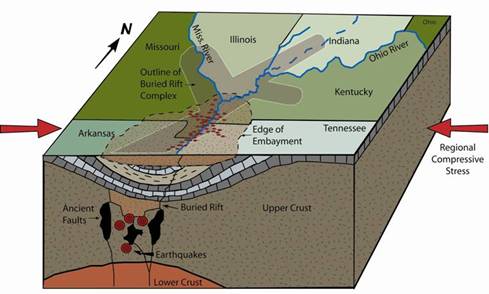
How the New Madrid Seismic Zone Works
The modern New Madrid system reflects stress acting on a complex network of inherited faults.
The basic process is:
- Regional stress is transmitted through the North American Plate.
- Stress concentrates around favorable buried structures.
- Friction locks parts of the faults.
- Elastic strain accumulates in surrounding rock.
- A fault segment slips when stress exceeds frictional resistance.
- Seismic waves radiate through the continental crust.
- Nearby faults may respond through aftershocks or triggered slip.
Why some ancient faults reactivate
A buried fault is most likely to reactivate when its orientation matches the present stress field.
Other factors may include:
- Weak minerals in the fault zone.
- Elevated fluid pressure.
- Contrasts between crustal blocks.
- Pre-existing fracture density.
- Stress changes from earlier earthquakes.
Does the zone move continuously?
New Madrid does not creep visibly at the surface like some sections of the San Andreas Fault.
Modern geodetic measurements suggest that any long-term deformation is small and difficult to isolate from broader continental motion.
This uncertainty is one reason New Madrid recurrence estimates remain difficult.
The Hidden Fault Geometry Beneath New Madrid
The active zone contains several intersecting seismic trends.
These include:
- Northeast-trending fault segments.
- Northwest-trending structures.
- The Reelfoot reverse-fault system.
- Strike-slip and oblique-slip components.
- Branches concealed beneath river sediment.
The Reelfoot Fault
The Reelfoot Fault is one of the major structures within the seismic zone.
It is associated with reverse faulting and uplift that contributed to deformation around Reelfoot Lake.
Why New Madrid is called a seismic zone
The term “New Madrid Fault” can be misleading because there is no single mapped fault responsible for every earthquake.
“New Madrid Seismic Zone” better reflects the distributed network of buried active structures.
Why the faults are difficult to map
Thick Mississippi Embayment sediments conceal basement structures.
Scientists therefore rely on:
- Earthquake hypocenter patterns.
- Seismic reflection surveys.
- Gravity and magnetic data.
- Drilling records.
- Paleoseismic trenches.
- LiDAR and geomorphic analysis.
The 1811–1812 New Madrid Earthquake Sequence
Between December 1811 and February 1812, the central Mississippi Valley was struck by one of the most dramatic earthquake sequences in North American history.
The sequence included several principal shocks and a very large number of aftershocks.
December 16, 1811 — First major earthquake
A powerful earthquake struck before dawn and was followed by a major aftershock later the same day. Strong shaking affected the Mississippi Valley and was felt across much of the eastern United States.
January 23, 1812 — Second principal earthquake
Another major shock struck the region, continuing ground deformation, liquefaction and widespread aftershock activity.
February 7, 1812 — New Madrid and Reelfoot earthquake
The final principal earthquake was among the strongest events in the sequence and was associated with major deformation near New Madrid and the Reelfoot region.
Why the sequence was so extraordinary
Instead of one isolated shock, the region experienced:
- Several very large earthquakes.
- Strong shocks separated by weeks.
- Thousands of smaller earthquakes.
- Repeated liquefaction.
- Progressive riverbank collapse.
- Continuing aftershocks for years.
Why damage records are limited
The Mississippi Valley was sparsely populated in 1811.
Modern cities, highways, pipelines, bridges, industrial facilities and power systems did not yet exist.
The limited historical death toll should not be mistaken for evidence that the earthquakes were harmless.
What Happened During the 1811–1812 Earthquakes?
Historical accounts and geological evidence describe extreme ground effects throughout the central Mississippi Valley.
Violent shaking
People reported difficulty standing, moving trees and repeated waves of ground motion.
Liquefaction
Water-saturated sediments lost strength as pore pressure increased during shaking.
Sand blows
Water and sand erupted through fissures, leaving pale deposits across fields and floodplains.
Ground fissures
Cracks opened in soil and riverbanks, especially in areas of soft sediment.
Riverbank collapse
Sections of unstable Mississippi River banks failed during prolonged shaking.
Land-level change
Uplift and subsidence altered drainage patterns and contributed to the formation or enlargement of wetlands and lakes.
Tree damage
Forests were damaged by shaking, ground deformation and flooding.
River disturbance
Waves, bank failures and temporary flow disturbances affected the Mississippi River.
Did the Mississippi River Really Flow Backward?
Historical descriptions often claim that the Mississippi River “flowed backward” during the New Madrid earthquakes.
The phrase is dramatic but needs context.
Strong shaking likely caused:
- Large temporary waves.
- Riverbank collapses.
- Displacement of water by landslides.
- Local changes in riverbed elevation.
- Upstream-directed surges or seiches.
These effects could make sections of the river appear to reverse temporarily.
The entire Mississippi River did not permanently reverse its regional direction.
How Large Were the 1811–1812 New Madrid Earthquakes?
The earthquakes occurred before modern seismographs, so their magnitudes cannot be measured directly.
Scientists estimate magnitude using:
- Historical felt reports.
- Damage descriptions.
- Liquefaction extent.
- Sand-blow distribution.
- Fault dimensions.
- Comparisons with modern earthquakes.
Estimates have changed over time.
Older popular accounts sometimes assigned magnitudes above 8. Modern estimates commonly place the principal earthquakes in the high-magnitude-7 range, although uncertainty remains.
Why magnitude estimates matter
A difference of several tenths of a magnitude unit represents a major difference in released energy.
Hazard planning should therefore consider a range of plausible scenarios instead of relying on one exact historical number.
Were they the largest earthquakes in U.S. history?
No.
Alaska has experienced much larger subduction-zone earthquakes, including the 1964 magnitude-9.2 event.
The New Madrid sequence remains exceptional because it occurred in the continental interior and affected an enormous area.
Evidence of Older New Madrid Earthquakes
The 1811–1812 sequence was not the first major earthquake episode in the region.
Paleoseismologists have identified evidence of prehistoric earthquakes through:
- Ancient sand blows.
- Liquefaction features.
- Deformed sediment layers.
- Buried soils.
- Faulted river deposits.
- Radiocarbon dating.
- Archaeological disturbance.
Sand blows as earthquake fossils
During liquefaction, pressurized water and sediment can erupt onto the surface.
The resulting sand deposits may be buried and preserved for centuries.
By dating organic material above and below the deposits, scientists can estimate when earlier earthquakes occurred.
Past earthquake clusters
Geological studies indicate that large earthquake episodes occurred before 1811–1812.
These records suggest:
- New Madrid has produced repeated strong earthquakes.
- Recurrence is irregular.
- Large events may occur in clusters.
- Long quiet periods do not eliminate future hazard.
Why recurrence is difficult to calculate
Intraplate fault behavior may change over time.
Activity can migrate between buried structures, and short geological records may not represent long-term patterns.
Is the New Madrid Seismic Zone Still Active?
Yes.
The region produces frequent small earthquakes and occasional events strong enough to be felt.
Modern seismicity outlines several active fault trends beneath the Mississippi Embayment.
Are today’s earthquakes still aftershocks of 1811–1812?
Scientists debate how much modern activity should be classified as continuing aftershocks versus normal background seismicity.
In stable continental crust, stress changes may persist for unusually long periods.
However, the zone also contains active faults capable of generating earthquakes independently of the 1811–1812 sequence.
Do earthquake swarms mean a large earthquake is coming?
Usually not.
Swarms can result from:
- Small stress adjustments.
- Complex fault interactions.
- Fluid movement.
- Aftershock sequences.
- Background seismic variability.
Most swarms do not develop into major earthquakes.
Why New Madrid Earthquakes Are Felt Across Such Large Areas
Earthquakes in the central and eastern United States are often felt across much larger areas than earthquakes of similar magnitude in California.
This difference reflects the physical properties of the crust.
Old, cold continental crust
The crust beneath central and eastern North America is generally:
- Older.
- Colder.
- More coherent.
- Less tectonically fractured than much of the western United States.
Seismic waves lose energy more slowly in this crust.
Western crust attenuates waves faster
The western United States contains numerous active faults, volcanic regions, sedimentary basins and zones of fractured crust.
These structures scatter and absorb seismic energy more efficiently.
Wide felt area does not mean equal damage everywhere
An earthquake may be noticed hundreds of kilometers away without producing destructive shaking across the entire area.
Damage depends on:
- Distance from rupture.
- Earthquake depth.
- Local soil.
- Building design.
- Shaking frequency.
- Duration.
Liquefaction and Sand Blows in the Mississippi Valley
Liquefaction is one of the most important New Madrid hazards.
It occurs when loose, water-saturated sediment is shaken strongly.
As pore-water pressure rises, grains lose contact and the sediment temporarily loses strength.
What liquefaction can do
- Cause buildings to tilt or sink.
- Damage foundations.
- Crack roads.
- Displace bridge supports.
- Float buried tanks and pipelines.
- Trigger lateral spreading toward rivers.
- Produce sand and water eruptions.
Why New Madrid is vulnerable
The Mississippi Valley contains extensive:
- Floodplain deposits.
- River sand.
- Shallow groundwater.
- Artificial fill.
- Levees and embankments.
These conditions can create widespread liquefaction during strong shaking.
Sand blows
Sand blows form when liquefied sediment and groundwater are forced upward through cracks.
Large sand-blow fields left by the 1811–1812 earthquakes remain visible in parts of the region.
Major New Madrid Earthquake Hazards
Strong ground shaking
Damaging motion could affect a broad multi-state region.
Liquefaction
Saturated river sediments may lose strength beneath buildings and infrastructure.
Lateral spreading
Soil may move toward rivers, channels and embankments.
Levee damage
Shaking, cracking and liquefaction may weaken flood-control systems.
Bridge disruption
Damage to major river crossings could isolate communities and interrupt commerce.
Pipeline failure
Oil, gas and water pipelines crossing the region may rupture.
Power outages
Substations, transmission lines and local distribution systems may fail.
Older masonry damage
Unreinforced brick buildings are especially vulnerable.
Industrial accidents
Chemical plants, fuel facilities and river terminals may be damaged.
River navigation disruption
Port damage, bridge failure, bank collapse and debris could restrict Mississippi River traffic.
Aftershocks
Strong aftershocks may continue damaging weakened structures.
Supply-chain failure
The central location of the zone means disruption could spread far beyond the damaged area.

Which Cities and States Could Be Affected?
The greatest shaking and liquefaction hazards are concentrated near the active fault network, but a major earthquake could affect a much broader region.
Memphis, Tennessee
Memphis is one of the largest cities near the New Madrid Seismic Zone.
Important concerns include:
- Older buildings.
- Mississippi River crossings.
- Liquefaction-prone sediment.
- Industrial facilities.
- Water and power infrastructure.
St. Louis, Missouri
St. Louis lies farther north but remains exposed to regional shaking.
Unreinforced masonry and aging infrastructure may be especially vulnerable.
Little Rock, Arkansas
Little Rock may experience significant shaking during a major regional event, along with transportation and utility disruption.
Evansville, Indiana
Evansville lies near the broader Wabash Valley seismic region and may be affected by both New Madrid and local intraplate sources.
Nashville, Tennessee
Nashville is farther from the core zone but may experience widely felt shaking and regional infrastructure impacts.
Mississippi River communities
Smaller communities may face severe challenges because of:
- Limited evacuation routes.
- Dependence on bridges.
- Soft floodplain soil.
- Older housing.
- Reduced emergency capacity.
New Madrid vs. the San Andreas Fault
| Feature | New Madrid | San Andreas |
|---|---|---|
| Tectonic setting | Inside the North American Plate | Pacific–North American plate boundary |
| Fault type | Complex buried intraplate network | Major right-lateral strike-slip system |
| Surface expression | Mostly concealed by sediment | Clearly mapped across much of California |
| Earthquake frequency | Lower and more irregular | Higher along the regional fault system |
| Felt area | Very broad | Generally smaller for comparable magnitude |
| Major soil hazard | Extensive river-basin liquefaction | Liquefaction in selected basins and coastal areas |
| Tsunami hazard | None from the fault itself | Limited from the main fault itself |
New Madrid is not the “San Andreas of the Midwest.”
The two systems differ in tectonic setting, fault geometry, recurrence, surface visibility and regional wave propagation.
Continue exploring:
San Andreas Fault Explained
.
New Madrid vs. the Cascadia Megathrust
| Feature | New Madrid | Cascadia |
|---|---|---|
| Boundary type | Intraplate | Subduction zone |
| Main structure | Buried failed-rift fault network | Large offshore megathrust |
| Maximum scale | Large crustal earthquakes | Magnitude-9-class earthquakes |
| Tsunami risk | No ocean tsunami | Major local and trans-Pacific tsunami |
| Major secondary hazard | Liquefaction across river sediments | Coastal subsidence and tsunami inundation |
| Volcanic connection | None | Feeds the Cascade volcanic arc |
Continue exploring:
Cascadia Megathrust Earthquake Explained
.
New Madrid Earthquakes vs. Induced Seismicity
Not every central U.S. earthquake has the same cause.
The New Madrid Seismic Zone is a natural tectonic system.
In other parts of the central United States, earthquake rates have increased because of human activities such as deep wastewater injection.
Natural New Madrid seismicity
- Occurs along ancient tectonic structures.
- Predates modern industrial activity.
- Includes the 1811–1812 sequence.
- Reflects regional intraplate stress.
Induced seismicity
- Can be triggered by fluid injection.
- May reactivate existing faults.
- Often changes rapidly with injection practices.
- Must be evaluated separately from New Madrid tectonics.
Learn more:
Induced Seismicity and Man-Made Earthquakes Explained
.
How the New Madrid Seismic Zone Is Monitored
Scientists use multiple methods to study ongoing activity and long-term hazard.
Seismic networks
Sensitive instruments detect small earthquakes and map active fault trends.
Earthquake locations
Hypocenter patterns reveal the depth and orientation of buried structures.
GNSS and GPS
Geodetic stations search for slow crustal deformation.
Paleoseismology
Sand blows and deformed deposits reveal prehistoric earthquakes.
Seismic reflection
Artificial sound waves image buried sediment and fault structures.
Gravity and magnetic surveys
These methods identify deep crustal boundaries and rift geometry.
LiDAR mapping
High-resolution terrain data can reveal subtle deformation.
Hazard modeling
Simulations estimate likely shaking, liquefaction and infrastructure impacts.
Why monitoring is difficult
The faults are buried, long-term deformation is subtle and major earthquakes are rare.
Scientists must combine short instrumental records with geological evidence spanning thousands of years.
Can Scientists Predict the Next New Madrid Earthquake?
Scientists cannot predict the exact date, time and magnitude of the next major New Madrid earthquake.
They can:
- Map active seismicity.
- Estimate long-term probabilities.
- Model shaking scenarios.
- Identify liquefaction-prone areas.
- Improve building codes.
- Plan emergency response.
Why exact prediction remains impossible
No known signal reliably identifies when a buried intraplate fault will rupture.
Small earthquakes, swarms, groundwater changes, animal behavior and unusual sounds do not provide dependable countdowns.
Is New Madrid overdue?
“Overdue” is an oversimplification.
Recurrence intervals are irregular, and paleoseismic records contain uncertainty.
The existence of hazard does not mean a major rupture is imminent.
Do small earthquakes release the pressure?
Small earthquakes release far less energy than major events.
They do not safely discharge the entire fault system.
Preparing for a New Madrid Earthquake
Earthquake preparedness is important throughout the central Mississippi Valley, especially where older buildings, bridges and soft soils create additional risk.
Before an earthquake
- Secure tall furniture and heavy objects.
- Brace water heaters.
- Store water, food and medicine.
- Know how to shut off utilities.
- Keep sturdy shoes and flashlights nearby.
- Prepare for bridge and road closures.
- Create a family communication plan.
- Review earthquake insurance separately from standard property coverage.
During shaking
- Drop, cover and hold on.
- Protect your head and neck.
- Stay away from windows.
- Do not run outside while debris is falling.
- If driving, stop away from bridges and power lines.
After shaking
- Expect aftershocks.
- Check for gas leaks and fire.
- Avoid damaged bridges and levees.
- Do not enter visibly damaged buildings.
- Use text messages when networks are overloaded.
- Follow official emergency information.
Special Mississippi Valley considerations
- Liquefaction may make roads impassable.
- River crossings may be closed.
- Levee damage may create flooding concerns.
- Water and fuel distribution may be interrupted.
- Communities may be isolated for extended periods.
Continue exploring:
Earthquake Preparedness Explained
.
New Madrid in the Global Intraplate Earthquake Context
New Madrid is one of many places where strong earthquakes occur inside tectonic plates.
Other important intraplate or stable-continental earthquake regions include:
Charleston, South Carolina
The destructive 1886 earthquake demonstrated that the eastern United States can produce damaging crustal earthquakes far from a plate boundary.
Eastern Canada
Ancient faults within the North American craton generate infrequent but widely felt earthquakes.
Australia
Damaging earthquakes have ruptured faults within the Australian Plate despite its stable-continent reputation.
Peninsular India
Earthquakes such as Latur and Bhuj show that continental interiors can produce severe disasters.
North China
Large continental earthquakes occur across complex inherited faults within eastern Asia.
Northern Europe
The United Kingdom, Germany and surrounding regions experience occasional intraplate earthquakes along reactivated crustal structures.

The East African Rift should not be classified as a typical intraplate earthquake region because it is an active divergent plate-boundary system.
Common Myths About New Madrid
Myth: Earthquakes only happen at plate boundaries
Intraplate earthquakes occur when modern stress reactivates faults inside tectonic plates.
Myth: New Madrid is one giant fault
It is a complex seismic zone containing several buried fault trends.
Myth: The Mississippi River permanently flowed backward
Temporary waves, surges and local flow disturbances occurred, but the river did not permanently reverse.
Myth: The 1811–1812 earthquakes were magnitude 9
Modern estimates generally place the principal events below magnitude 8, although uncertainty remains.
Myth: Small earthquakes prevent a big one
Small events release only a tiny fraction of the energy associated with a major earthquake.
Myth: New Madrid is overdue
Recurrence is irregular and cannot be converted into a reliable countdown.
Myth: Every central U.S. earthquake is New Madrid
Other tectonic zones and induced-seismicity regions exist across the central United States.
Myth: A major earthquake would split the United States
New Madrid faults can produce damaging earthquakes but cannot split the continent in half.
Myth: Reelfoot Rift is opening into a new ocean
The ancient rift is being reactivated locally, not undergoing renewed continental breakup.
Myth: The Midwest is earthquake-free
Earthquakes are less frequent than in California, but the hazard is real and well documented.
New Madrid and Intraplate Earthquake Event Archive
This expandable archive can absorb useful legacy earthquake reports redirected to this pillar.
Prioritize events that improve understanding of New Madrid, central U.S. intraplate tectonics, liquefaction, earthquake swarms or related stable-continental hazards.
December 16, 1811 — First principal New Madrid earthquake
The first major earthquake began the 1811–1812 sequence and was followed by another powerful shock later the same day.
January 23, 1812 — Second principal New Madrid earthquake
A second major earthquake produced renewed shaking, liquefaction and ground deformation across the Mississippi Valley.
February 7, 1812 — Reelfoot and New Madrid earthquake
One of the strongest earthquakes in the sequence caused major regional deformation and additional river disturbance.
October 31, 1895 — Charleston, Missouri earthquake
A damaging late nineteenth-century earthquake demonstrated that the New Madrid region remained active long after the 1811–1812 sequence.
November 9, 1968 — Southern Illinois earthquake
A magnitude-5-class earthquake in the Illinois Basin was felt across a wide area and highlighted broader central U.S. intraplate hazard.
Modern era — Persistent small earthquakes
Instrumental monitoring records frequent small earthquakes along buried New Madrid fault trends.
New Madrid Seismic Zone FAQs
What is the New Madrid Seismic Zone?
It is an active network of buried intraplate faults beneath the central Mississippi River Valley.
Where is the New Madrid Seismic Zone?
It is centered around southeastern Missouri, northeastern Arkansas, western Tennessee, western Kentucky and southern Illinois.
Is New Madrid one fault?
No. It is a complex seismic zone containing several intersecting buried fault trends.
What is the Reelfoot Rift?
The Reelfoot Rift is an ancient failed continental rift whose buried structures underlie the New Madrid region.
Why are earthquakes happening in the middle of North America?
Modern stresses within the North American Plate can reactivate ancient faults and crustal weaknesses.
When did the major New Madrid earthquakes occur?
The principal historical earthquakes occurred between December 16, 1811, and February 7, 1812.
How many major earthquakes occurred in 1811–1812?
The sequence included at least three principal earthquakes, one large same-day aftershock and thousands of smaller aftershocks.
How large were the 1811–1812 earthquakes?
Their exact magnitudes are uncertain because they predated seismographs. Modern estimates generally place the principal events in the high-magnitude-7 range.
Did the Mississippi River flow backward?
Strong shaking caused waves, bank collapses and local upstream surges that may have appeared to reverse the river temporarily. The river did not permanently reverse direction.
Did New Madrid create Reelfoot Lake?
Earthquake-related uplift and subsidence altered drainage in the Reelfoot region and contributed to the formation or enlargement of the lake.
Can New Madrid produce another large earthquake?
Yes. Geological evidence shows that the region has produced repeated strong earthquakes, although the timing of the next major event cannot be predicted.
Is New Madrid overdue?
No reliable schedule exists. Recurrence intervals are irregular and should not be interpreted as a countdown.
Is the New Madrid Seismic Zone still active?
Yes. Seismic networks continue to record frequent small earthquakes along the fault system.
Are current earthquakes still aftershocks from 1811–1812?
Some scientists argue that long-lived aftershock processes may contribute, but the region also has ongoing background tectonic seismicity.
Why are New Madrid earthquakes felt so far away?
Seismic waves travel efficiently through the old, cold and relatively coherent crust of central and eastern North America.
What is liquefaction?
Liquefaction occurs when saturated loose sediment loses strength during shaking, causing ground failure, settlement and sand eruptions.
Why is the Mississippi Valley vulnerable to liquefaction?
The region contains extensive loose river sediment and shallow groundwater.
Could Memphis be badly affected?
Yes. Memphis is close to the seismic zone and contains infrastructure and soil conditions that may increase vulnerability.
Could St. Louis be affected?
Yes. St. Louis could experience damaging regional shaking, particularly in vulnerable older buildings.
Can New Madrid trigger the San Andreas Fault?
No automatic trigger relationship exists. The systems are far apart and belong to very different tectonic settings.
Can New Madrid generate a tsunami?
It cannot generate an ocean tsunami because it is inland, although earthquakes can disturb rivers, lakes and reservoirs.
Is every central U.S. earthquake part of New Madrid?
No. Other natural seismic zones and human-induced earthquake regions exist across the central United States.
Are New Madrid earthquakes caused by fracking?
No. The New Madrid Seismic Zone is a natural tectonic system that existed long before modern drilling. Some earthquakes elsewhere may be induced by fluid injection.
Can scientists predict the next New Madrid earthquake?
No. Scientists can estimate hazard and probability but cannot predict the exact date, time or magnitude.
What should people do during a New Madrid earthquake?
Drop, cover and hold on, stay away from windows and expect aftershocks after the main shaking ends.
Plate Interiors Look Quiet—Until Ancient Faults Wake Up
New Madrid demonstrates that the absence of a visible plate boundary does not equal geological safety.
Beneath the Mississippi River Valley, ancient rift faults remain embedded within the North American Plate. Most of the time they release only small earthquakes. The geological record shows that, occasionally, the system can produce a much larger sequence.
New Madrid cannot be placed on a countdown, but its hazards can be mapped, studied and prepared for.
Support Independent Earth Science Publishing
Help Strange Sounds continue building detailed guides to earthquakes, volcanoes, geological hazards and unusual natural phenomena.
“`html
“`