
STRANGE SOUNDS
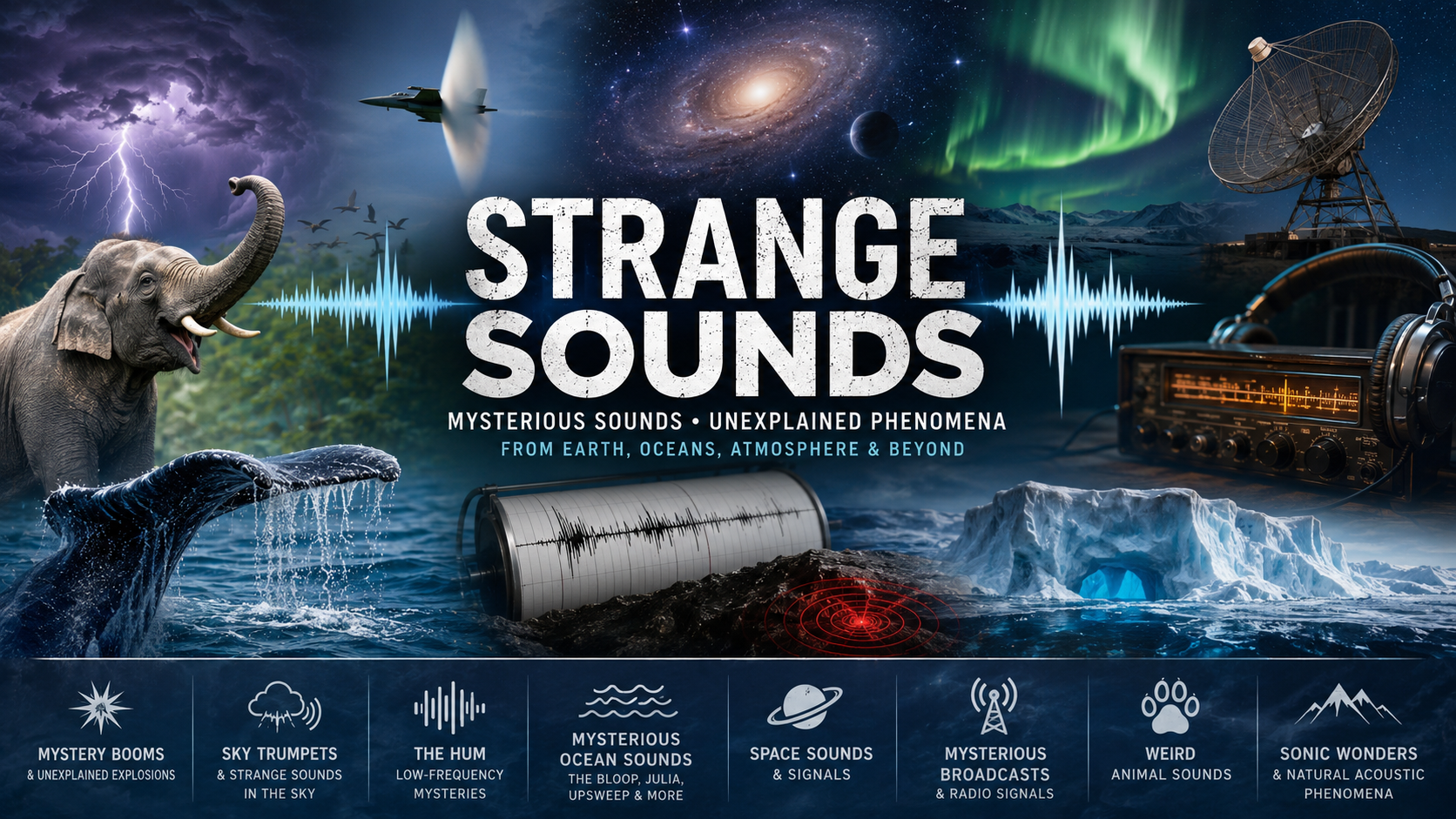
Explosions with no visible source. Metallic groans in the sky. A low-frequency hum only some people can hear. Strange signals from the ocean, atmosphere and space.
Earth is a noisy planet — and not every sound is immediately easy to explain.
The Strange Sounds hub explores unusual acoustic phenomena from the ground beneath our feet to the upper atmosphere, deep ocean and space beyond Earth.
Some strange noises are eventually traced to earthquakes, meteors, aircraft, weather, animals or industrial activity. Others remain difficult to identify because the source is distant, transient or poorly recorded.
Here you can investigate mystery booms, skyquakes, sky trumpets, The Hum, mysterious ocean sounds, space signals, strange radio broadcasts, unusual animal calls and natural acoustic phenomena through scientific explanations, historical cases, recordings and the long-running Strange Sounds archive.
Updated on:
Strange Sounds: Key Facts
- “Strange sound” is a broad description, not a single phenomenon. Unusual noises can originate in the atmosphere, ground, ocean, living organisms, technology or space-related observations.
- Many strange sounds have ordinary physical explanations. Meteors, sonic booms, earthquakes, thunder, industrial activity, animals and acoustic propagation can all create surprising noises.
- Some reports remain unresolved. Usually the problem is insufficient evidence rather than a violation of known physics.
- Sound can travel far from its source. Wind, temperature gradients, terrain and atmospheric inversions can make distant events sound local.
- Low-frequency sound is especially deceptive. Infrasound and low-frequency vibrations can travel long distances and may be felt as much as heard.
- Recordings matter. Exact time, location, weather, video, audio and multiple independent observations can often transform a mystery into an identifiable event.
📩 Heard something strange? Report the time, location, weather conditions and any recording.
What Are Strange Sounds?
Strange sounds are unusual, unexpected or difficult-to-identify noises reported in the natural environment or detected by scientific instruments.
They can include:
- explosive booms;
- deep rumblings;
- metallic groans;
- horn-like tones;
- persistent low-frequency humming;
- unusual underwater recordings;
- radio and electromagnetic signals converted into sound;
- extraordinary animal calls;
- and naturally resonant landscapes or rocks.
Some are heard directly by people.
Others are captured by:
- seismometers;
- hydrophones;
- microphones;
- infrasound arrays;
- radio telescopes;
- spacecraft instruments;
- or other scientific sensors.
The goal of this hub is not to treat every unusual noise as unexplained.
It is to separate observation from interpretation and organize the world’s strangest acoustic phenomena by what we actually know about them.
Explore Strange Sounds by Phenomenon
Start with one of the major Strange Sounds pillars below.
Each guide explains the phenomenon, likely causes, famous examples and relevant archives.
Mystery Booms & Unexplained Explosions
A cannon-like blast shakes houses, windows rattle, but there is no obvious explosion.
These events are commonly described as mystery booms, unexplained explosions, strange rumblings or skyquakes.
The term describes the observation rather than a single cause.
Individual mystery-boom events may involve:
- Seneca Guns — historic cannon-like booming reports in parts of the eastern United States;
- Mistpouffers and Barisal Guns — historic regional traditions of unexplained booming sounds;
- skyquakes — explosive sounds apparently coming from the sky;
- earthquake booms — audible sounds associated with shallow seismic events;
- meteor and bolide booms — atmospheric shockwaves from fast-moving space rocks;
- sonic booms — shockwaves from supersonic aircraft or other fast-moving objects;
- frost quakes or cryoseisms — explosive ground cracking during rapid freezing;
- thunder and atmospheric booms — including distant thunder carried unusually far;
- quarry, mining and construction blasts;
- military explosions and training;
- and genuinely unresolved mystery-boom events.
The Mystery Booms pillar also preserves the chronological Strange Sounds archive, organizing historic reports by year while keeping scientific explanations on one authoritative page.
Sky Trumpets & Strange Sounds in the Sky
Metallic scraping. Horn-like blasts. Deep groans apparently rolling across the sky.
The phenomenon commonly called sky trumpets became famous through recordings shared from communities around the world.
Unlike mystery booms, which are generally short and explosive, sky-trumpet reports often involve:
- long metallic drones;
- horn-like sounds;
- scraping or grinding;
- repeating tonal noises;
- low-frequency atmospheric rumbling;
- and sounds apparently continuing for many seconds or minutes.
Possible explanations vary from event to event and can include:
- industrial or mechanical noise;
- aircraft;
- construction;
- wind interacting with structures;
- distant sound carried by atmospheric conditions;
- edited or misidentified recordings;
- and unresolved acoustic events.
The Sky Trumpets pillar also maintains the long Strange Sounds video archive organized by year.
The Hum: Persistent Low-Frequency Noise
Imagine a distant diesel engine idling somewhere outside — except nobody else can find it.
The Hum refers to persistent low-frequency humming or droning reported by some people in communities around the world.
Unlike a sudden mystery boom, The Hum may continue for:
- minutes;
- hours;
- or recur repeatedly over months or years.
Reports often describe the noise as:
- a distant engine;
- machinery;
- a low electrical drone;
- or a vibration more noticeable indoors and at night.
Famous Hum Hotspots
The best-known locations include:
- Taos Hum — New Mexico, United States;
- Windsor Hum — Ontario, Canada;
- Bristol Hum — United Kingdom;
- Kokomo Hum — Indiana, United States;
- and numerous other reported Hum hotspots.
Possible explanations include industrial low-frequency noise, ventilation systems, machinery, electrical infrastructure, environmental noise, acoustic perception and other local sources.
No single mechanism necessarily explains every reported Hum.
Selected cases:
Taos Hum
·
Kokomo Hum
Mysterious Ocean Sounds
The deep ocean is one of the largest acoustic environments on Earth.
Sound travels efficiently through seawater, allowing hydrophones to detect events occurring hundreds or even thousands of kilometers away.
Over the decades, underwater listening networks have recorded unusual signals that became famous under names such as:
- The Bloop;
- Upsweep;
- Julia;
- Slow Down;
- and other unusual hydrophone mysteries.
The Bloop
The famous Bloop was recorded in the Pacific Ocean in 1997.
Its enormous apparent scale triggered years of speculation before evidence pointed toward ice-related processes as the likely explanation.
Upsweep
Upsweep is a long-observed seasonal underwater acoustic signal recorded in the Pacific.
Its exact source has been associated with geophysical activity in a volcanically active region, although it remains one of the classic named ocean sounds.
Julia and Slow Down
Other named signals including Julia and Slow Down were also associated with large-scale ice processes.
These examples illustrate how spectacular unknown signals can become understandable once enough geophysical evidence is available.
Other unusual underwater noises can originate from:
- icebergs;
- earthquakes;
- underwater volcanoes;
- ships;
- marine mammals;
- seafloor processes;
- and human activity.
➜ Explore Mysterious Ocean Sounds
Listen:
The Bloop
·
Julia and other deep-ocean sounds
Space Sounds & Signals
Space is essentially a vacuum, so ordinary sound waves cannot travel through it in the same way they travel through air or water.
But space is full of:
- radio waves;
- plasma waves;
- magnetic-field variations;
- electromagnetic emissions;
- and oscillations detected by scientific instruments.
Scientists can convert these measurements into audible frequencies through sonification.
The results can sound remarkably eerie:
- pulsars ticking like cosmic clocks;
- plasma waves around planets;
- Jupiter’s intense radio emissions;
- Saturn’s magnetospheric signals;
- solar activity;
- auroral emissions;
- and astronomical data converted into sound.
These are not necessarily “sounds traveling through empty space.”
They are scientific measurements translated into frequencies humans can hear.
Mysterious Broadcasts & Radio Signals
Some of the strangest sounds ever recorded do not come from geology or weather at all.
They arrive through the radio spectrum.
Mysterious broadcasts include:
- numbers stations;
- repeating coded messages;
- unidentified radio transmissions;
- military or intelligence signals;
- strange shortwave broadcasts;
- and long-running stations such as UVB-76, “The Buzzer.”
Many have human origins even when their exact purpose remains unknown.
The mystery lies not necessarily in the physics of the signal, but in who is transmitting, why, and what the message means.
Weird Animal Sounds
Some of Earth’s strangest noises are perfectly natural — they just come from animals humans rarely hear.
Examples include:
- whale songs traveling enormous distances through the ocean;
- elephant infrasound;
- pistol shrimp producing explosive snaps;
- lyrebirds copying machinery and other sounds;
- fox screams;
- koala bellows;
- frog choruses;
- bird mimicry;
- and deep-sea biological sounds.
Animal calls can easily be misidentified when the species is hidden, nocturnal, distant or producing a sound very different from what people expect.
This makes biology an important part of any serious strange-sound investigation.
Sonic Wonders & Natural Acoustic Phenomena
Not every strange sound is a mystery.
Some landscapes, rocks, dunes and natural structures simply have extraordinary acoustic properties.
These natural sonic wonders include:
- singing sand dunes;
- booming dunes;
- ringing rocks;
- resonant caves;
- wind-driven tones;
- ice singing and cracking;
- natural echoes;
- and other geological or atmospheric acoustic effects.
Singing and Booming Sand Dunes
Certain dry dunes can emit powerful humming or booming sounds when sand grains avalanche down their slopes.
The resulting vibration can become surprisingly loud and tonal.
Ringing Rocks
Some boulder fields contain rocks that produce clear metallic tones when struck.
The exact acoustics depend on rock composition, internal stress, weathering and how the stones are supported.
➜ Explore Sonic Wonders & Natural Acoustic Phenomena
Example:
Ringing Rocks Park, Pennsylvania
Why Strange Sounds Can Be Difficult to Locate
One recurring problem connects many Strange Sounds phenomena:
the place where a sound is heard may be far from the place where it originated.
Sound propagation depends on:
- temperature;
- wind;
- humidity;
- terrain;
- buildings;
- water;
- frequency;
- and the height of the source.
Temperature Inversions
Atmospheric temperature inversions can refract sound waves and occasionally return them toward the ground.
This can allow distant thunder, explosions, aircraft or industrial noise to become audible far beyond the area where people normally hear them.
➜ How weather conditions can make sound travel great distances
Low-Frequency Sound
Low-frequency sound generally attenuates differently than high-frequency sound and can propagate efficiently over long distances under favorable conditions.
This is one reason deep booms and low rumbles can be difficult for human listeners to localize accurately.
Sound Through Water and Ground
Acoustic energy can also travel through:
- water;
- rock;
- soil;
- buildings;
- and other solid structures.
That means an unusual vibration may be transmitted through several media before a person finally hears or feels it.
How to Investigate a Strange Sound
When a strange sound occurs, the first few minutes can provide the most useful evidence.
1. Record the Exact Time
Write down the time as accurately as possible.
Precise timing allows comparison with:
- earthquakes;
- meteors;
- lightning;
- aircraft;
- military activity;
- industrial incidents;
- rocket launches;
- and other events.
2. Record Your Location
Location helps determine whether reports form a geographic pattern.
3. Describe the Sound
Note whether it was:
- a boom;
- a rumble;
- a hum;
- a horn-like tone;
- a metallic scraping sound;
- a repeating pulse;
- or another acoustic pattern.
4. Note Duration
A half-second explosion and a five-minute metallic drone probably require very different explanations.
5. Did You Hear It or Feel It?
Record whether:
- you heard sound;
- felt vibration;
- noticed pressure in your ears;
- or experienced several effects together.
6. Look for Visual Clues
Check for:
- lightning;
- meteors;
- aircraft;
- smoke;
- dust;
- fire;
- contrails;
- or visible damage.
7. Check Weather and Environmental Conditions
Weather can create sounds directly or dramatically alter how distant sounds propagate.
8. Save Audio and Video
Doorbell cameras, security cameras, phones and dashcams may preserve exact timing and the acoustic signature.
9. Compare Multiple Reports
Several independent reports can reveal whether the event was:
- localized;
- regional;
- moving;
- or heard over a very wide area.
10. Avoid Jumping to Conclusions
A sound may initially appear inexplicable and later turn out to have a straightforward origin.
The best investigations keep several plausible explanations open until evidence eliminates them.
How the Strange Sounds Archive Is Organized
Strange Sounds separates evergreen explanations from historical reports.
The major pillars explain:
- what the phenomenon is;
- how it sounds;
- possible causes;
- scientific mechanisms;
- famous cases;
- and how the phenomenon is investigated.
Where a phenomenon has a substantial historical archive — particularly Mystery Booms and Sky Trumpets — individual year pages preserve the chronological record.
This keeps two different questions separate:
“What is this phenomenon?”
and:
“What events were reported during a particular year?”
Start Exploring Strange Sounds
💥 Mystery Booms & Unexplained Explosions
Skyquakes, Seneca Guns, meteors, sonic booms, earthquake sounds, cryoseisms and unexplained explosions.
🎺 Sky Trumpets & Strange Sounds in the Sky
Metallic groans, horn-like sounds, scraping noises and strange atmospheric recordings.
〰️ The Hum
Taos, Windsor, Bristol, Kokomo and other persistent low-frequency Hum hotspots.
🌊 Mysterious Ocean Sounds
The Bloop, Upsweep, Julia, Slow Down and other strange hydrophone recordings.
🪐 Space Sounds & Signals
Pulsars, plasma waves, planetary radio emissions and scientific sonification.
📻 Mysterious Broadcasts & Radio Signals
Numbers stations, coded transmissions, UVB-76 and unusual radio broadcasts.
🐋 Weird Animal Sounds
Whales, elephants, pistol shrimp, mimicry, screams, calls and biological acoustic oddities.
🎶 Sonic Wonders & Natural Acoustic Phenomena
Singing dunes, ringing rocks, resonant landscapes and other natural acoustic phenomena.
Strange Sounds: Frequently Asked Questions
- What causes strange sounds around the world?
- Strange sounds can have many causes, including meteors, earthquakes, sonic booms, thunder, industrial machinery, military activity, animals, ice, ocean processes, radio transmissions and unusual sound propagation through the atmosphere. Some events remain unresolved because there is not enough evidence to identify the source.
- What causes unexplained mystery booms?
- Mystery booms may result from meteors, supersonic aircraft, shallow earthquakes, frost quakes, thunder, quarry blasting, military exercises, industrial explosions, rockets or distant sound carried through unusual atmospheric conditions.
- Are skyquakes and sky trumpets the same thing?
- No. Skyquakes generally describe short explosive or cannon-like booms apparently coming from the sky, while sky trumpets usually describe longer metallic, horn-like, scraping or groaning sounds.
- What is The Hum?
- The Hum is a persistent low-frequency humming or droning sound reported by some people in locations such as Taos, Windsor, Bristol and Kokomo. Different locations may have different causes, including industrial, mechanical, environmental and perceptual factors.
- What was the Bloop?
- The Bloop was an unusually powerful underwater sound recorded in the Pacific Ocean in 1997. Later evidence linked the signal to large-scale ice-related processes rather than an unknown sea creature.
- Can you really hear sounds from space?
- Ordinary sound cannot propagate through the vacuum of space, but spacecraft and telescopes detect radio waves, plasma waves and other signals that scientists can convert into audible frequencies through sonification.
- Why do distant sounds sometimes seem nearby?
- Wind and temperature gradients can refract sound through the atmosphere. Temperature inversions can sometimes allow thunder, aircraft, explosions or industrial noise to travel far beyond the area where people normally hear them.
- Can animals produce sounds humans mistake for something mysterious?
- Yes. Many animals produce unexpected screams, rumbles, clicks, whistles and low-frequency sounds. Nocturnal or hidden animals are especially easy to misidentify.
- What should I do if I hear a strange sound?
- Record the exact time and location, describe the sound and duration, note whether you felt vibration, check the weather and visible conditions, save any audio or video and compare your observation with known seismic, meteor, aviation or local activity.
- How can I report a strange sound to Strange Sounds?
- Use the Strange Sounds contact page and include the date, exact local time, location, weather conditions, description of the sound and links to any audio or video recordings.
Scientific Sources & Further Reading
Investigating unusual sounds can require information from several scientific disciplines.
Useful authoritative sources include:
- USGS — earthquakes, seismic activity and geology.
- NOAA — atmospheric science, weather, oceans and environmental observations.
- NOAA PMEL — underwater acoustics and hydrophone monitoring.
- NASA — meteors, spacecraft, planetary science and scientific sonification.
- Met Office — meteorology, atmospheric structure and weather.
Latest Strange Sounds Reports
Follow the newest reports, recordings and investigations across the Strange Sounds archive.
🧭 Browse the latest Strange Sounds reports
Heard Something Strange?
A useful strange-sound report should include:
- date;
- exact local time;
- city and region;
- description of the sound;
- duration;
- whether you felt vibration;
- weather conditions;
- any visible flashes, smoke, aircraft or unusual activity;
- and links to audio or video if available.

We should know what these trumpet sounds are , the Bible clearly tells us . If you have any doubt , I suggest you take the time and take note of what is occurring in the world today . And tell yourself ,to listen .
I heard what sounded like a trumpet resonating last night Thursday December 15th, 2022.
Lancaster Pennsylvania. Anyone else hear the noise recently?
My dad just heard the same noise as described above Saturday 22th at 2am In Morocco and he phoned me and told me and I have sent him one of the video and confirmed it , he also told me someone else heard it in the Northern part of Morocco . Saturday 22th at 2am same strange scary noise as dad described is recorded in Morocco 2022.
My opinion is it’s possibly a chainsaw, chipper, planer, or other power equipment besides the possible theories on this website.
[…] STRANGE SOUNDS […]
[…] such as this one have been set up in dedication to solving the […]
[…] Strange Sounds in the Sky […]
[…] the years passed in this decade, the phenomena became clearer. Entire websites have been dedicated to trying to figure out what these sounds […]
[…] the years passed in this decade, the phenomena became clearer. Entire websites have been dedicated to trying to figure out what these sounds […]
[…] such as this one have been set up in dedication to solving the […]
[…] such as this one have been set up in dedication to solving the […]
[…] Strange Sounds in the SkyYour browser indicates if you’ve visited this link […]
[…] phenomenon above. There continues to be widespread speculation as to what could be causing loud unnatural humming and percussive sounds coming from the sky in many areas, as no natural explanation fits and no known civilian industry is capable of creating […]
[…] În orice caz, am devenit deja familiari cu aceste zgomote asemănându-se cu motoare, lovituri metalice, zumzete, gemete sau chiar trompete în anumite cazuri. Dacă nu ştii încă nimic despre acest fenomen neexplicat, vom lăsa aici câteva cazuri mai interesante, plus un link pentru mai multe informaţii. […]
[…] Strange Sounds […]
[…] Strange Sounds […]
[…] Strange Sounds […]
[…] the “Bell Sound” at the end. Now report yourself to the mysterious bells and trumpets heard in the skies of multiple countries in the following […]
[…] What about these strange sounds in the sky heard all around the world? […]
[…] Strange Sounds […]
[…] Strange Sounds […]
[…] denger ini o_O eh seriously udah 6 kali?? creepy […]
[…] Strange Sounds […]
[…] Strange Sounds […]
[…] Strange Sounds […]
[…] Strange Sounds […]
[…] Strange Sounds […]
[…] Strange Sounds […]
[…] Noch mehr seltsame Geräusche weltweit (Pravda TV) Das ist nun wirklich ganz weit draußen. Himmlische Posaunen, HAARP in Aktion oder Fake? Eine aktuelle Auswahl von Videos in denen Leute (angeblich) unerklärliche Geräusche aus der Atmosphäre aufgenommen haben. Ziemlich verrückt. Sowas ist auch leicht zu fälschen und deshalb mit Vorsicht zu genießen. Wer mehr hören will: hier gibt’s eine Liste. […]
[…] Strange Sounds […]
[…] Strange Sounds […]
[…] You can find hundreds of videos of these sounds around the world and this website list many of the others reported. https://strangesounds.org/strange-sounds […]
[…] (Source from Strange Sound at https://strangesounds.org/strange-sounds) […]
[…] Strange Sounds […]
[…] Strange Sounds […]
[…] https://strangesounds.org/strange-sounds […]
[…] Strange Sounds […]
There is a humming noise in magee ms right now