

Updated on:
· Back to the Geology Hub
· Natural gas emissions, toxic ground gases, volcanic degassing and mystery odors explained
Some of Earth’s most dangerous geological processes are invisible.
No lava. No obvious crater. No dramatic fault rupture. Sometimes the first warning is a foul odor,
bubbling water, steaming ground, dead vegetation, animals collapsing in a hollow, or flames appearing
where gas escapes through soil and fractures.
Earth constantly releases gases from rocks, magma, groundwater, sediments, faults, geothermal systems
and volcanic regions. This natural release is called Earth degassing.
Most degassing is weak, diffuse and harmless. Problems begin when gas is toxic, flammable, released at
high rates, or trapped in basements, caves, mines, pits, valleys, volcanic craters and other poorly
ventilated spaces.
This guide explains the main gases released from Earth, how they reach the surface, why carbon dioxide
can pool silently, how hydrogen sulfide differs from sulfur dioxide, what helium and radon reveal,
when volcanic gas changes matter, how gas vents ignite, and how to separate real geological hazards
from exaggerated “the Earth is leaking everywhere” claims.

geological pathways.
Earth Degassing in 60 Seconds
-
Earth degassing: The release of gases from rocks, magma, groundwater, sediments,
soils and geological structures. -
Diffuse degassing: Gas escaping across broad areas of soil rather than through one
obvious vent. - Mofette: A low-temperature vent dominated by carbon dioxide.
- Fumarole: A vent releasing steam and volcanic or hydrothermal gases.
- CO₂ hazard: Odorless gas that can collect in low terrain and displace oxygen.
-
H₂S hazard: Toxic hydrogen sulfide, often recognized by a rotten-egg odor at low
concentrations. -
SO₂ hazard: Irritating sulfur dioxide commonly associated with active volcanic
degassing. -
Radon: A radioactive gas that can accumulate indoors after migrating from soil and
rock. -
Helium seepage: A geological tracer that can reveal deep fluid pathways and crustal
permeability. -
Gas accumulation: The real danger in many events—gas becomes concentrated in a
confined or low-lying area.
TL;DR: Earth-Degassing Reality Check
-
Earth releases gases continuously through volcanoes, faults, groundwater, soils, sediments and
geothermal systems. -
Most gas release is weak and harmless. The greatest danger comes from high concentrations
in poorly ventilated places. -
Carbon dioxide is especially dangerous because it is invisible, odorless and capable of pooling in
depressions. -
Hydrogen sulfide may smell like rotten eggs at low concentrations, but smell is not a reliable
warning at dangerous levels. -
Sulfur dioxide is strongly associated with volcanic gas emissions and can affect communities far
downwind. -
Methane can burn, but many bubbling-river and frozen-lake stories belong in the dedicated
Methane Seeps & Hydrates pillar. -
Radon is one of the most important geological gas hazards because it can accumulate indoors over
long periods. -
Helium, radon and carbon dioxide may act as geological tracers, but isolated anomalies are not
reliable earthquake predictions. -
A sulfur smell, bubbling spring or new gas vent does not automatically mean a volcano is about to
erupt. -
Real degassing disasters are usually local events involving gas accumulation, terrain, weather and
limited ventilation—not a global release from the planet.
What Is Earth Degassing?
Earth degassing is the natural release of gases from the solid Earth and its associated
water, soil and sediment systems.
Gas may escape from magma, hot rock, metamorphic reactions, groundwater, organic-rich sediment,
hydrocarbon reservoirs, fault zones and radioactive decay.
Degassing occurs at many scales:
- individual bubbles rising through a spring;
- diffuse CO₂ escaping through several square kilometres of soil;
- fumaroles venting volcanic gases;
- radon seeping through a foundation;
- gas discharging along a fault;
- large volcanic plumes releasing sulfur dioxide;
- rare catastrophic releases from gas-charged lakes.
Degassing is not always volcanic
Geological gas can come from volcanic, hydrothermal, sedimentary, biological, metamorphic or
industrial sources.
Determining the source requires chemistry, isotopes, geological context, temperature, pressure and
field observations.
Where Geological Gases Come From
Magma and volcanic systems
Magma contains dissolved gases. As magma rises and pressure decreases, gases separate from the melt
and migrate upward.
Important volcanic gases include:
- water vapor;
- carbon dioxide;
- sulfur dioxide;
- hydrogen sulfide;
- hydrogen chloride;
- hydrogen fluoride;
- carbon monoxide;
- trace metals and aerosols.
Metamorphic reactions
Heat and pressure can transform carbonate-bearing rocks and release carbon dioxide. Water and other
gases may also be liberated as minerals recrystallize.
Sedimentary basins
Organic-rich sediments can generate methane, carbon dioxide and hydrogen sulfide. Gas may migrate
through porous rock or faults.
Groundwater
Water can dissolve gas underground and transport it toward springs, wells, rivers and lakes.
Radioactive decay
Radon forms naturally from the decay of uranium-bearing minerals in rock and soil.
Biological activity
Microorganisms produce methane and hydrogen sulfide in oxygen-poor sediments, wetlands, lakes and
sewage systems.
Human activity
Drilling, mining, fracking, wastewater injection, construction and excavation can create new pathways
for pre-existing gas.
How Gases Reach the Surface
Gas moves upward because of pressure differences, buoyancy, groundwater flow and the permeability of
rock and soil.
Faults and fractures
Cracks can connect deep gas-bearing layers to the surface. Some faults act as conduits, while others
become sealed by clay or mineral deposits.
Porous rock
Sandstone, fractured limestone, volcanic deposits and unconsolidated sediment can allow gas to migrate.
Groundwater
Gas dissolves in water under pressure and may bubble out when the water rises and pressure decreases.
Volcanic conduits
Magma and hydrothermal systems provide high-temperature pathways for steam, sulfur gases and carbon
dioxide.
Human-made openings
Wells, boreholes, mines, tunnels, basements and utility trenches may intersect gas-bearing formations.
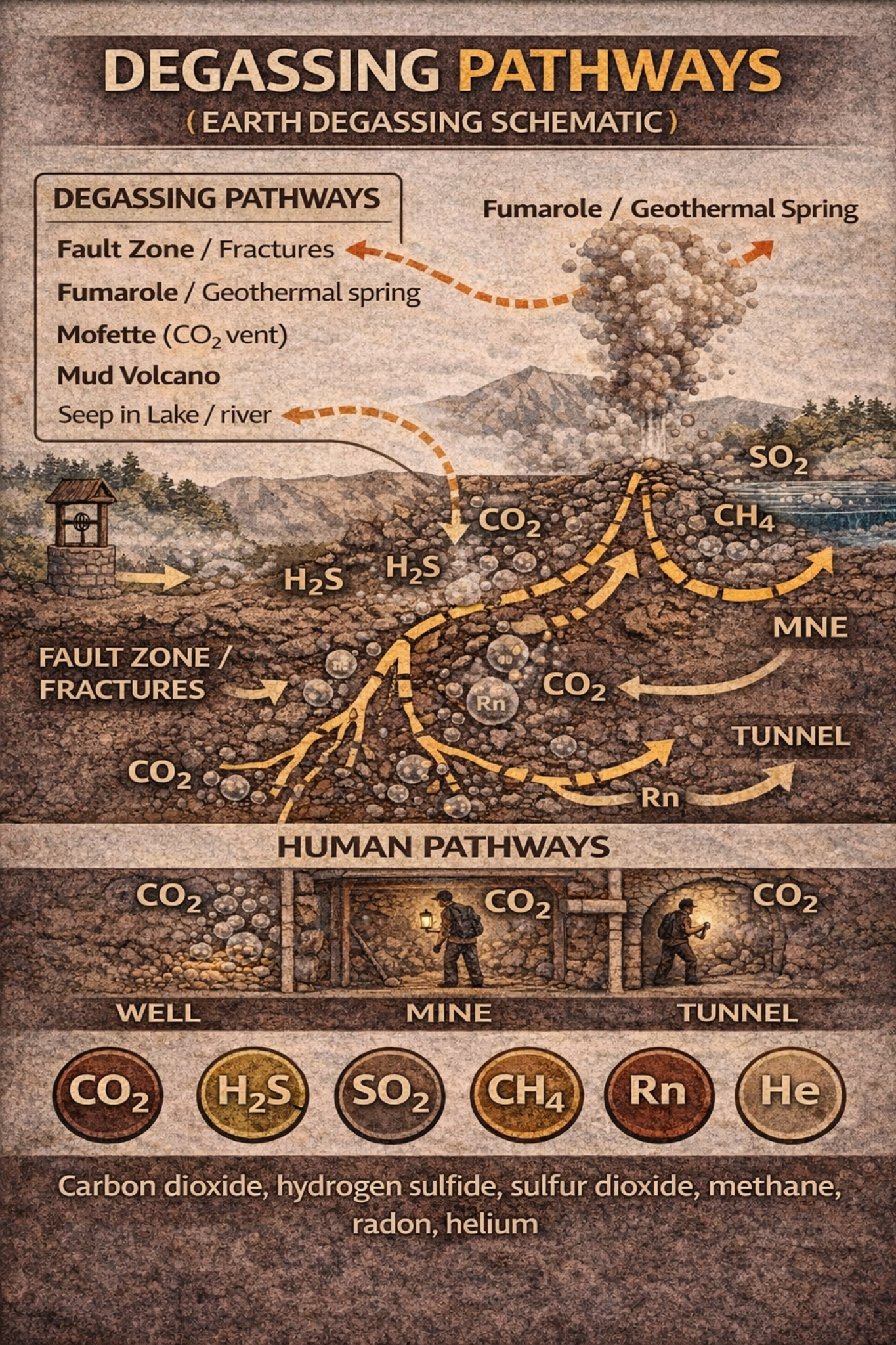
human-made pathways such as wells, mines and tunnels.
The Main Gases Released from Earth
| Gas | Main sources | Main hazard | Typical clue |
|---|---|---|---|
| CO₂ | Volcanoes, metamorphism, groundwater, soils | Oxygen displacement and asphyxiation | Usually invisible and odorless |
| H₂S | Geothermal systems, sediments, sewage, petroleum | Acute toxicity | Rotten-egg odor at low levels |
| SO₂ | Volcanic magma and fumaroles | Respiratory irritation and volcanic smog | Sharp choking volcanic haze |
| CH₄ | Sediments, wetlands, hydrocarbons, seeps | Fire and explosion in confined spaces | Bubbles or flammable gas |
| Radon | Radioactive decay in rock and soil | Long-term lung-cancer risk | No odor; detected by testing |
| Helium | Crust, mantle and hydrocarbon reservoirs | Usually low direct toxicity outdoors | Measured as a deep-fluid tracer |
Carbon Dioxide: The Silent Asphyxiant
Carbon dioxide is one of the most important natural geological gas hazards because it is invisible,
odorless and capable of collecting near the ground.
CO₂ is denser than normal air. Under calm conditions, it may accumulate in:
- volcanic craters;
- basements;
- caves;
- wells;
- ditches;
- pits;
- mine workings;
- valleys;
- low-lying forest depressions.
Why CO₂ kills
The primary danger is not classic poisoning. CO₂ displaces breathable oxygen and interferes with
normal respiration.
Possible symptoms include:
- headache;
- dizziness;
- rapid breathing;
- confusion;
- loss of consciousness;
- death in severe exposure.
CO₂ tree-kill zones
Elevated soil CO₂ can damage roots by displacing oxygen in the soil. Large tree-kill areas have
developed around volcanic systems such as Mammoth Mountain in California.
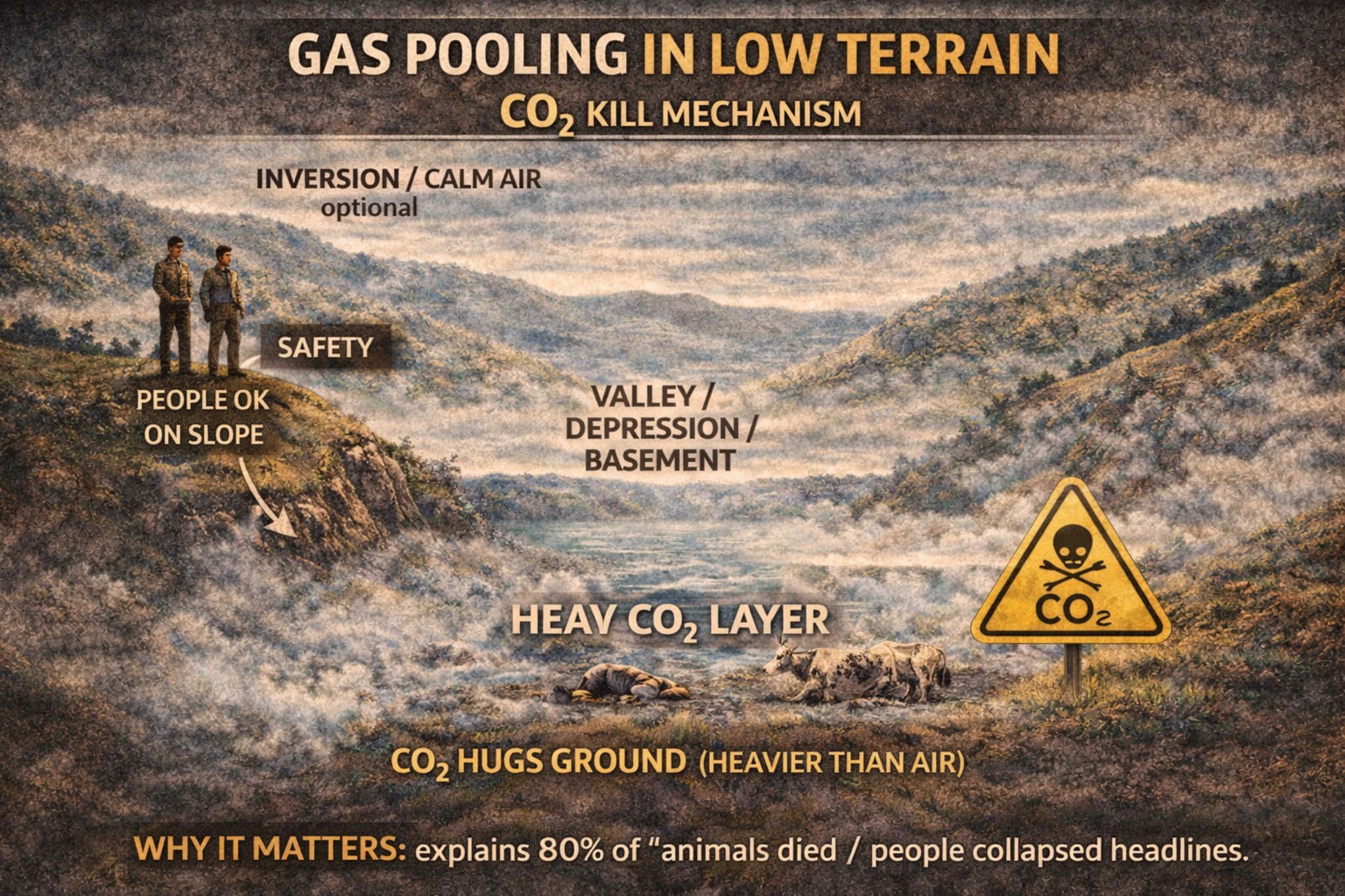
Mofettes and Diffuse CO₂ Vents
A mofette is a cool or low-temperature gas vent dominated by carbon dioxide.
Mofettes commonly occur in volcanic, tectonic and post-volcanic regions where deep CO₂ rises through
fractures.
They may appear as:
- bubbling mineral springs;
- dry soil vents;
- areas where insects and small animals die;
- patches of damaged vegetation;
- shallow depressions filled with dense gas;
- persistent bubbling in ponds and wells.
A mofette is not necessarily hot and may show no obvious volcanic surface feature.
Hydrogen Sulfide: The Rotten-Egg Gas
Hydrogen sulfide is a toxic gas produced in geothermal systems, volcanic settings, petroleum
reservoirs, sewers, manure pits and oxygen-poor sediments.
Why smell is unreliable
H₂S has a distinctive rotten-egg smell at low concentrations. At higher concentrations, however, it
can rapidly impair the sense of smell.
The disappearance of the odor may therefore mean increased danger—not cleaner air.
Where H₂S becomes dangerous
- confined geothermal vents;
- caves and mines;
- sewers;
- oil and gas facilities;
- manure pits;
- low-lying shorelines near gas-rich water;
- poorly ventilated industrial spaces.
H₂S and fish kills
Hydrogen sulfide may contribute to fish deaths in stratified lakes or coastal basins when
oxygen-depleted bottom water rises toward the surface.
Sulfur Dioxide: The Volcanic Gas
Sulfur dioxide is a pungent, irritating gas released when sulfur-bearing magma degasses.
It is one of the most useful gases for volcano monitoring because changing SO₂ output may reveal
changes in magma supply or pressure.
Health effects
- eye irritation;
- coughing;
- airway constriction;
- breathing difficulty;
- increased risk for people with asthma or lung disease.
Volcanic smog
SO₂ can react in the atmosphere and form sulfate aerosols, producing volcanic smog or “vog.”
Wind direction and atmospheric conditions determine which communities are affected.

Methane: What Belongs Here and What Does Not
Methane is part of Earth’s broader degassing system, but it deserves separate treatment because it
has biological, sedimentary, permafrost, hydrate and hydrocarbon sources.
Keep in Earth Degassing
- mixed-gas vents where methane is one component;
- fault-controlled gas release with uncertain composition;
- flammable ground vents;
- natural gas emerging through springs;
- mystery gas events involving several possible gases.
Redirect to Methane Seeps & Hydrates
- persistent seabed methane seeps;
- methane hydrates;
- frozen lake methane bubbles;
- burning methane trapped beneath ice;
- Arctic methane craters and seeps;
- river or lake bubbling confirmed as methane;
- methane plumes from sediments or permafrost.
Explore the dedicated guide:
Methane Seeps & Hydrates Explained
.
Radon: The Geological Gas Hazard Inside Buildings
Radon is a radioactive gas produced naturally by the decay of uranium in rock and soil.
It can migrate through pores and fractures and enter buildings through:
- foundation cracks;
- construction joints;
- floor drains;
- pipe openings;
- crawl spaces;
- well water.
Why radon matters
Radon is not usually an acute outdoor emergency. Its importance comes from long-term indoor exposure
to radioactive decay products.
Testing is the only reliable way to know whether a building has elevated radon.

tested and ventilated.
Helium and Deep-Fluid Tracers
Helium is valuable to geologists because different helium isotopes help identify gas sources.
Helium-3 may indicate a stronger mantle contribution, while helium-4 is commonly produced by
radioactive decay in the crust.
Helium measurements can help investigate:
- deep faults;
- mantle-derived fluids;
- volcanic systems;
- geothermal reservoirs;
- hydrocarbon basins;
- crustal permeability.
Helium seepage is a geological clue, not evidence of a “portal,” planetary crack or imminent global
rupture.
Other Gases Released from Geological Systems
Carbon monoxide
Carbon monoxide can occur in volcanic gases, combustion zones, underground fires and industrial
settings.
Nitrogen
Nitrogen-rich gases may originate from sedimentary basins, metamorphic reactions, groundwater or the
atmosphere.
Hydrogen
Natural hydrogen may form through water–rock reactions, oxidation of iron-bearing minerals,
radiolysis and deep geological processes.
Hydrogen chloride and hydrogen fluoride
These acidic gases may occur in volcanic emissions and can irritate eyes, skin and lungs.
Mercury and trace metals
Some volcanic and geothermal gases carry mercury, arsenic or other trace elements.
Bubbling Water, Springs and Rivers
Bubbles in water may result from geological gas, biological methane, air trapped in sediment,
groundwater pressure or leaking infrastructure.
Possible natural sources
- CO₂-rich springs;
- methane from sediment;
- fault-controlled gas seepage;
- geothermal steam;
- nitrogen-rich groundwater;
- hydrocarbon reservoirs.
Possible human sources
- damaged gas pipelines;
- sewer leaks;
- landfills;
- drilling;
- abandoned wells;
- industrial wastewater.
Bubbles alone do not identify the gas. Sampling and chemical analysis are required.
Burning Ground, Flaming Springs and Fire from Cracks
Flames emerging from soil, water or fractures may result from methane, natural gas, hydrogen,
petroleum vapor or underground combustion.
Natural gas seeps
Hydrocarbon-rich formations may leak gas through faults and fractures. If ignited, the vent may burn
continuously.
Eternal flames
Some “eternal flames” persist where small but continuous gas seepage feeds combustion.
Underground coal fires
Burning coal seams can heat the ground, release smoke and gases, open cracks and create collapse
features.
Confirmed underground coal-fire stories should be redirected to
Underground Coal Fires Explained
.
Industrial and waste fires
Landfills, buried waste, oil contamination and broken pipelines can create apparently geological
flames.
Faults, Fractures and Gas Migration
Faults can create pathways connecting deep fluids to the surface.
Gas anomalies may occur along:
- active faults;
- ancient rift systems;
- fractured volcanic fields;
- sedimentary basin boundaries;
- mine-related fractures;
- areas affected by subsidence.
However, not every fault leaks gas, and not every gas vent marks an active fault.
Clay-rich fault gouge can seal fluid pathways, while fractured damage zones may increase
permeability.
Can Earthquakes Release Gas?
Earthquakes can alter pressure, crack rock and change groundwater pathways.
Possible post-earthquake effects include:
- increased bubbling in springs;
- temporary changes in radon;
- changes in CO₂ discharge;
- new groundwater pathways;
- release of methane from sediments;
- changes in spring temperature and chemistry.
These effects are usually local or regional and vary greatly from one earthquake to another.
Do gas anomalies predict earthquakes?
Radon, helium, carbon dioxide and other gases have been studied as possible earthquake precursors.
Results remain inconsistent because emissions also change with rain, groundwater level, atmospheric
pressure, temperature and soil conditions.
A gas spike by itself is not a reliable earthquake forecast.
Volcanic Degassing
Volcanoes release gas during eruptions, between eruptions and sometimes during long periods of
apparent quiet.
Gas can escape directly from magma, through fumaroles, through crater lakes or diffusely through soil.
Why gas monitoring matters
Volcano observatories track:
- SO₂ flux;
- CO₂ flux;
- CO₂/SO₂ ratios;
- H₂S/SO₂ ratios;
- gas temperature;
- isotopic composition;
- changes over time.
Gas change does not equal eruption
Gas data must be interpreted together with seismicity, deformation, thermal observations and
geological history.
Explore volcanic monitoring in
Volcano Monitoring & Forecasting Explained
.
Earth Degassing vs Geothermal Activity
Geothermal systems often release CO₂, H₂S, steam and other gases, so the topics overlap.
Keep in Earth Degassing
- toxic gas accumulation;
- mystery odors;
- CO₂ vents;
- H₂S exposure;
- fault-controlled gas seepage;
- diffuse soil degassing;
- gas-related deaths or evacuation.
Redirect to Geothermal Systems
- geyser eruptions;
- hot springs;
- mud pots;
- fumarole fields described as hydrothermal features;
- travertine terraces;
- moving mud springs;
- subglacial geothermal heat;
- geothermal-energy development.
Explore:
Geothermal Systems Explained
.
Gas-Charged Lakes and Limnic Eruptions
Some deep lakes accumulate dissolved carbon dioxide or methane in bottom water.
If the water column becomes unstable, gas-rich deep water may rise, pressure decreases and gas
rapidly escapes.
This process is called a limnic eruption.
Lake Nyos
In 1986, Lake Nyos in Cameroon released a massive CO₂ cloud that flowed into nearby valleys and
caused widespread fatal asphyxiation.
Lake Monoun
Lake Monoun experienced a smaller but deadly CO₂ release in 1984.
Lake Kivu
Lake Kivu contains large amounts of dissolved methane and carbon dioxide and is closely monitored.
Detailed killer-lake science belongs in
Exploding Lakes Explained
.

of flowing down valleys.
Where Geological Gas Becomes Dangerous
The source matters, but accumulation often determines whether gas becomes lethal.
Confined spaces
- basements;
- mines;
- caves;
- tunnels;
- utility vaults;
- storage tanks;
- sewers;
- abandoned wells.
Low terrain
- valleys;
- craters;
- ditches;
- pits;
- shoreline depressions;
- sinkholes;
- forest hollows.
Poor ventilation
Even modest gas release can become dangerous where air exchange is limited.
How Weather and Topography Trap Gas
Atmospheric conditions strongly influence gas concentration near the ground.
Calm weather
Wind disperses gas. Calm conditions allow it to accumulate.
Temperature inversions
A layer of warmer air above cooler surface air can suppress vertical mixing and trap gas near the
ground.
Rainfall
Rain may seal soil pores, push gas sideways, raise groundwater and change the location of vents.
Atmospheric pressure
Falling pressure may encourage gas to escape from soil or groundwater.
Snow cover
Snow can reduce ventilation and redirect gas toward buildings or openings.
Dead Trees, Animals and Fish Kills
Gas-related biological damage can look mysterious because the hazard leaves no visible residue.
Dead trees
High soil CO₂ can suffocate roots, while sulfur gases and acidic fluids can damage leaves and soil.
Animal deaths
Small animals are especially vulnerable to dense gas accumulating close to the ground.
Fish kills
Fish deaths may result from:
- oxygen depletion;
- H₂S-rich bottom water;
- CO₂-rich upwelling;
- algal blooms;
- pollution;
- sudden temperature change.
Not every fish kill is geological. Water chemistry and biological evidence are needed.
How Scientists Monitor Earth Degassing
Gas monitoring combines field measurements, laboratory analysis, satellites and geophysical data.
Gas flux measurements
Instruments measure how much gas crosses a vent, soil surface or volcanic plume.
Gas chemistry
Relative concentrations of CO₂, SO₂, H₂S, helium, radon and other gases help identify sources.
Isotopes
Carbon, helium and other isotopes can distinguish mantle, crustal, sedimentary and biological gas.
Soil probes
Soil-gas surveys map diffuse emissions across faults and volcanic fields.
Air-quality sensors
Fixed stations detect hazardous concentrations near communities and workplaces.
Satellite observations
Satellites can detect large SO₂ plumes and some broad atmospheric gas anomalies.
Water sampling
Scientists measure dissolved gas in springs, wells, lakes and rivers.
Integrated monitoring
Gas measurements become more useful when combined with earthquakes, deformation, thermal imaging and
hydrology.
Can Gas Emissions Predict Earthquakes or Eruptions?
Volcanic eruptions
Gas monitoring can contribute to eruption forecasts because rising magma releases gases.
Sustained changes in SO₂, CO₂, gas ratios, temperature and flux may signal changing magma conditions.
Earthquakes
Gas anomalies before earthquakes remain difficult to use reliably.
Problems include:
- strong natural variability;
- rainfall effects;
- atmospheric-pressure changes;
- groundwater movement;
- instrument differences;
- lack of repeatable timing;
- many anomalies without earthquakes;
- many earthquakes without detectable gas anomalies.
Gas data may contribute to research, but it is not a dependable standalone earthquake warning system.
Major Earth-Degassing Disasters and Gas Crises
1979 — Dieng Plateau, Indonesia
A phreatic event and dense volcanic gases caused fatalities around the Dieng volcanic complex.
Carbon dioxide accumulated in low terrain.
1984 — Lake Monoun, Cameroon
A sudden release of dissolved CO₂ caused fatal asphyxiation near the lake.
1986 — Lake Nyos, Cameroon
A catastrophic CO₂ release produced a dense cloud that flowed through valleys and killed people and
livestock.
1990s — Mammoth Mountain, California
Diffuse magmatic CO₂ migrated through soil and killed large areas of forest without a volcanic
eruption.
Ongoing — Lake Kivu, Rwanda and the Democratic Republic of the Congo
Large dissolved reserves of CO₂ and methane make Lake Kivu a major monitored gas-risk system.
Ongoing — Horseshoe Lake, California
Magmatic CO₂ continues to affect vegetation and can create hazardous concentrations in enclosed or
low areas.
Quick Diagnostic: What Is the Most Likely Gas or Process?
Odorless collapse in a low area
- CO₂ accumulation is a leading possibility.
- Oxygen depletion may also occur without obvious gas odor.
Best fit: CO₂ or oxygen-deficient atmosphere.
Rotten-egg odor
- H₂S is possible.
- Sewage, manure, geothermal fluids and petroleum systems are common sources.
Best fit: Hydrogen sulfide or related sulfur compounds.
Sharp choking haze near a volcano
- SO₂ is a strong possibility.
- Check official volcanic and air-quality advisories.
Best fit: Sulfur dioxide or volcanic aerosol.
Bubbling water that burns
- Methane or natural gas may be present.
- Pipeline leaks and abandoned wells must also be considered.
Best fit: Methane or hydrocarbon gas.
Dead trees around volcanic ground
- Diffuse CO₂ may be displacing oxygen in the soil.
- Acidic hydrothermal fluids may also damage roots.
Best fit: Soil CO₂ or hydrothermal alteration.
Smoke and heat from collapsing ground
- Underground coal or waste fire may be more likely than volcanism.
Best fit: Underground combustion.
Gas detected in a basement
- Radon, methane, sewer gas or a utility leak may be involved.
Best fit: Requires testing—do not identify by smell alone.

identification.
Earth-Degassing Myths vs Geological Reality
Myth 1: “Gas coming from the ground means a volcano is forming.”
Reality: Gas may originate from sediments, groundwater, faults, hydrocarbons,
decomposing organic matter, landfills or industry.
Myth 2: “A sulfur smell means an eruption is imminent.”
Reality: Sulfur odors occur in geothermal areas, sewers, petroleum systems and
industrial sites. Eruption forecasts require multiple signals.
Myth 3: “Carbon dioxide from the ground is causing global atmospheric CO₂ records.”
Reality: Local geological CO₂ vents can be hazardous, but modern global atmospheric
increases are primarily driven by human fossil-fuel emissions and land-use change.
Myth 4: “Methane bubbles mean a river or lake will explode.”
Reality: Methane bubbles are common in organic-rich sediment. The largest fire and
explosion risks occur where gas accumulates in confined spaces.
Myth 5: “Helium leaking through a fault proves a massive earthquake is coming.”
Reality: Helium reveals fluid pathways but is not a reliable standalone earthquake
predictor.
Myth 6: “A sudden bad smell is always natural degassing.”
Reality: Industrial leaks, sewage, pipelines, landfills and agriculture are often
more likely.
Myth 7: “CO₂ is harmless because people exhale it.”
Reality: High concentrations can rapidly cause unconsciousness and death.
Myth 8: “If the rotten-egg smell disappears, the gas is gone.”
Reality: High H₂S concentrations can impair smell, making odor an unreliable safety
indicator.
Myth 9: “All bubbling water is geothermal.”
Reality: Bubbles may be biological methane, trapped air, pipeline gas, CO₂-rich
groundwater or ordinary turbulence.
Myth 10: “Earth is suddenly degassing more everywhere.”
Reality: Degassing is widespread but highly local. Better cameras, social media and
monitoring make events more visible without proving a synchronized global increase.
Earth-Degassing Event Index
This section is the permanent archive destination for legacy reports involving toxic gas, mystery
odors, bubbling ground, breathing roads, burning vents, helium leaks, sulfur emissions, CO₂ pooling
and unexplained fumes.
Recommended archive format
- Date
- Location
- Observed phenomenon
- Suspected or confirmed gas
- Geological or human source
- Hazard and outcome
- Best scientific or institutional source
Volcanic and hydrothermal gas
- Taal sulfur-dioxide emissions and vog episodes.
- Horseshoe Lake CO₂ tree-kill and asphyxiation zones.
- Eldvörp and Icelandic volcanic-gas warnings.
- Laacher See CO₂ bubbling and post-volcanic degassing.
- Salton Sea hydrogen-sulfide odor advisories.
Fault and ground-gas events
- Helium leakage along the Newport–Inglewood Fault Zone.
- Breathing roads and pavement caused by gas or groundwater pressure.
- Gas emerging through cracks, springs and disturbed ground.
- Post-earthquake changes in bubbling springs and gas discharge.
Burning ground and flaming vents
- Natural-gas vents igniting in springs or fields.
- Long-lived eternal flames fed by hydrocarbon seepage.
- Burning cracks caused by gas, coal fires, waste or industrial leakage.
Mystery odors
- Coastal rotten-egg odors.
- Urban sulfur smells.
- Unexplained gas clouds.
- Evacuations caused by suspected methane or H₂S.
Frequently Asked Questions
What is Earth degassing?
Earth degassing is the release of gases from rocks, magma, soils, sediments, groundwater and
geological structures through vents, fractures and diffuse seepage.
What gases naturally escape from Earth?
Important gases include carbon dioxide, sulfur dioxide, hydrogen sulfide, methane, radon, helium,
nitrogen, hydrogen, carbon monoxide and water vapor.
Is Earth degassing normal?
Yes. Gas release is a normal part of volcanic, geothermal, sedimentary, biological and crustal
processes.
What is the most dangerous natural ground gas?
Carbon dioxide is especially dangerous outdoors because it is odorless and can pool in low terrain.
Hydrogen sulfide is highly toxic in confined spaces.
Can CO₂ from the ground kill people?
Yes. High concentrations displace oxygen and can cause rapid unconsciousness and fatal asphyxiation.
Why does carbon dioxide collect in valleys?
CO₂ is denser than normal air and can remain near the ground during calm weather or temperature
inversions.
What is a mofette?
A mofette is a low-temperature geological vent dominated by carbon dioxide.
What gas smells like rotten eggs?
Hydrogen sulfide commonly produces a rotten-egg odor at low concentrations.
Can I rely on smell to detect hydrogen sulfide?
No. High concentrations can impair the sense of smell, making instruments essential for safety.
What gas causes volcanic smog?
Sulfur dioxide reacts in the atmosphere to form sulfate aerosols, producing volcanic smog or vog.
Does a sulfur smell mean a volcano will erupt?
No. Sulfur smells may come from geothermal activity, industry, sewage or long-lived volcanic
degassing. Forecasts require several independent signals.
Why does water sometimes bubble and catch fire?
Methane or another hydrocarbon gas may be escaping through the water, although pipeline leaks and
abandoned wells must also be considered.
Is all bubbling water caused by methane?
No. Bubbles may be carbon dioxide, air, nitrogen, steam, methane or turbulence.
What is radon?
Radon is a radioactive gas produced by uranium decay in rock and soil. It can accumulate indoors and
increase long-term lung-cancer risk.
Why do geologists measure helium?
Helium isotopes help distinguish mantle, crustal and sedimentary gas sources and reveal deep fluid
pathways.
Can gas emissions predict earthquakes?
Gas anomalies are studied, but they are too variable to provide reliable standalone earthquake
predictions.
Can earthquakes release gas?
Yes. Earthquakes can open fractures, change groundwater pressure and temporarily alter gas discharge.
Can gas emissions predict volcanic eruptions?
Gas changes can contribute to eruption forecasting when combined with seismicity, deformation and
thermal observations.
What happened at Lake Nyos?
A large quantity of dissolved carbon dioxide escaped from deep lake water in 1986 and flowed through
nearby valleys as a dense asphyxiating cloud.
Are methane seeps part of Earth degassing?
Broadly yes, but persistent methane seeps, hydrates and frozen methane bubbles are covered in the
dedicated Methane Seeps & Hydrates pillar.
Are fumaroles Earth degassing or geothermal activity?
They are both. Use Earth Degassing when the focus is gas chemistry or toxicity, and Geothermal
Systems when the focus is the hydrothermal feature.
What should someone do if they suspect toxic ground gas?
Leave the area, avoid entering pits or confined spaces, move uphill or upwind when possible, and
contact emergency or environmental authorities. Do not investigate with an open flame.
Authoritative Sources and Further Reading
-
US Geological Survey — Volcanic Gases
-
US Geological Survey — Volcanic Gas Questions and Hazards
-
CDC/NIOSH — Hydrogen Sulfide
-
US Environmental Protection Agency — Radon
-
World Health Organization — Radon and Health
-
International Volcanic Health Hazard Network
-
National Park Service — Volcanic Gases
-
EarthScope Consortium — Solid-Earth Monitoring
Explore Related Guides
Methane Seeps & Hydrates
Explore seabed methane, gas hydrates, frozen bubbles, Arctic methane and natural methane seepage.
Exploding Lakes
Learn how CO₂ and methane accumulate in deep lakes and how rare limnic eruptions occur.
Geothermal Systems
Explore hot springs, geysers, fumaroles, mud pots, steam vents and hydrothermal circulation.
Mud Volcanoes
Discover gas-driven mud eruptions, sedimentary plumbing and mud-volcano hazards.
Volcano Monitoring
Learn how gas, earthquakes, deformation and satellite observations reveal volcanic unrest.
Geology Hub
Explore Earth’s interior, geothermal systems, magnetic anomalies, landforms and geological history.
## Article + Breadcrumb + ItemList + FAQ Schema