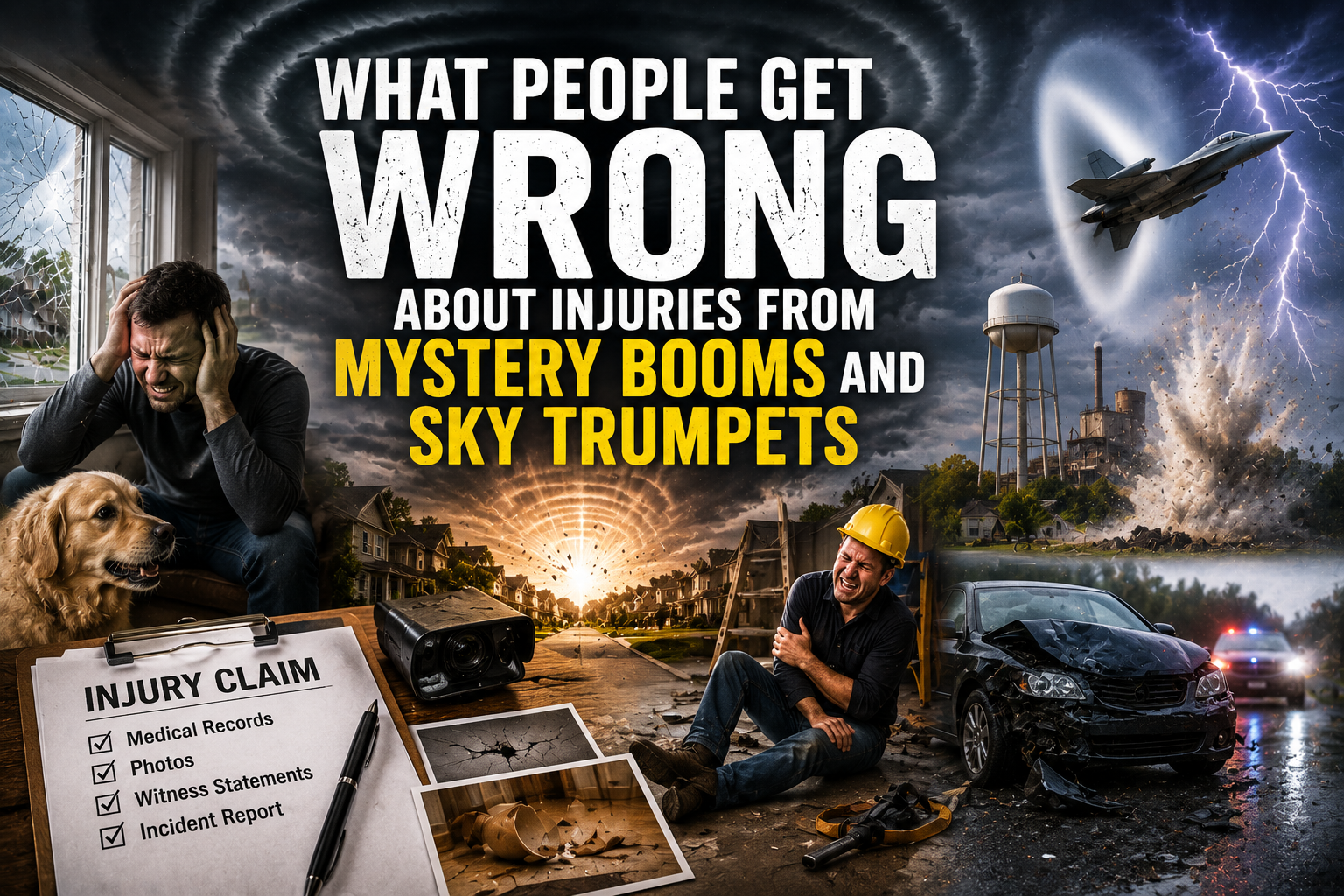
A sky-splitting boom rarely hurts anyone, and that one fact upends most of the arguments people have about it. The rattled windows, the pets losing their minds, the neighbor swearing something fell out of the sky — that part is real. What comes next, the confident theories about the source and who owes whom, is where the folklore starts.
You have likely heard the rumble or felt the floor jump, and watched the internet fill in the blanks within the hour.
However, most of those blanks get filled in wrong. Here are the assumptions worth taking apart, one at a time.
The Boom Itself Almost Never Causes The Injury
People hear a house-shaking boom and assume the pressure wave did the damage to their body. It didn’t. The overpressure from a typical sonic boom is a fraction of what a human eardrum can shrug off, and National Geographic notes that most normal buildings hold up to roughly 11 pounds per square foot of overpressure without damage. The sound is startling. The physics, at ground level, is not.
What hurts people is the reaction to it. Someone jerks awake and trips on the stairs. A driver flinches and clips a guardrail. A worker on a ladder loses grip.
The injury is real, but the cause of the injury is a fall or a crash, not the noise. That distinction matters, because a fall down your own staircase and a fall off scaffolding at work are governed by very different rules.
“Act Of God” Is Not A Free Pass For Whoever Made The Noise
When the source turns out to be mundane — a low-flying jet, a quarry blast, a construction detonation, a fuel tank rupture — people assume nobody is on the hook because it felt like weather. Liability doesn’t work that way. If a party had a duty to operate carefully and didn’t, and someone got hurt as a foreseeable result, calling it a freak event doesn’t erase the duty.
There’s precedent for this in the plain sense of the word. No lawsuit. Just a recognition that the noise had a source, and the source had responsibility.
Property Damage And Bodily Injury Aren’t The Same Claim
A cracked window and a cracked wrist go in different buckets, even when the same boom caused both. People lump them together and either overshoot or give up entirely. Treat them as separate conversations from the start.
- Property claims. These focus on repair or replacement cost — glass, plaster, a fallen shelf, a spooked horse that broke a fence. Documentation is straightforward: photos, receipts, a contractor’s estimate.
- Bodily injury claims. These follow the injury, not the boom. Medical records, lost wages, and the treating provider’s opinion about cause carry the weight. A vague “the noise made me sick” won’t move the needle without clinical support.
- Emotional distress. Standalone claims for fright are hard almost everywhere. Distress tied to a real physical injury is a different story and usually rides along with it.
Unexplained Doesn’t Mean Unprovable
The word “mystery” in mystery boom does a lot of psychological work. It makes people assume no one will ever identify a source, so there’s no point writing anything down.
The cases that get resolved are the ones where somebody logged the time to the minute, kept the doorbell-camera clip, and saved the seismograph screenshot before it rolled off the public feed.
Sources get identified more often than the folklore suggests — military flight tests, meteor entries, industrial blasts, offshore activity. Answers can take weeks. Evidence collected in the first 48 hours is what makes those answers useful later.
The Same Incident Can Trigger Very Different Cases
One boom, three neighbors, three completely different legal situations. That’s normal, and it confuses people who expect a single “the boom case” to exist. The facts around each person’s injury drive everything.
A warehouse worker who fell off a lift when the building shook is likely looking at workers’ compensation, not a lawsuit against whoever made the noise. Workplace injuries are a much larger category than most readers realize, running into the millions of nonfatal cases every year in private industry alone. A driver who swerved and hit a pedestrian is in an auto-liability conversation with their own insurer. A homeowner whose ceiling fan fell and hit them is dealing with a product or property claim.
Same boom, three lanes. Talking to an experienced injury attorney early is how people figure out which lane they’re actually in before a deadline closes the door.
Waiting To See If It Happens Again Is The Worst Move
Plenty of people who felt hurt after a strange event tell themselves they’ll deal with it if the symptoms stick around. A month goes by, the headache is still there, and the paper trail has gone cold. Insurers and defense lawyers use that gap. Every week between the event and the first medical visit becomes an argument that something else caused the problem.
You don’t need to know what made the noise to see a doctor and write down what happened. Those two steps preserve the option to do something later. Skip them and the option usually closes for good.