

Earth Oddities
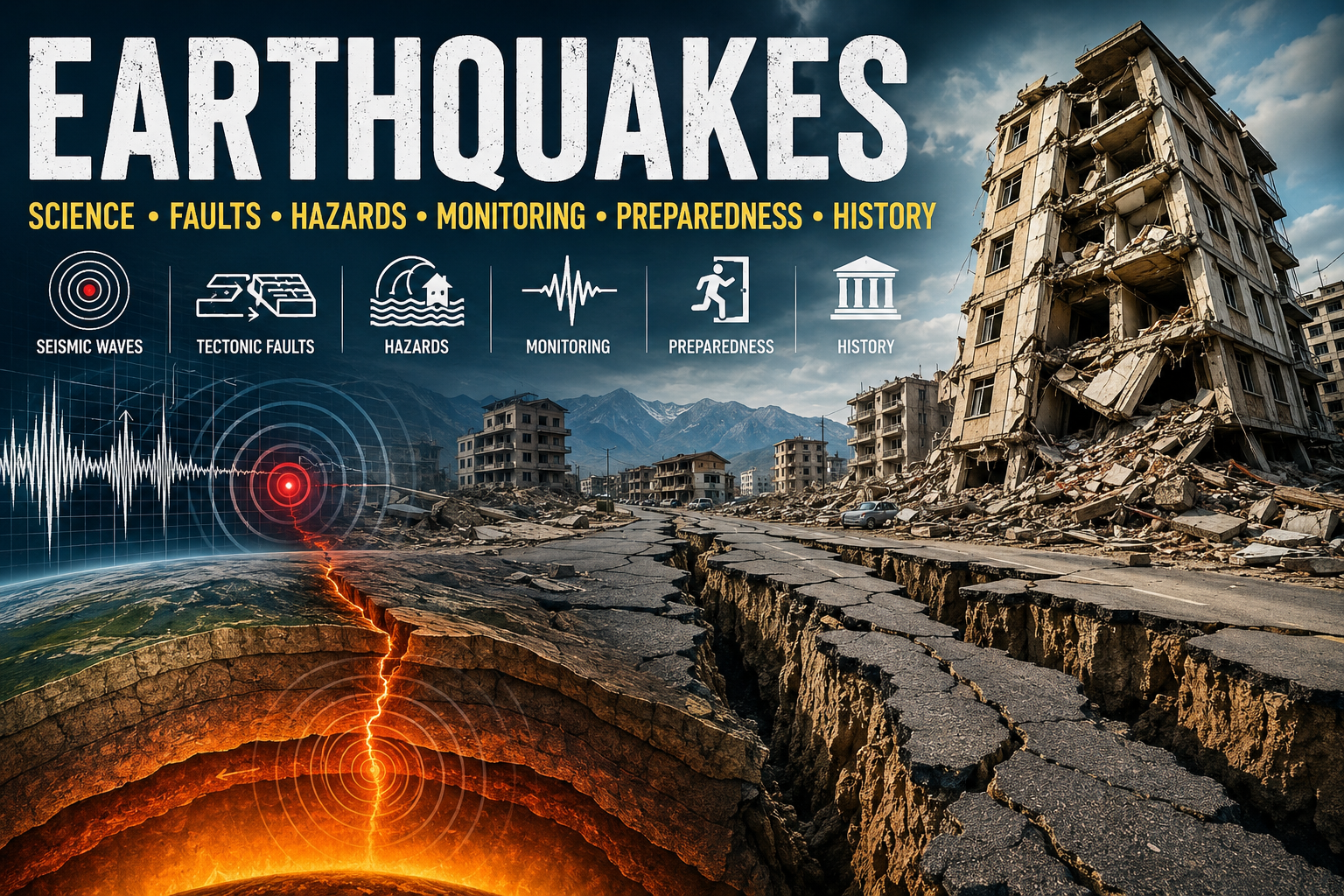
Earthquakes begin deep underground, but their effects can fracture landscapes, liquefy soil,
collapse cities, trigger landslides and launch devastating tsunamis. This earthquake hub
explains how seismic events start, where they occur, why some faults produce catastrophic
ruptures and how scientists monitor an unstable planet.
Explore earthquake science, major fault systems, global seismic belts, earthquake hazards,
forecasting technology, preparedness advice and the most powerful earthquakes in recorded
history.
Understanding a Restless Planet
Most earthquakes occur when accumulated stress overcomes friction along a fault, allowing
blocks of rock to move suddenly. The released energy travels through Earth as seismic waves,
shaking the ground near the rupture and sometimes across entire continents.
Yet earthquakes are not all alike. Some rupture shallow crustal faults beneath cities. Others
originate hundreds of kilometers deep inside subducting tectonic plates. Earthquake swarms,
slow-slip events, volcanic earthquakes and human-induced seismicity reveal that the planet
releases tectonic stress in many different ways.
Use the main pillars below to move from basic earthquake mechanics to specific fault systems,
seismic hazards, monitoring methods and landmark disasters.
01
Earthquake Science
Learn what causes earthquakes, how elastic rebound releases stored tectonic stress and why
magnitude is different from observed shaking intensity. This pillar also examines
foreshocks, aftershocks, earthquake swarms, deep-focus earthquakes, slow-slip events,
supershear ruptures and common earthquake myths.
Key topics
- What causes earthquakes
- Elastic rebound and fault rupture
- Magnitude versus intensity
- Foreshocks, aftershocks and earthquake swarms
- Deep, slow and supershear earthquakes
- Earthquake triggering and seismic myths
Featured child pillar:
Induced Seismicity and Man-Made Earthquakes
02
Faults & Tectonic Settings
Earthquake behavior depends heavily on tectonic setting. Explore subduction zones,
transform faults, continental rifts, intraplate seismic zones and hotspot regions where
magma, crustal stress and plate motion interact.
Key topics
- Subduction-zone megathrust earthquakes
- Transform and strike-slip faults
- Rift earthquakes and crustal extension
- Intraplate earthquakes far from plate boundaries
- Hotspot and volcano-related seismicity
03
Regional Seismic Systems
Some earthquake zones are larger than any single fault. This pillar examines broad tectonic
belts where multiple plates, faults and subduction systems combine to produce recurring
seismic crises.
Key regions
- The Pacific Ring of Fire
- The Mediterranean–Alpine seismic belt
- The Caribbean plate boundary
- Middle Eastern fault systems
- The Himalayan collision zone
- South Pacific subduction systems
04
Earthquake Hazards
Ground shaking is only the beginning. Earthquakes can rupture the surface, destabilize
slopes, liquefy waterlogged sediment, damage infrastructure and ignite urban fires long
after the shaking stops.
Key hazards
- Surface fault rupture
- Liquefaction and lateral spreading
- Soil amplification and basin effects
- Building collapse
- Infrastructure and utility failure
- Fire following earthquakes
Tsunamis, landslides and rockfalls are covered in their dedicated Strange Sounds hubs and
are cross-linked from this pillar to avoid duplicate content.
05
Earthquake Monitoring & Forecasting
Scientists cannot reliably predict the exact time, place and magnitude of a future
earthquake. They can, however, identify active faults, measure deformation, estimate
long-term probabilities and issue warnings after rupture begins.
Key topics
- Seismographs and seismic networks
- GPS and ground deformation
- Satellite radar monitoring
- Earthquake early-warning systems
- Probability-based forecasting
- Earthquake lights and unusual precursors
- Animal behavior and gas emissions
Featured child pillar:
Earthquake Early Warning
06
Earthquake Preparedness
Earthquakes strike without conventional warning, making preparation essential. Learn how
to secure a home, assemble emergency supplies, protect yourself during strong shaking and
respond safely to aftershocks and tsunami alerts.
Key topics
- Earthquake emergency kits
- Drop, Cover and Hold On
- Home earthquake safety
- Family and community drills
- Seismic building codes
- Aftershock safety
- Tsunami evacuation
07
Historic Earthquakes
The world’s most destructive earthquakes reveal how geology, population density,
construction quality and secondary hazards combine to create disaster. Explore landmark
earthquakes that transformed science, cities and emergency planning.
Major case studies
- 1755 Lisbon earthquake and tsunami
- 1811–1812 New Madrid earthquakes
- 1906 San Francisco earthquake
- 1960 Valdivia earthquake
- 1964 Alaska earthquake
- 1976 Tangshan earthquake
- 2004 Sumatra–Andaman earthquake and tsunami
- 2011 Tōhoku earthquake and tsunami
- 2023 Turkey–Syria earthquakes
08
Earthquake Records & Statistics
Which was the largest earthquake ever measured? Which earthquakes were the deadliest,
deepest or most expensive? This reference pillar compares major seismic events and explains
what earthquake records really mean.
Key records
- Largest earthquakes ever recorded
- Deadliest earthquakes in history
- Deepest known earthquakes
- Costliest earthquake disasters
- Earthquake records by country
- Major earthquakes by year
Earthquakes and Connected Natural Phenomena
Earthquakes rarely exist in isolation. Large ruptures can disturb oceans, destabilize
mountains, alter groundwater systems and interact with volcanic regions. Explore the related
Strange Sounds topics below for a wider view of Earth’s interconnected hazards.
-
Volcanoes:
Earthquake swarms can accompany magma movement and volcanic unrest.
Explore the Volcanoes hub
. -
Tsunamis:
Undersea megathrust earthquakes can displace enormous volumes of water and send destructive
waves across entire ocean basins. -
Landslides:
Strong shaking can trigger rockfalls, debris avalanches, submarine slope failures and
widespread ground collapse. -
Earth degassing:
Fault movement may alter pathways used by groundwater and naturally occurring gases.
Explore Earth degassing and toxic gas emissions
.
Earthquake FAQs
What causes most earthquakes?
Most earthquakes occur when tectonic stress causes rocks to break or slip suddenly along a
fault. The released energy travels outward as seismic waves and produces ground shaking.
Can scientists predict earthquakes?
Scientists cannot reliably predict the exact time, location and magnitude of an individual
earthquake. They can identify active faults, calculate long-term probabilities, monitor
seismic activity and provide early warning after a rupture has begun.
What is the difference between earthquake magnitude and intensity?
Magnitude measures the size of an earthquake at its source. Intensity describes the level
of shaking and damage observed at a particular location, so one earthquake can produce many
different intensity values.
Can one earthquake trigger another?
Yes. Large earthquakes redistribute stress within the crust and can trigger aftershocks or
alter seismic activity on nearby and sometimes distant faults. Triggering does not mean that
every affected fault will produce a major earthquake.
Can earthquakes trigger volcanic eruptions?
Large earthquakes can disturb volcanic and hydrothermal systems, but a direct eruption
usually requires a volcano that is already close to instability. Most earthquakes do not
trigger eruptions.
What should you do during an earthquake?
In most indoor situations, drop to the ground, take cover beneath sturdy furniture and hold
on until the shaking stops. Stay away from windows and do not run outside while debris may
be falling.
