

Rivers • Water Cycle • Drought • New Research
More rain should mean more water flowing through rivers. But a massive global analysis of more than 10,000 river sites finds that rainfall and river discharge are increasingly telling different stories — including watersheds where precipitation is rising while river flow is falling.
It sounds like one of the simplest rules in the water cycle.
More rain falls. Rivers carry more water.
Except across large parts of the planet, that apparently isn’t what is happening.
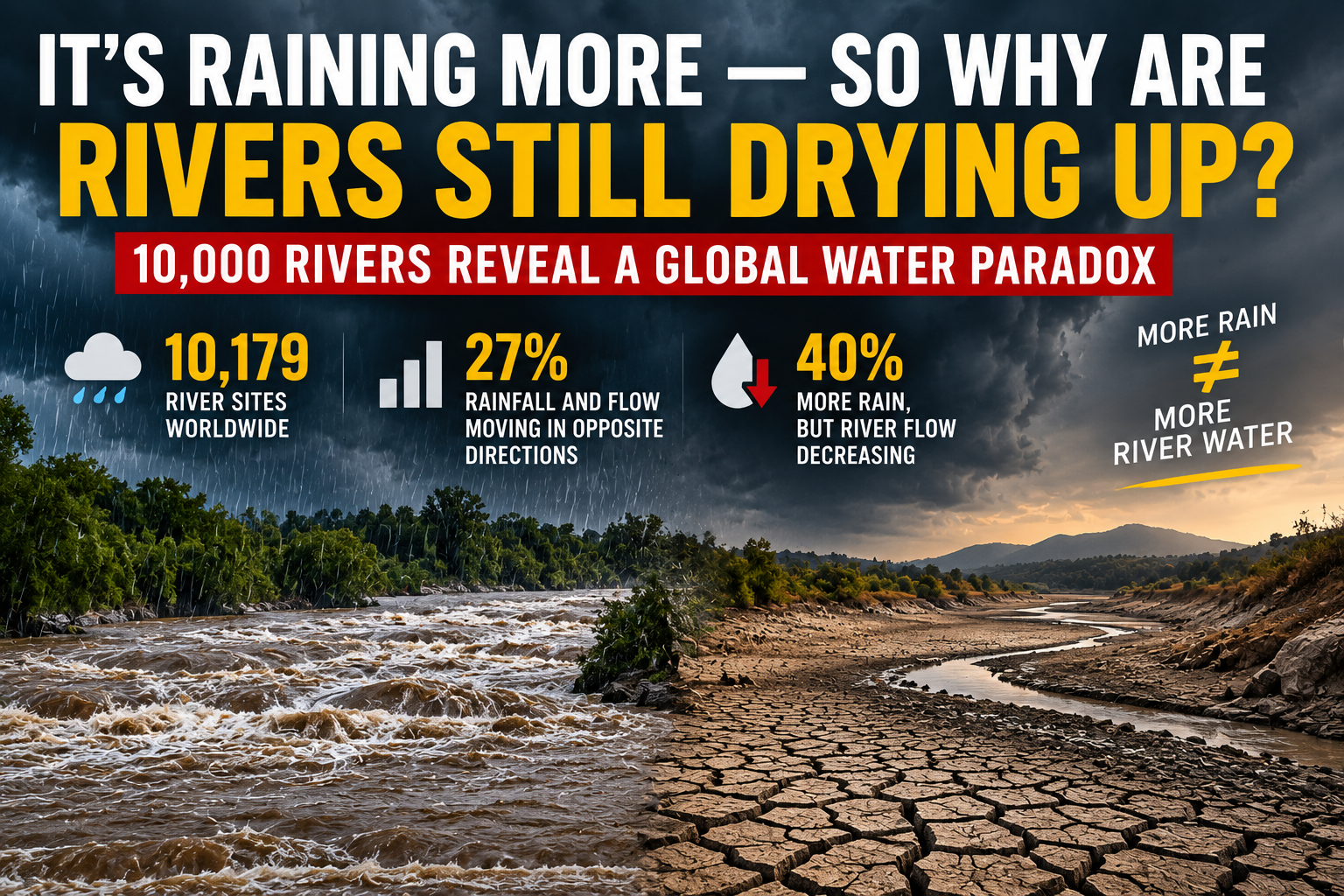
A new global analysis of 10,179 river monitoring sites has uncovered a striking disconnect between changes in precipitation and changes in river discharge.
At roughly 27% of the sites analyzed, rainfall and river flow were trending in opposite directions.
And among those diverging watersheds, approximately 40% showed perhaps the strangest combination of all:
Precipitation was increasing — while river discharge was decreasing.
In other words:
It’s raining more, but less water is reaching the river.
The findings challenge one of the easiest assumptions to make about Earth’s hydrological cycle and could help explain why
rivers, lakes and reservoirs can continue losing water
even when rainfall totals don’t appear particularly alarming.
10,179 Rivers Reveal a Surprisingly Complicated Water Cycle
The study, published in Geophysical Research Letters, examined long-term precipitation and river-discharge trends across 10,179 monitoring sites around the world.
Researchers were essentially asking a very straightforward question:
When precipitation changes, does river flow change in the same direction?
At many sites, yes.
More precipitation corresponded with increasing discharge, while declining precipitation corresponded with decreasing discharge.
That’s roughly what basic intuition predicts.
But at approximately 27% of the river sites, the trends diverged.
Rainfall moved one way.
River discharge moved the other.
And the mismatch was particularly pronounced in more arid environments.
The Global Water Paradox: More Rain, Less River Flow
The most counterintuitive group contained watersheds receiving increasing precipitation but experiencing decreasing river discharge.
These represented about 40% of the sites where rainfall and discharge trends diverged.
That sounds contradictory only if we imagine a watershed as a giant funnel.
Rain falls into the funnel.
Water comes out through the river.
But real landscapes don’t work like that.
Between a raindrop hitting the ground and water reaching a river channel, that water can:
- evaporate back into the atmosphere;
- be absorbed by vegetation and released through transpiration;
- infiltrate into soil;
- recharge groundwater;
- remain stored in wetlands, lakes or reservoirs;
- be extracted for irrigation or other human uses;
- or run rapidly across the surface into a river.
Changing any of those pathways can alter how efficiently precipitation becomes river flow.
And that means annual rainfall totals alone can hide enormous changes occurring inside a watershed.
Rainfall Totals Don’t Tell You How the Rain Fell
This may be one of the most important lessons from the study.
Two years can receive exactly the same amount of precipitation and produce completely different river conditions.
Imagine a watershed receiving 1,000 millimeters of rain in a year.
In one scenario, that rain arrives as frequent moderate storms spread across many months.
In another, much of it arrives during a handful of violent downpours separated by long dry periods.
The annual total might look identical.
Hydrologically, the two years can behave very differently.
The new analysis indicates that the frequency of extremely wet and extremely dry days helps explain some of the divergence between precipitation and river discharge.
That’s important because a changing climate doesn’t simply change how much precipitation falls.
It can also change when, where and how intensely that precipitation arrives.
More Extreme Rain Doesn’t Necessarily Solve the Problem
A landscape can therefore experience heavier rainfall events while still struggling with water availability between storms.
During intense rainfall, soil may not be able to absorb water quickly enough.
Instead, large quantities can rush across the surface over a short period.
That can produce river flooding without necessarily providing the slow, sustained recharge needed to maintain healthy river flows months later.
The apparent contradiction becomes:
more extreme rainfall + more flooding + worsening water scarcity.
Those conditions are not mutually exclusive.
A watershed can experience all three.
That’s one reason extreme rainfall shouldn’t automatically be interpreted as relief from long-term hydrological stress.
Hotter Air Can Steal More Water Back
Then there is the atmosphere itself.
As temperatures rise, the atmosphere generally has greater evaporative demand.
That means more water can be transferred from soils, vegetation and surface water back into the atmosphere through evaporation and transpiration.
Hydrologists often describe this combined process as evapotranspiration.
Imagine two watersheds receiving the same amount of rain.
If one experiences substantially greater atmospheric demand, more of its water may return to the atmosphere before it ever reaches the river.
The rainfall gauge says:
Water arrived.
The river gauge says:
Not here it didn’t.
Runoff Efficiency Is Changing
One of the key concepts behind the new findings is runoff efficiency.
In simple terms, it describes how effectively precipitation entering a watershed is converted into river discharge.
If 100 units of precipitation fall across a basin but only a relatively small fraction eventually contributes to streamflow, runoff efficiency is low.
If a larger proportion reaches the river, runoff efficiency is higher.
And runoff efficiency isn’t fixed.
It can change with:
- temperature;
- soil moisture;
- vegetation;
- groundwater conditions;
- snow accumulation and melt;
- land-use change;
- water extraction;
- reservoir operations;
- and the timing and intensity of rainfall.
The new study suggests these changing relationships are important enough that precipitation trends alone frequently fail to predict what rivers are actually doing.
The Paradox Gets Stronger in Dry Regions
The mismatch between rainfall and river discharge becomes particularly important in arid and water-limited environments.
That’s not surprising when you consider how aggressively dry landscapes compete for incoming water.
After a long dry period, the first rainfall may be absorbed by depleted soils.
Plants use some of the available moisture.
Groundwater deficits may need to be replenished.
High temperatures can increase evaporation.
Only after some of those deficits are satisfied does substantial water necessarily remain available to feed rivers.
This means a region can technically become wetter according to precipitation measurements without experiencing an equivalent improvement in its rivers.
A River Is the Final Result of an Entire Landscape
That’s perhaps the easiest way to understand the discovery.
A rain gauge measures what falls from the sky at a particular location.
A river measures the integrated result of what happened to water across an entire watershed.
Everything between those two measurements matters.
Forests.
Farms.
Cities.
Soils.
Wetlands.
Groundwater.
Reservoirs.
Snow.
Evaporation.
Human withdrawals.
And increasingly, the timing of extremes.
A river is therefore not simply a giant rain gauge.
How Can Rivers Dry Up After Heavy Rain?
This also helps explain something that can look completely absurd when it happens locally.
A region suffers months of low river levels.
Then enormous storms arrive.
Flood warnings are issued.
Fields disappear beneath water.
Roads flood.
A few weeks or months later, water shortages return.
How can both be true?
Because flooding and water availability operate on different timescales.
A flood can represent an enormous volume of water moving rapidly through a watershed.
Long-term water security depends on how much water remains stored in soils, aquifers, lakes, reservoirs and sustained river baseflow after that event has passed.
Fast water isn’t necessarily stored water.
Drought Is More Than “Not Enough Rain”
The findings also illustrate why drought can be surprisingly complicated.
Meteorological drought generally refers to an abnormal lack of precipitation.
But hydrological drought involves reduced water in rivers, reservoirs, lakes and groundwater systems.
The two are related — but they don’t always begin or end at exactly the same time.
Rainfall can recover while rivers remain depleted.
Reservoirs can remain low after drought conditions ease.
Groundwater can take even longer to recover.
That’s why understanding drought and water scarcity requires looking far beyond rainfall alone.
And Sometimes Rivers Disappear Completely
At the extreme end of the spectrum are waterways that periodically or permanently vanish from the surface.
Some rivers disappear naturally underground into karst systems.
Some lakes drain through fractures or subterranean channels.
Others shrink because evaporation exceeds water input.
And still others disappear because dams, irrigation, groundwater pumping or diversion remove too much water from the system.
Those mechanisms are explored in our guide to disappearing rivers and lakes.
The new global research adds another important lesson:
even increasing rainfall doesn’t guarantee that surface waters will recover.
Does This Mean Rain No Longer Controls Rivers?
No.
Precipitation remains one of the fundamental controls on river discharge.
The study isn’t saying rainfall doesn’t matter.
It’s showing that the relationship is not one-to-one.
Across most monitoring sites, precipitation and discharge trends still move together.
But finding opposing trends at roughly one in four sites is far too widespread to dismiss as an occasional anomaly.
It means that understanding future river conditions requires considering the entire watershed and atmosphere rather than simply asking whether annual rainfall is increasing or decreasing.
Why This Matters for Water Management
The distinction has enormous practical consequences.
Cities, farms, industries and ecosystems depend on river discharge — not precipitation statistics.
If water planners assume increasing rainfall will automatically translate into increasing river flow, they can underestimate future water stress.
Likewise, rainfall projections alone may not reveal how much water will actually become available for reservoirs, irrigation, hydropower or ecosystems.
Hydrological forecasting therefore needs to account for changing:
- evapotranspiration;
- runoff efficiency;
- soil and groundwater storage;
- rainfall intensity;
- dry-period duration;
- land use;
- and human water management.
The atmosphere supplies the water.
The landscape decides what happens to it.
More Rain Does Not Necessarily Mean More Water
The global water cycle is often reduced to a simple diagram.
Water evaporates.
Clouds form.
Rain falls.
Rivers carry the water back toward the ocean.
Repeat.
The real Earth is considerably messier.
Across thousands of watersheds, precipitation and river discharge are already moving in opposite directions.
Some places are becoming drier and seeing more river flow.
Others are receiving more precipitation while their rivers decline.
And the explanation lies in everything happening between the cloud and the river: atmospheric demand, extreme wet and dry periods, soil, vegetation, groundwater, runoff and human water use.
So the next time a drought-stricken river receives heavy rain, don’t ask only:
“How much did it rain?”
Ask the much more important question:
Where did all that water actually go?
Frequently Asked Questions About the Rainfall–River Flow Paradox
How can rivers dry up when rainfall is increasing?
More rainfall does not automatically mean more river flow. Water can evaporate, be used by vegetation, infiltrate into soil and groundwater, be stored in reservoirs or wetlands, or be removed for human use before it reaches a river. Changes in these processes can cause river discharge to decline even when precipitation increases.
How common is the mismatch between rainfall and river discharge?
In the global study of 10,179 river sites, precipitation and river discharge trends moved in opposite directions at about 27% of locations. Among those diverging watersheds, roughly 40% experienced increasing precipitation while river discharge declined.
Why does extreme rainfall not always increase long-term water availability?
Intense rain can produce rapid runoff and flooding without providing sustained soil moisture, groundwater recharge or long-term river baseflow. A region can therefore experience more extreme rainfall and flooding while still facing drought or water scarcity between storms.
What is runoff efficiency?
Runoff efficiency describes how effectively precipitation falling across a watershed is converted into river discharge. It can change with temperature, vegetation, soil moisture, groundwater conditions, land use, rainfall intensity and water management.
What is hydrological drought?
Hydrological drought refers to unusually low water levels or flows in rivers, reservoirs, lakes and groundwater systems. It can persist even after rainfall returns to normal because rivers, aquifers and reservoirs may take much longer to recover.
Why is the rainfall–river flow mismatch stronger in dry regions?
In arid regions, incoming rainfall must often replenish dry soils, groundwater deficits and vegetation water demand while also competing with strong evaporation. That can leave a smaller fraction of precipitation available to become sustained river flow.
Study
Widespread Divergence Between Precipitation and Discharge Trends Across Global Rivers
Geophysical Research Letters (2026)
DOI: 10.1029/2026GL122253

