
Astronomy • Venus • Moon • September 14, 2026
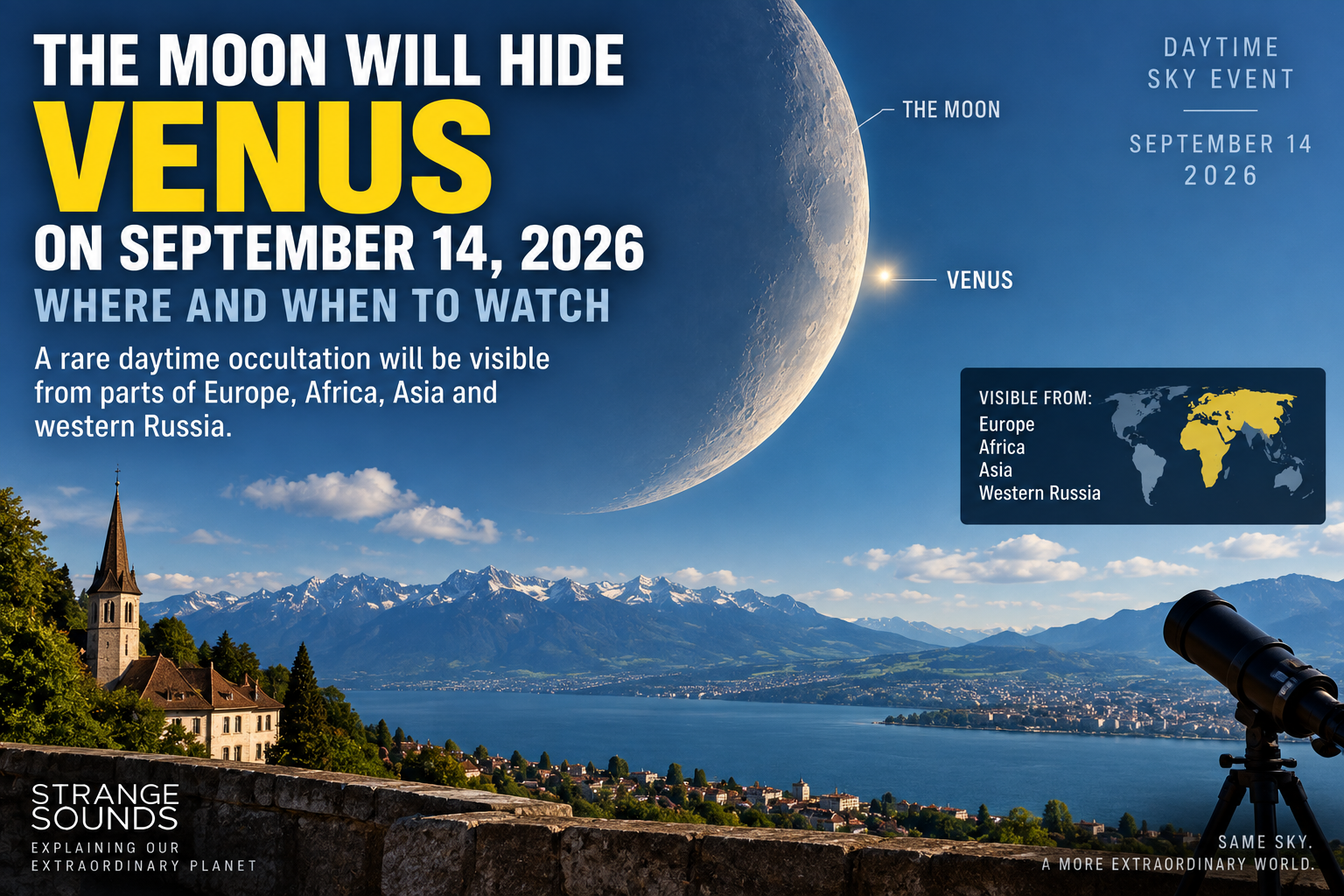
On September 14, 2026, the crescent Moon will pass directly in front of Venus, temporarily making the brilliant planet disappear from the daytime sky. The lunar occultation of Venus will be visible from parts of Europe, Africa, Asia and western Russia — including Central Europe.
One of September’s most unusual astronomical events will happen in broad daylight.
On September 14, 2026, the Moon will pass directly between Earth and Venus, causing the planet to vanish behind the lunar disk before reappearing roughly an hour later.
This is known as a lunar occultation of Venus.
And unlike a simple conjunction, the two objects will not merely appear close together.
The Moon will actually cover Venus.
The event will be visible across a broad swath of Europe, Africa, western Russia and Asia, with the overall occultation path occurring between approximately 09:26 and 13:42 UTC, depending on location.
NASA has also highlighted September 14 as the second of three Venus occultations visible from Earth in 2026.
What Is a Lunar Occultation of Venus?
An occultation occurs when one celestial object passes directly in front of another from our viewpoint on Earth.
In this case, the Moon will move across the line of sight to Venus.
The planet will first disappear behind one edge of the Moon, remain hidden for a period of time, and later reappear from the opposite side.
The exact timing depends on where you are located because observers across Earth see the Moon against slightly different parts of the background sky.
That is why occultation times can vary significantly from one city or country to another.
When Is the Venus Occultation on September 14, 2026?
Across the entire visibility zone, the event takes place between approximately 09:26 UTC and 13:42 UTC.
Those times describe the global span of the occultation path, not the duration at any single location.
At an individual observing site, Venus will generally remain hidden for roughly about an hour, although the exact duration varies.
In Central Europe, disappearance generally occurs during the late morning, followed by reappearance roughly an hour later.
Venus Occultation Time in Switzerland
Switzerland is well positioned for the event.
Sternwarte Rümlang near Zurich lists the occultation beginning at approximately 11:28 CEST on September 14.
At that time, the dark limb of the Moon will move across Venus.
A little more than one hour later, the planet will reappear from the bright side of the crescent Moon.
Exact times will differ slightly elsewhere in Switzerland, so observers should calculate circumstances for their specific location.
Where Will the September 14 Venus Occultation Be Visible?
The occultation path crosses a large portion of the Eastern Hemisphere.
Observers in parts of the following regions may be able to see Venus disappear:
- Central and southern Europe
- parts of western and eastern Europe
- western Russia
- North and East Africa
- the Middle East
- South Asia
- parts of Southeast Asia
Visibility is extremely location-dependent near the edges of the occultation path.
Some observers outside the main zone will instead see a very close Moon–Venus conjunction without Venus being completely covered.
The Moon Will Be Only About 12–13% Illuminated
The geometry makes this event particularly beautiful.
The Moon will be a thin waxing crescent, only about 12–13% illuminated.
Venus will also appear extremely bright in the daytime sky.
Through a telescope, the planet itself will show a distinct phase rather than a full disk.
Observers may therefore watch a brilliant planet disappear behind the dark, largely invisible portion of a crescent Moon.
In Central Europe, disappearance occurs at the Moon’s dark limb, while Venus reappears from the illuminated side roughly an hour later.
Why Will the Venus Occultation Happen During Daylight?
The Moon and Venus happen to occupy the same line of sight while the Sun is above the horizon for much of the occultation path.
That means the event is not a conventional nighttime observing spectacle.
Instead, Venus will disappear against a bright blue daytime sky.
Fortunately, Venus is extraordinarily bright.
Under good conditions, it can be seen in daylight if an observer already knows exactly where to look.
The nearby crescent Moon provides a useful positional reference, although finding both objects can still be difficult without optical aid.
Can You See the Venus Occultation With the Naked Eye?
Possibly — but it will not be easy.
Venus is bright enough to be visible with the naked eye during daylight under favorable atmospheric conditions, especially when its precise position is known.
However, the daytime sky significantly reduces contrast.
For most observers, binoculars or a telescope will make the event much easier to follow.
A telescope can also reveal the gradual disappearance of Venus behind the lunar limb more clearly than the naked eye.
Important Solar Safety Warning
Because the September 14 occultation occurs during daylight across much of Europe, solar safety is especially important.
The safest approach is to position yourself where a building, wall or other solid object completely blocks the Sun while the Moon and Venus remain visible elsewhere in the sky.
Never use the Sun itself as a reference point when searching with binoculars or an unfiltered telescope.
If you are uncertain about safely locating Venus, observe through a local astronomy club or observatory instead.
How to Watch the September 14 Venus Occultation
Preparation will make a huge difference because the disappearance itself happens quickly.
- Check the exact occultation time for your location. Times vary by city.
- Set up at least 20–30 minutes early. This gives you time to locate the crescent Moon safely.
- Make sure the Sun is physically blocked. Never sweep optical instruments anywhere near it.
- Find the Moon first. Venus will be extremely close to it immediately before disappearance.
- Use a stable tripod if possible. This makes binocular and camera observations considerably easier.
- Continue watching after Venus disappears. The reappearance from the opposite lunar limb can be equally impressive.
What Will the Disappearance Look Like?
Venus will not gradually fade away.
Instead, the edge of the Moon will move across the apparent disk of Venus.
Through sufficient magnification, observers may see the planet progressively covered by the lunar limb before it disappears completely.
Because Venus has a measurable apparent disk rather than behaving like a point-like star, its disappearance takes a short but perceptible interval.
Roughly an hour later, the process reverses as Venus emerges from the Moon’s opposite edge.
Why Planetary Occultations Are Different From Conjunctions
The Moon passes near planets frequently.
Most close encounters between the Moon and planets are celestial alignments or planetary conjunctions, where the objects simply appear close together in the sky.
An occultation is more precise: the Moon passes directly in front of the background object and temporarily hides it from view.
Because the Moon is relatively close to Earth, its apparent position shifts significantly depending on where an observer stands.
As a result, one country can experience a complete occultation while observers elsewhere see Venus pass just above or below the lunar disk.
2026 Has Three Venus Occultations
The September event is part of an unusual sequence.
NASA notes that there are three observable lunar occultations of Venus in 2026.
- June 17, 2026 — visible across parts of the United States and Canada.
- September 14, 2026 — visible from parts of Europe, Africa, Asia and western Russia.
- November 7, 2026 — visible from southern South America.
NASA photographed the June event from Washington, D.C., showing Venus disappearing behind the Moon during daylight.
The September 14 Venus occultation is one of several notable astronomical events visible during 2026.
Will the Venus Occultation Be Visible From North America?
The September 14 occultation itself is not favorably visible across most of North America.
The main occultation path is concentrated over Europe, Africa and Asia.
Observers outside the path may instead see Venus and the young Moon appearing very close together around the same date.
This distinction matters because a close conjunction can look spectacular, but Venus will not actually disappear behind the Moon unless you are inside the occultation visibility zone.
Weather May Decide Whether You See It
Unlike an eclipse lasting for hours across a broad region, an occultation gives observers a very specific observing window.
Clouds at the wrong moment can therefore hide the entire event.
Check your local forecast during the 24–48 hours before September 14 and consider moving to a nearby location if a clearer sky is available.
Because the event happens during daylight, even thin cloud or atmospheric haze can make the crescent Moon and Venus considerably harder to locate.
Explore more unusual planetary encounters, eclipses, meteor showers and celestial phenomena in our Space & Beyond hub.
September 14 Could Produce Some Extraordinary Images
If the weather cooperates, the occultation has excellent photographic potential.
The combination of a thin crescent Moon, brilliant Venus and a blue daytime sky creates a scene very different from a conventional nighttime planetary conjunction.
Telescopic sequences showing Venus approaching the dark lunar limb, disappearing and then emerging roughly an hour later could be especially striking.
And because observers across multiple continents will see the event at different times, September 14 should produce an interesting global collection of images and videos.
The Moon Is About to Make Venus Disappear
Venus is normally one of the brightest objects in Earth’s sky.
But on September 14, even the brilliant planet will briefly lose a celestial game of hide-and-seek.
Across parts of Europe, Africa and Asia, the thin crescent Moon will slowly approach Venus in broad daylight.
Then the dark lunar limb will reach the planet.
Venus will disappear.
About an hour later, it will emerge from the other side.
September 14, 2026: the day the Moon temporarily erases one of the brightest planets from the sky.
Frequently Asked Questions About the September 14 Venus Occultation
What time is the Venus occultation on September 14, 2026?
The global occultation window runs approximately from 09:26 to 13:42 UTC. Exact disappearance and reappearance times depend on your location.
What time will Venus disappear behind the Moon in Switzerland?
At Sternwarte Rümlang near Zurich, Venus is expected to disappear behind the Moon at approximately 11:28 CEST. It should reappear a little more than an hour later.
Where is the Venus occultation visible?
The September 14 occultation will be visible from parts of Europe, Africa, western Russia and Asia. Exact visibility depends on the observer’s location.
Will the September 14 Venus occultation happen during daylight?
Yes. Across much of the main visibility zone, including Central Europe, the occultation occurs during daylight. Venus is bright enough to be detected in daylight when its position is known, although binoculars or a telescope may be needed.
Can I see the Venus occultation without a telescope?
Venus can sometimes be seen with the naked eye during daylight, but locating it against the blue sky can be difficult. Binoculars or a telescope make the event easier to observe, provided they are used safely and kept well away from the Sun.
Why does Venus disappear behind the Moon?
From parts of Earth, the Moon and Venus will become almost perfectly aligned. Because the Moon is much closer to us, its disk passes in front of Venus, temporarily hiding the planet from view.
What is the difference between an occultation and a conjunction?
During a planetary conjunction, two celestial objects simply appear close together in the sky. During an occultation, the nearer object passes directly in front of the more distant object and temporarily hides it from view.
Is it safe to observe Venus during the daytime?
Daytime astronomy requires extreme caution. Never sweep binoculars or a telescope around the sky near the Sun. Ideally, observe from a location where a building or other solid object completely blocks the Sun before using optical equipment.