
You’ve probably heard of the Mandela effect – a phenomenon where large groups of people recall details differently than how it appears in documented reality. Although some of the examples seem like a legitimate glitch in the matrix, many appear to be the result of poor memory.
Human memory is known to be unreliable when it comes to details and can be shaped retroactively by suggestion and repetition. However, this effect involves more than just things like company logos and variations on spelling. There’s a whole world full of Mandela effects that involve physical goods made of leather.
The following are examples of how perceptions differ regarding everyday leather objects.
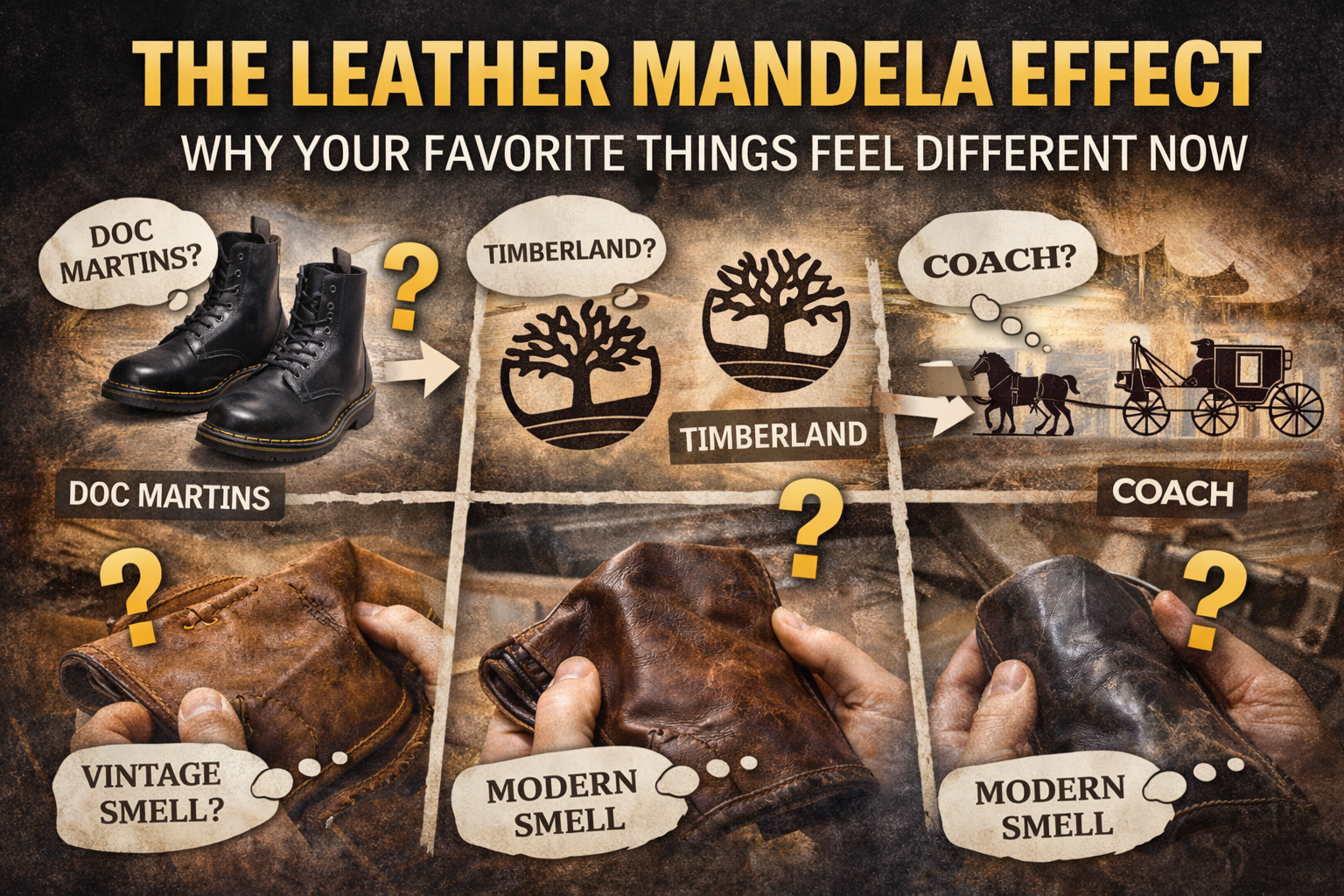
1. Doc Martens – how is it really spelled?
A common memory discrepancy involves the iconic boot brand Dr. Martens, often referred to as “Doc Martens.” Many long-time fans say they remember the name with a possessive apostrophe and it was spelled “Martins.” The official spelling is Dr. Martens, but this shared perception shows how brand familiarity doesn’t automatically guarantee details are memorable.
Another group of fans say they remember owning Doc Martens with black stitching, while it appears they’ve always had yellow stitching. However, when you look closely at their website, you can find variations of boots with black stitching. However, it’s not clear whether these black-stitched boots were available in the past. All available archived product photos show the yellow stitching.
In addition to memory being unreliable, there’s a reason people might misremember details about leather goods. Older goods may have had thicker stitching and were made with sturdier construction compared to recent goods. While the brain does tend to idealize the past, it’s true that many of today’s leather goods tend to be made cheaply. With the exception of a handful of quality companies like Portland Leather Goods and Dr. Martens, mass market products are a gamble.
2. Timberland boot logos – what direction is it facing?
The Timberland logo is a simple, stylized tree with roots that has been stamped onto the company’s leather boots for years, but many people remember the tree facing the opposite direction. Some remember the tree having fewer roots, while others remember it being more detailed with thicker branches and longer roots. Others say the tree looked more realistic and less like a graphic.
This could be caused by the logo looking different on a variety of materials. It’s not just stamped into boots. The tree is stitched onto patches, printed on boxes, and even engraved on metal hardware. Each of these alters the appearance of the logo. Over time, it’s possible the brain combines these impressions into a single remembered version. It’s also possible that scuffs and patina distort the logo, and seeing the logo online looks too clean.
3. The Coach logo – which way is the horse walking?
The Coach logo features a horse-drawn carriage, which seems easy to remember. However, many people insist the horse used to face the opposite direction and the overall style was more ornate. Some people even say the horse was posed differently and the wheels were different.
The Coach logo was changed in 2013 and features a similar design with a smaller horse and carriage. The horse displays the same general pose, but it’s a different horse. And while the carriage appears to be the same, the driving whip is now looped.
4. The smell of leather
Many people say that real leather used to smell stronger, richer, sweeter, and more “animal like” decades ago. They say it smelled Earthy or musky in a way that doesn’t exist today.
This may be the result of how tanning processes alter the smell and the fact that more people are buying faux leather without realizing it. If faux leather is passed off as quality, it’s going to smell different and less “animal like.” It’s also possible that people are purchasing lower-quality leather that smells different.
It’s also possible that people are experiencing the smell emotionally. When someone smells leather that doesn’t evoke the same emotional response that they remember, they interpret it as a change in the material.
Why leather feels like it’s changed
There might be some genuine Mandela effects out there, but it seems like these examples are the result of false memory. Leather goods – boots, jackets, bags, purses, and even smells – become deeply rooted in personal identity and nostalgia.
When people encounter logos and products from the past, it can trigger a false memory when the object doesn’t elicit the same feelings it once did. The takeaway is that memories are emotional and interpretive, and sometimes that can make familiar things feel strangely unfamiliar.