

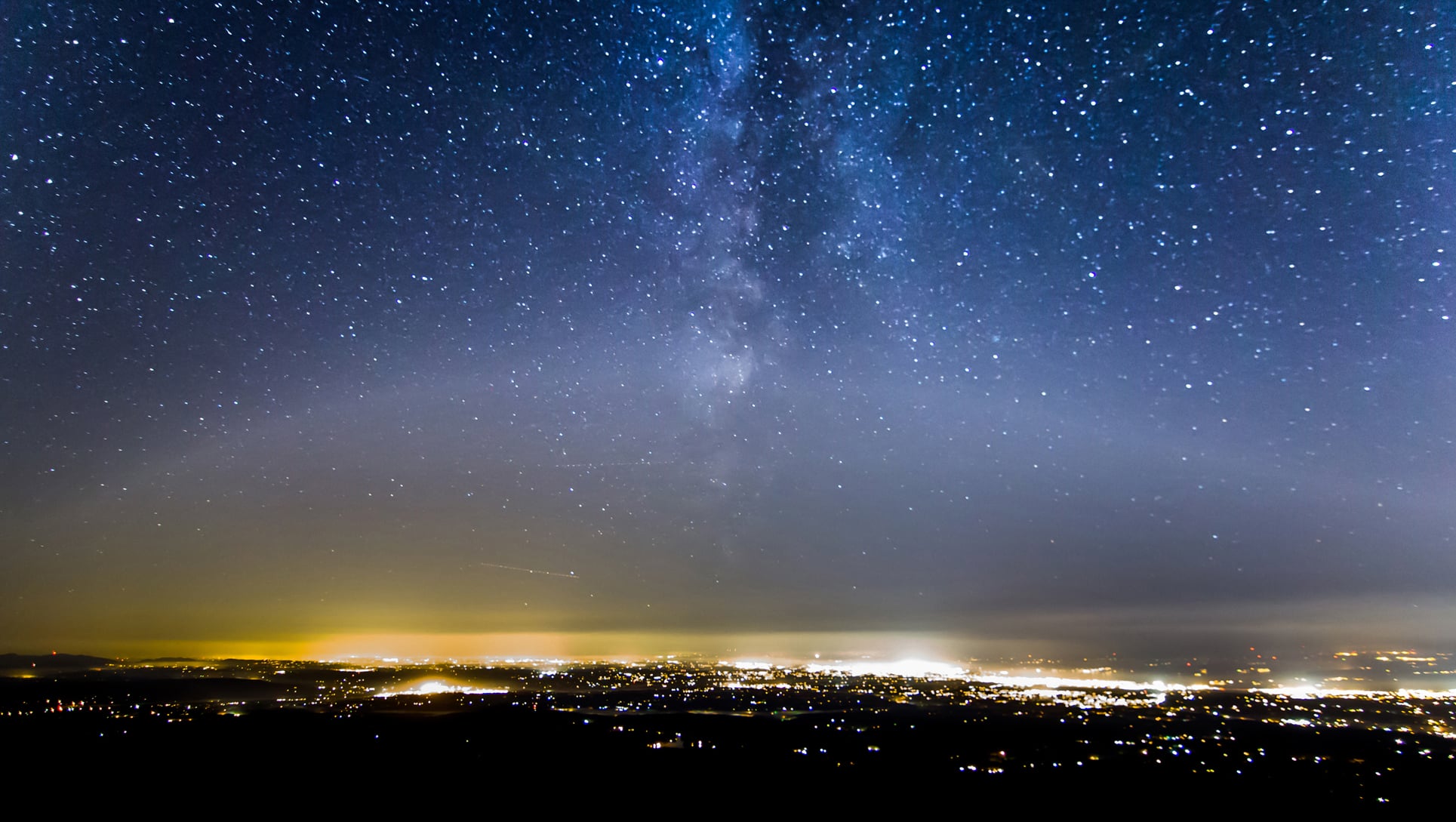
Imagine a summer night when you look up at the sky and, instead of a blanket of stars, you see only a dull milky sheet. For millions of people around the world, this has become the new reality. Light pollution has long ceased to be a problem only for astronomers. It affects everyone: we lose not only the opportunity to admire the Universe, but also face serious consequences for nature and our own health.
How light pollution changes our world
Light pollution is excessive artificial light that scatters in the atmosphere and makes the night sky brighter. An example is the glow from streetlights, billboards, and shop windows, which is visible even tens of kilometers from the city. Each such source of light takes away part of the cosmic landscape from us, hiding the stars behind a veil of light.
The growth of cities and the emergence of new lighting technologies intensify this problem. Modern LED lamps have a particularly strong impact. They emit brighter and colder light, which scatters much more actively in the atmosphere and makes the sky even brighter. As a result, even in small settlements it becomes difficult to see the Milky Way.
Why the dark sky disappears faster than it seems
Recent studies show an alarming trend: the level of light pollution is growing by almost 10% annually. This conclusion was made by scientists after analyzing data from the Globe at Night project, in which more than 50,000 volunteers from around the world participated. People compared the visibility of stars in the sky with proposed maps and noted how many stars they could distinguish.
Satellites record the increase in night sky brightness much more slowly—about 2% per year. However, this is due to the specifics of their operation: they do not capture the entire spectrum of light and do not see side emissions from windows and billboards. The analogy with compound interest helps to understand the scale: if the brightness of the sky increases by 10% annually, then in 7–8 years it doubles. In a single generation, the number of visible stars can decrease severalfold.
How light pollution affects nature and human health
Bright night lighting disrupts the natural rhythms of life for many creatures. Birds lose their migration routes, orienting themselves by artificial light instead of the stars. The flowering of plants shifts because they lose their time cues. Insects, such as fireflies, cannot find each other to mate.
For humans, the consequences are also tangible. Excessive light disrupts melatonin production—the sleep hormone—which can lead to insomnia and other health problems. Some studies link light pollution to an increased risk of cardiovascular and oncological diseases. In addition, the loss of the starry sky deprives us of psychological comfort and a sense of connection with nature.
What we lose along with the disappearing stars
The loss of stars is not just the disappearance of beautiful views. It is a loss of cultural and spiritual heritage, akin to closing museums or losing great works of music. The starry sky has inspired artists, poets, and scientists for thousands of years. It was part of myths, navigation, and even calendars.
When we stop seeing the stars, we lose the opportunity to feel like part of the Universe. The night sky gives a sense of beauty, scale, and mystery, helps children dream, and adults—relax and find harmony. Without stars, we lose an important part of the human experience.
Why new technologies can worsen the problem
The transition to LED lighting was supposed to reduce energy costs and decrease light pollution. However, in practice, LED lamps often make the sky brighter. The reason is that they emit more blue light, which is especially actively scattered in the atmosphere and is less well detected by satellites.
Urban lighting systems are often designed so that light goes not only downward but also sideways, entering windows and reflecting off facades. This creates additional glare, which is not recorded by satellites but is noticeable to anyone trying to see the stars in the city.
How cities and countries are seeking ways to restore the dark sky
In many countries, initiatives to protect the night sky are already emerging. The International Dark-Sky Association brings together scientists, activists, and municipalities who fight for the reasonable use of lighting. Some cities, such as Pittsburgh and Fort Collins in the USA, have managed to reduce the level of light pollution by installing “smart” lights and limiting the operating hours of outdoor lighting.
Effective measures include:
- Using fixtures with a directed light flow only downward
- Choosing lamps with a warm (yellowish) spectrum
- Limiting the brightness and operating hours of building and street lighting
At the same time, there are cities that are literally the brightest example of light pollution. These are megacities such as New York, Shanghai, Dubai, Los Angeles, and Shenzhen. But the brightest example in every sense is Las Vegas. This is not surprising, since people most often play in casinos in the evening and at night.
However, recent trends give hope that at least over the Nevada desert, stars may be seen again. Las Vegas is gradually ceasing to be the city of lights, as more and more people prefer online casinos. This information is confirmed by analysts and experts, as well as by authors of thematic review sites. They talk about a constant increase in traffic. While working on this topic, representatives of crazy time casino sites contacted us. They pointed out that most gambling enthusiasts do not visit land-based casinos at all. And among them there are many not only beginners, but also those who used to actively visit Vegas, Macau, and other world gambling centers. Now these people see less and less sense in such trips.
This fact forces Las Vegas to reconsider its policy of attracting tourists. More and more attention is paid to daytime entertainment, while nighttime activities take a back seat. As a result, the level of light pollution from the city is gradually decreasing.
What difficulties different regions face
In developing countries, the problem looks different. There is often a lack of street lighting, and existing light sources are inefficient and run on expensive fuel. The introduction of modern technologies requires investment and time. However, even under these conditions, the transition to energy-efficient and controlled lighting systems can reduce costs and improve quality of life.
Global solutions require coordinated efforts and resources, but local successes prove that change is possible.
What each person can do to preserve the starry sky
Each of us can contribute to the fight against light pollution. Here are a few simple steps:
- Use outdoor lights only when necessary and direct them downward
- Choose lamps with warm light instead of cold LEDs
- Turn off facade and yard lighting at night
- Tell friends and neighbors about the importance of a dark sky
When such actions are taken by thousands of people, the effect becomes noticeable even at the city level.
Why it is worth fighting for the starry sky for future generations
The night sky is a source of inspiration and joy for people of all ages. Remember how in childhood you made wishes on shooting stars or learned to find constellations with your parents. These memories form a connection between generations and give a sense of wonder.
To preserve the starry sky means to give future generations the opportunity to dream, learn, and feel part of a vast world. The responsibility for this lies with each of us. Only together can we restore the nights to their former beauty and preserve the cosmic heritage for all.

