

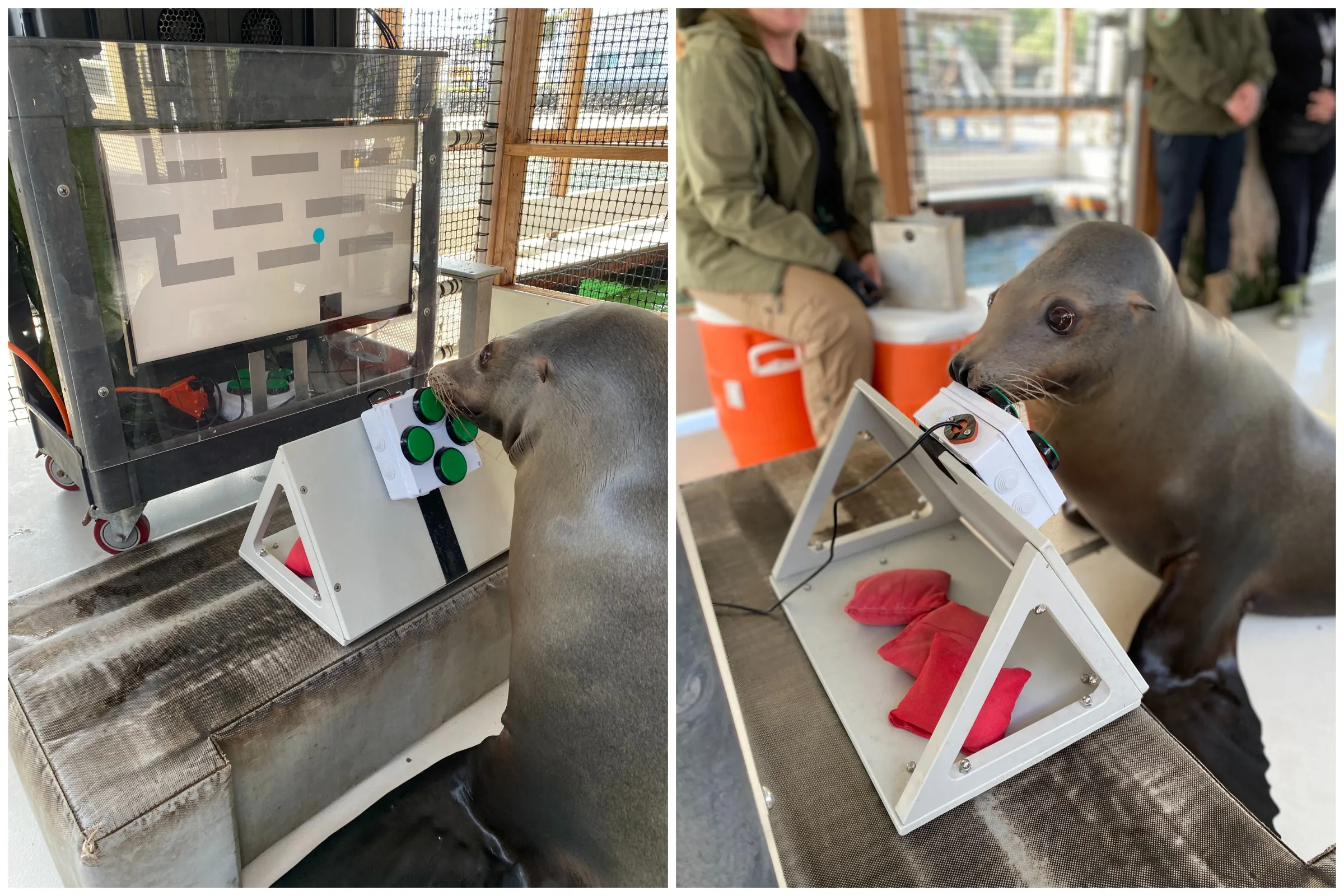
Can a sea lion navigate a virtual maze, and can a pig move a cursor precisely to a target? Modern experiments prove that animals are capable of mastering video games and demonstrating unexpected abilities. These digital games are not just entertainment, but a powerful tool for studying the intelligence of different species. The results of such research are changing our understanding of the minds of our animal counterparts and opening new horizons in science.
Scientists reveal the secrets of training marine mammals in digital games
In California, sea lions are being trained to control a cursor on a screen using four buttons, which they press with their snouts. The animal’s task is to guide the cursor through a virtual maze using up, down, left, and right commands. For successfully completing a level, the sea lion receives not a virtual bonus, but a real herring as a reward (emphasizing the contrast between virtual and real rewards).
In parallel with sea lions, dolphins also participate in the experiments. These marine mammals control a joystick by holding it in their mouths and solve complex puzzles on the screen. Dolphins and sea lions participate in searching for and retrieving objects from the water, and the game-based tasks help assess their memory and learning abilities.
Such experiments not only expand the possibilities for animal training but also allow us to understand how they memorize information, make decisions, and learn new things.
Primates master virtual worlds and demonstrate remarkable ingenuity
At the Edinburgh and Leipzig zoos, chimpanzees and orangutans are learning to search for food in a digital environment. Virtual apples, grapes, and bananas are scattered throughout the game space, and the primate’s task is to find them using landmarks such as virtual trees.
When a monkey finds a digital fruit, it receives a real counterpart as a reward (meaning a real fruit). These experiments simulate the animals’ natural behavior in the wild: searching for food while taking surrounding objects into account.
In studies by American scientists, it was found that some chimpanzees cope with virtual mazes at the level of children aged three to six years. By analyzing how primates solve such puzzles, scientists gain new data on the thinking and navigational abilities of great apes.
Simple games are developed not only for experiments
Of course, people have access to the widest range of games, and most projects have an impressive level of complexity. However, many developers intentionally make their projects simple so that as many people as possible will want to play. This strategy really works, as evidenced by the example of games in the online gambling sector.
Developers of online casino games make projects so simple that anyone can understand the rules. This fact is always emphasized by authors of gambling reviews on websites that appear at the top of search results. When we searched for the necessary data, we received additional information from the administrators of a website dedicated to funky time online game. They claim that simple gameplay in popular games is always accompanied by bright graphics and pleasant music. In this case, simplicity is a marketing strategy, as it means the game will appeal to a mass audience.
Interestingly, there are currently studies devoted to gambling behavior in animals. They show that the species most prone to risk-taking are those closest to humans, that is, primates.
Pigs and pets amaze with their gaming achievements
In the United States, four pigs learned to control a joystick to direct a cursor to a specific area of the screen. To successfully complete the task, the animals needed not only precise movement but also an understanding of the game’s goal.
Experiments involving pigs have shown that these animals are capable of mastering complex tasks requiring coordination and abstract thinking.
At home, cats become true virtual hunters. Using special apps on tablets, they catch digital mice and fish, reacting to movement on the screen. Thanks to technological advances, such games are becoming available to many pet owners, and interest in them is growing.
Scientists explain why animals need video games and what cognitive abilities are
The term “cognitive abilities” refers to the ability to perceive, remember, and process information, as well as to solve tasks and learn new things.
Research with video games helps scientists and trainers understand how animals search for objects, remember routes, and develop intellectual skills.
Military and scientific organizations use game-based tests to select and train animals for search and rescue operations.
Just as people learn through game simulators, animals also acquire new skills in the process of play, which makes learning more effective and interesting.
Comparisons and analysis of the successes of different animal species in digital experiments
Different animal species demonstrate unique abilities in mastering video games. Marine mammals quickly memorize commands and show persistence in finding solutions. Primates stand out for their ability to use landmarks and plan actions. Pigs and cats display excellent motor skills and quickly learn to respond to changing game conditions.
Training marine mammals requires complex devices and lengthy preparation, whereas pets can play with simple apps.
During the research, there have been cases when chimpanzees found their way out of a virtual maze as well as young children, and dolphins quickly mastered new game scenarios.
Technology opens new opportunities for studying animal minds
Modern gadgets and apps make experiments with animals accessible not only to scientists but also to zoo staff and ordinary pet owners.
New projects dedicated to animal gaming activity are appearing in different countries, which indicates global interest in this topic.
The development of digital technologies and methods for analyzing behavior allows researchers to delve deeper into the mysteries of animal minds and discover unexpected aspects of their intelligence.
The future of research raises new questions about the boundaries of the mind
What discoveries will further experiments with video games for animals bring? Will new technologies blur the boundaries between human and animal intelligence?
Today it is becoming clear: animals are capable of much more than is commonly believed, and their gaming achievements make society reconsider its attitude toward their abilities and role in human life.
Perhaps the most interesting discoveries about animal minds are yet to come, and it is digital games that will help make them.