
A remote town in South Australia just broke its all-time heat record — and it did it with the kind of number that makes your nervous system flinch.
Ceduna (about 780 km from Adelaide) hit 49.5°C, beating its previous record of 48.9°C.
Forecasters warned it could climb even higher as a historic heatwave smothers multiple states.
The atmospheric setup is brutally simple: leftover moisture/energy from an ex-tropical cyclone meets a stubborn high-pressure system — and Australia gets held under a giant invisible frying pan. Australia Day events were cancelled in Adelaide, and bushfire risk rose.
Earth’s thermostat isn’t “broken.” It’s just… possessed.
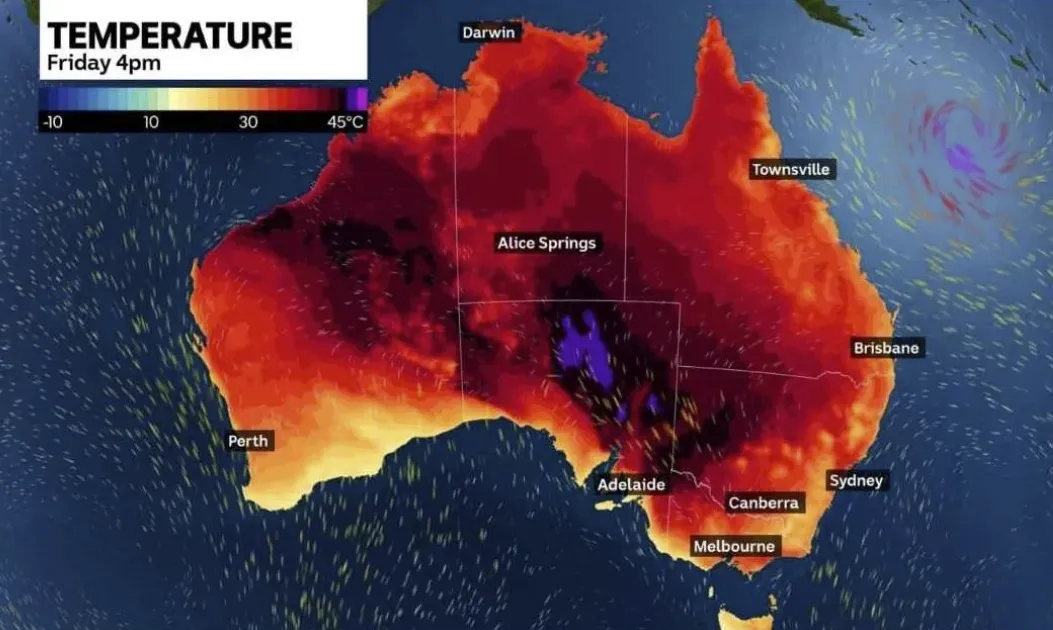
TL;DR — What Happened in Australia
- Ceduna (South Australia) hit 49.5°C, breaking its all-time record.
- A stubborn high-pressure system + tropical leftovers created prolonged extreme heat.
- Events were canceled and bushfire risk increased.
- Near-50°C heat is dangerous: heat stress can escalate fast, even for healthy people.
Why Near-50°C Heat Is So Dangerous
Temperatures near 50°C don’t just feel uncomfortable — they can overwhelm the body’s cooling systems. Your ability to regulate heat depends on sweating and evaporation. When conditions are hot enough (and especially humid enough), that mechanism stops working efficiently.
The danger isn’t only “being outside too long.” It’s also what extreme heat does to everything that keeps a society running: power demand spikes, infrastructure expands and strains, fires ignite more easily, and medical systems get hit by a wave of heat-related illness.
Heatwaves Don’t Need Chaos — They Create It
Australia doesn’t need a meteor to go into crisis mode. Sometimes all it takes is air that refuses to move. High-pressure systems can stall weather patterns, trap heat, and allow days of compounding stress.
And once the background becomes extreme, every small failure becomes a headline:
transport delays, fire warnings, blackouts, water shortages, and public events canceled because the outdoors becomes unsafe.
How to Protect Yourself During an Extreme Heatwave
Heatwaves aren’t just “hot weather” — they’re a health risk. If temperatures are pushing into the dangerous zone,treat it like a real hazard (because it is).
- Hydrate early: drink water before you feel thirsty, and keep sipping throughout the day.
- Avoid peak heat hours: stay indoors (or in shade) during the hottest part of the day.
- Cool the body fast: cool showers, wet towels, and fans can help — A/C is best when available.
- Reduce exertion: don’t exercise or do heavy work outdoors when heat stress is high.
- Check vulnerable people: older people, kids, and people with medical conditions can overheat quickly.
- Never leave anyone in a parked car: internal temperatures can spike dangerously within minutes.
- Watch for heat illness signs: dizziness, nausea, confusion, rapid pulse, headache, fainting.
- If someone stops sweating + gets confused: treat it as an emergency and call local services.
Today’s Strange Sounds Digest
Today’s edition is a full-spectrum reality check: record heat in Australia, deadly landslides, winter storm tragedies, privacy infrastructure surprises, and the atmosphere doing physics tricks in the sky like it’s showing off.
In today’s edition
- Why snow isn’t actually white: clear ice crystals scatter all wavelengths — snow is a physics flex.
- Sicily landslide: 1,000+ evacuated after storm-driven cliff collapse leaves homes perched at the edge.
- U.S. winter storm death toll climbs: at least 29 dead; over a million customers without power in 12+ states.
- ICE agents sent to Italy: “support security” at the Winter Olympics — Italians are not impressed.
- China quake: a magnitude 5.5 shakes Gansu with violent-looking footage.
- BitLocker reality check: Microsoft can provide keys under valid court orders — encryption isn’t always “you hold the keys.”
- Light pillars in Colorado: ice crystals reflect light into vertical beams — pure winter magic.
- CATL sodium batteries: stable to –40°C, cheaper than lithium, safer, long cycle life — quietly huge infrastructure tech.
- Indonesia landslide: 25 dead and 80+ missing in West Java — grief, not “weird.”
- Ancient spear in India: 2.4-meter iron spear dated to ~3345 BC — serious Iron Age energy.
- Kelvin–Helmholtz clouds: rare wave-like formations spotted in New York.
- Moderna pulls back trial investment: vaccine politics colliding with science pipelines.
- Geomagnetic storm watch (G1): coronal hole solar wind could spark minor storms Jan 28.
Frequently Asked Questions About Extreme Heatwaves
- How hot is 49.5°C in Fahrenheit?
- 49.5°C is about 121°F — extreme heat capable of causing dangerous heat stress quickly.
- Why do heatwaves break records now?
- Heat records can be influenced by both short-term weather patterns (high pressure, dry air, wind) and long-term warming trends that raise the baseline.
- What makes bushfire risk increase during heatwaves?
- Hot air dries vegetation and lowers moisture levels. Combined with wind and sparks, fire spread becomes much more likely and much harder to control.
- Is extreme heat more dangerous than extreme cold?
- Both can be deadly. Heat can be especially dangerous because it quietly escalates inside the body, and because it stresses power grids, health systems, and fire conditions at the same time.
- What’s the safest advice during record heat?
- Limit outdoor exposure, hydrate early, avoid physical exertion at peak heat, check on vulnerable people, and treat heat warnings as serious — not “optional.”
Read the Full Edition on Substack
This article is a preview of today’s Strange Sounds newsletter. The full edition includes all stories, links, and the daily dose of “why is the planet like this?”
👉 Read the complete edition here:
One hemisphere is freezing. The other is cooking. The Earth is speedrunning chaos again…
❤️ Support Strange Sounds
If you value independent reporting on strange phenomena and quiet signals, you can support the archive via PayPal or Donorbox.
📰 Subscribe for daily chaos
Get the Strange Sounds newsletter — a curated digest of natural disasters, weird science, and the planet quietly updating itself.
👉 Subscribe on Substack