But it is not engineered for hard freezes. When arctic air pushed deep into the Sunshine State, the results were immediate: record lows, stressed power infrastructure, and the most Florida headline imaginable — iguanas falling out of trees.It looks funny until you realize what it means: if it’s cold enough to shut down reptiles in the canopy, it’s cold enough to endanger people without heat, burst pipes, and turn “normal” winter routines into a grid-level stress test.
TL;DR — What Happened in Florida?
- Arctic air surged into Florida and broke 15+ record-low temperatures.
- Multiple cities dropped into the 20s°F (dangerous for a state built for humidity, not frost).
- Power demand spiked as residents turned on heat, stressing the electrical grid.
- Thousands lost power at peak outage levels.
- Iguanas became accidental meteorology mascots because cold can shut them down mid-perch.
Why This Cold Snap Hit Florida
The basic setup behind most Florida freezes is the same: a strong dome of cold, dense air builds over North America, then an atmospheric pattern allows it to spill south. Think of it as a cold-air “dam break” — once the steering currents align, the air mass slides downhill and southward, sometimes all the way into the subtropics.
Cold air is heavy. It hugs the surface and pours into low-lying areas like an invisible liquid.
If winds are light overnight, temperatures can drop even faster. That’s why freezes can feel surprisingly harsh even without dramatic snow: the air is simply the wrong kind of cold for a place built around warmth.
Florida Record Lows: The “Sunshine State” Meets Winter
According to FoxNews, this wasn’t a cute hoodie moment. It was a genuine freeze across large parts of the state. Highlights from the “Sunshine State” experience:
- Melbourne: 25°F
- Tampa: 28°F (coldest since 2010)
- Miami + Fort Lauderdale: 35°F
- Orlando: 25°F
- Daytona Beach: 23°F
- Jacksonville: 7 straight mornings below freezing
When cold reaches this deep into Florida, it’s not just uncomfortable — it’s disruptive.
Homes, pipes, infrastructure, and even vegetation are simply not designed to handle repeated freezes.
Cold-Stunned Iguanas: When Do They Start Falling, and Why?
Iguanas are ectothermic (cold-blooded). They don’t generate internal heat the way mammals do. Their body temperature — and therefore their ability to move — depends on the surrounding air.
When temperatures drop into the 40s°F (around 4–10°C), many iguanas become sluggish. When it dips closer to the mid-to-low 30s°F (near freezing), they can become cold-stunned — basically immobilized.
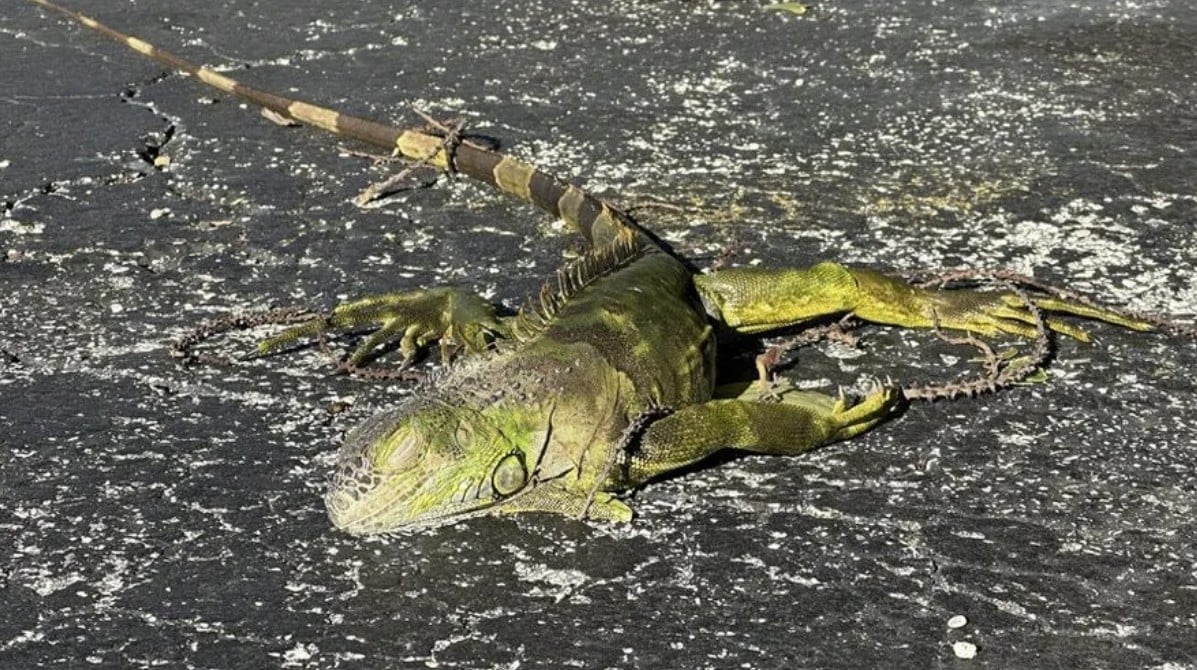
And here’s the part that turns into a viral headline: iguanas often sleep or rest in trees. Once they go stiff from cold, their grip weakens. They don’t “jump” out. They don’t “attack” anyone. They simply lose motor control and fall.
Are the iguanas dead?
Not necessarily. Cold-stunned iguanas can look dead because they’re immobile and unresponsive. But in many cases, once the air warms up, they can “wake up” and regain movement. That said, prolonged exposure to near-freezing temperatures can be fatal — especially if the cold lasts through multiple nights.
What should people do if they find one?
- Do not assume it’s dead. It may revive when warmed.
- Do not bring it into your home unless you know what you’re doing (they can bite/scratch when they revive).
- Keep pets away. A “sleeping” iguana can become a chaotic animal once it warms up.
- If needed, contact local animal control or wildlife services for guidance.
The iguana phenomenon is the meme version of a serious point: Florida’s ecosystem (and Florida’s infrastructure) is tuned for heat — not recurring hard freezes.
The Grid Stress Problem: Cold Weather = High Demand
Cold outbreaks don’t just break temperature records — they stress infrastructure. When everyone turns on heating at the same time, demand spikes quickly. Power systems can struggle when load rises fast, equipment is stressed by cold, or localized failures cascade.
At one point, around 20,000 customers reportedly remained without power. Numbers can change quickly, but the pattern is consistent: extreme weather finds the weak links.
Florida’s New Normal: Weather Volatility
Florida is no stranger to hurricanes, heat, and flooding. But deep freezes that reach this far south are a reminder that the atmosphere can swing hard in both directions. Not every cold snap “proves” a trend by itself — but the bigger picture is that weather volatility is increasingly the baseline.
❄️ Quick Freeze Checklist: Protect Pipes + Pets
- Protect pipes: drip faucets overnight, open cabinet doors under sinks, and wrap exposed outdoor pipes.
- Know your shutoff: locate the main water valve before something bursts at 3 a.m.
- Keep pets inside: if it’s too cold for you, it’s too cold for them — especially overnight.
- Outdoor animals: provide windproof shelter + fresh (unfrozen) water + extra bedding.
- Avoid unsafe heating: never run grills or generators indoors (carbon monoxide is invisible and fast).
- Prep for outages: charge power banks, keep flashlights ready, and have blankets + warm layers available.
🦎 Florida iguana safety note: If you find an iguana on the ground during a freeze, don’t assume it’s dead. Cold-stunned iguanas can “wake up” once temperatures rise.
Keep dogs away and don’t grab it unless you know exactly what you’re doing.
Today’s Strange Sounds Digest (February 3, 2026)
Today’s edition is a perfect StrangeSounds cocktail:
Florida freezing, volcanoes throwing ash, the UK rolling out a laser weapon,
ancient sharks quietly flexing on humanity, and a French ER calling bomb disposal…
because somebody introduced a WWI artillery shell into the wrong internal storage compartment.
In today’s edition
- Pakistan: a major crackdown after coordinated attacks in Balochistan, with officials claiming 177 insurgents killed.
- Guatemala: Volcán de Fuego erupts with ash plumes reaching 14,000–16,000 feet.
- Glaciers: evidence suggests glacier retreat may have been globally synchronized during the last ice age.
- South Africa: lightning kills two people who sought shelter under a tree (still the worst choice).
- Neuroscience: scientists study how “aha!” insight moments form and why they stick.
- UK DragonFire: a directed-energy mega-laser weapon is real and expected around 2027.
- SpaceX + xAI: “orbiting data centers” vibes intensify.
- Greenland shark: deep-sea footage reinforces the idea these animals may live for centuries.
- Credit Suisse: hundreds of Nazi-linked accounts reportedly discovered.
- Sunspot AR4366: described as a solar flare factory with multiple M-class and X-class flares.
- France ER: WWI artillery shell lodged internally → bomb squad called → perimeter set → headline achieved.
- Taklamakan Desert: snow falls in the “Sea of Death” for the fifth consecutive year.
Frequently Asked Questions (Florida Freeze + Cold-Stunned Iguanas)
- Why did Florida get so cold?
- A strong outbreak of arctic air pushed unusually far south. Cold air is dense and spreads along the surface,
and when the atmospheric pattern allows it, it can surge into subtropical regions like Florida. - When do iguanas start falling from trees?
- Many become sluggish in the 40s°F, and can become cold-stunned near the mid-30s°F (near freezing). When they stiffen,
they may lose grip strength while perched and fall. - Are cold-stunned iguanas dead or do they wake up?
- Often they are not dead — they can revive once temperatures rise. However, prolonged near-freezing conditions can be fatal,
especially if cold persists across multiple nights. - Why do iguanas fall out of trees?
- Because they are cold-blooded. Cold reduces muscle function and coordination. When their bodies stiffen,
they can’t hold on. - What should I do if I find one?
- Don’t assume it’s dead, keep pets away, and avoid handling it. If it warms up, it can suddenly move and defend itself.
Contact local animal services if it’s in a dangerous location.
Read the Full Edition on Substack
This blog post is an excerpt from today’s Strange Sounds newsletter.
The full edition includes the complete roundup, extra links, and the daily dose of:
“why is reality doing this?”
👉 Read the complete edition here:
🛰️ Strange Sounds is reader-supported.
If you value independent reporting on weird phenomena, extreme weather, and quiet signals, you can support the archive via PayPal or Donorbox.
📰 Subscribe for daily chaos
Get the Strange Sounds newsletter — a curated digest of natural disasters, strange science, and the planet updating itself in real time.
👉 Subscribe on Substack