
Earth is “missing” huge amounts of its lighter elements — hydrogen, carbon, nitrogen, sulfur, helium — compared with the Sun and primitive meteorites. Not a little missing. In some cases, up to 99% missing.
Now a new idea is gaining traction: the elements might not be gone at all. They may be locked inside Earth’s solid inner core, trapped by iron behaving in a bizarre high-pressure state called an electride.
At the same time, a comet just flashed brighter in a suspected cryovolcanic eruption,
and scientists found evidence of a massive underground lava tube beneath Venus.
The Solar System isn’t a museum. It’s an active construction site…
TL;DR — What’s Going On Here?
- Earth appears depleted in light elements (H, C, N, S, noble gases) compared with the Sun/meteorites.
- New work suggests the solid inner core may trap these elements because iron becomes an electride at extreme pressure.
- Comet 29P abruptly brightened by 5+ magnitudes — consistent with a major cryovolcanic outburst.
- Venus may contain a giant empty lava tube (~1 km wide), a potential natural shelter from surface extremes.
- Meanwhile on Earth: cyclones, sinkholes, and a big fireball remind us the planet is “stable” only by agreement.
Earth’s “Missing” Light Elements: A Century-Old Mystery
For decades, geoscientists have noticed something weird when they compare Earth’s composition with the Sun and with primitive, relatively unprocessed meteorites: Earth is strongly depleted in lighter elements.
Some of that is understandable. Early Earth was hot, chaotic, and violent — a place where volatiles could be lost through heating, impacts, and incomplete retention during planet formation. But the scale of the missing fraction has always suggested there’s more going on than just “it boiled off.”
The big suspects include:
- Hydrogen (H)
- Carbon (C)
- Nitrogen (N)
- Sulfur (S)
- Noble gases like helium (He)
And here’s the twist: some researchers now argue that Earth didn’t lose all of these elements. It may have stored them — deep, deep down.
The Inner Core as a Planetary Storage Vault
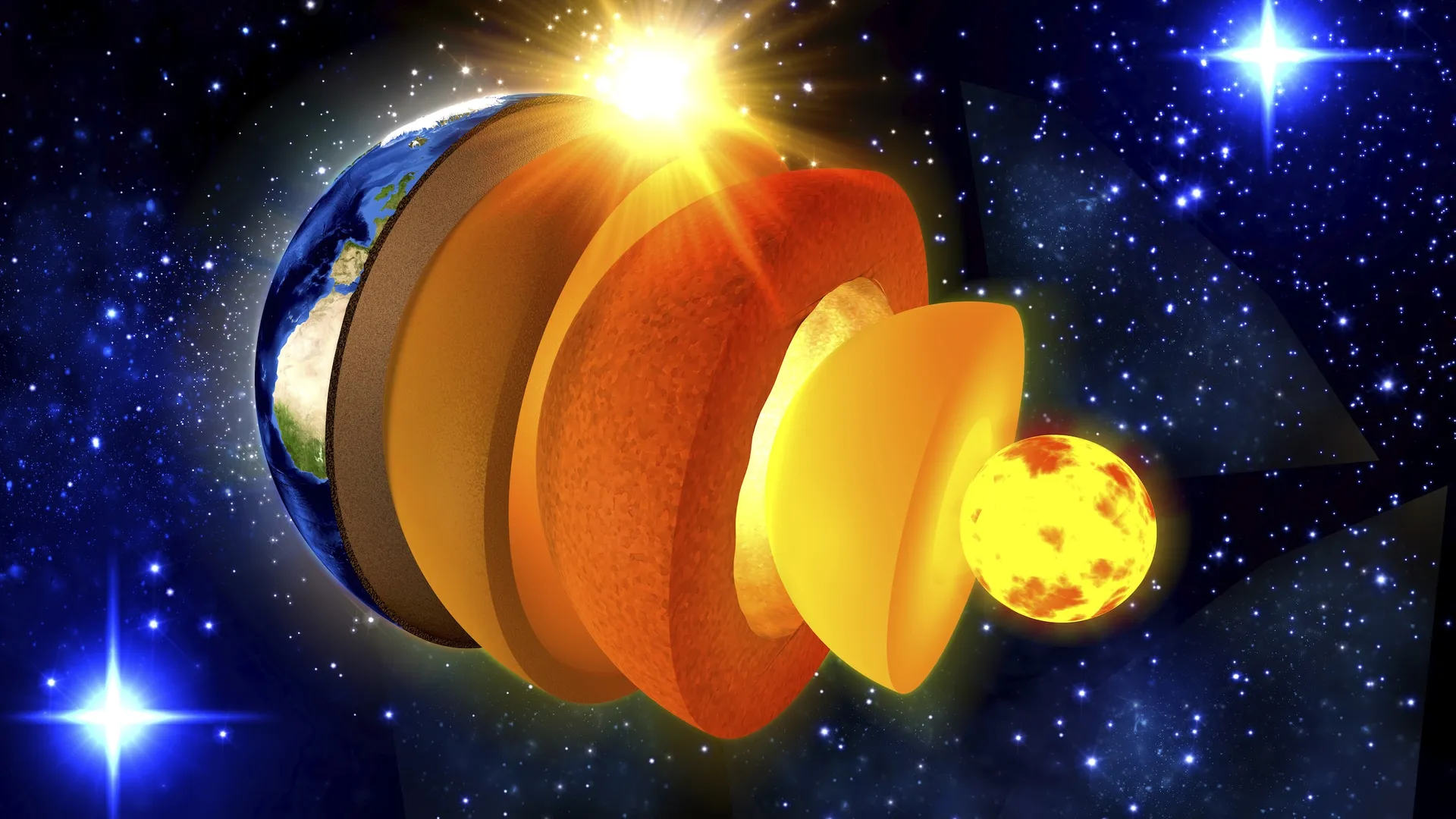
Earth’s inner core is solid iron alloy under impossible conditions. We’re talking about pressures around 360 gigapascals — roughly 3.6 million times atmospheric pressure.
Under those pressures, iron can behave in a strange state called an electride. In an electride, some electrons are not attached to specific atoms. They occupy “pockets” in the crystal structure and act like a kind of anion.
Why does that matter? Because this electron-rich structure can attract and hold light elements that don’t normally “fit” as easily into iron at lower pressures.
In plain English: the inner core might be acting like a planet-scale absorber — trapping the missing elements inside iron’s high-pressure structure.
What Would This Change?
If this mechanism holds up, it could reshape how we think about:
- Earth’s true volatile inventory (what we started with vs. what we lost)
- Core formation chemistry (what gets partitioned into metal under extreme conditions)
- Deep Earth evolution over billions of years
- Why Earth’s atmosphere and mantle ended up with the balance they have today
It doesn’t mean the inner core is a neat “vault” with a label on it. It means Earth may be hiding the evidence inside the only place we can’t sample.
Source:
Live Science — Earth is “missing” lighter elements. They may be hiding in its solid inner core
Comet 29P Just Erupted — Cryovolcano Style
The British Astronomical Association reported a major outburst from Comet 29P/Schwassmann-Wachmann. The comet brightened by more than 5 magnitudes, which is a huge jump — consistent with a major eruption.
Comet 29P is unusual because it appears to erupt frequently. The proposed mechanism is basically ice volcanism: instead of molten rock, the “magma” may be cold liquid hydrocarbons (methane/ethane/propane) with dissolved CO2, explosively venting into space.
In other words: a comet with cold volcanoes that behave like pressure-release events.
It’s geology, but cryogenic.
Comet 29P is currently in Leo and within reach of mid-sized backyard telescopes (around magnitude 12).
Venus Has a Hidden Underground Tunnel
Researchers reanalyzing NASA Magellan radar data reported evidence for an
empty lava tube beneath Venus — potentially gigantic:
- ~1 km wide
- Roof thickness at least ~150 m
- Empty space at least ~375 m tall
- Extending at least ~300 m below the surface
Venus’s lower gravity and dense atmosphere may allow larger, more stable lava tubes than Earth. These structures matter because they could offer natural shielding from radiation and surface extremes — the kind of shelter that becomes relevant if we ever try to explore hostile worlds more directly.
Source:
Nature Communications — Evidence for an empty lava tube beneath Venus (2026)
Today’s Strange Sounds Digest
Today’s edition is the Solar System doing what it does best: hiding, erupting, collapsing, and casually reminding you that “stable” is a temporary setting.
In today’s edition
- Cyclone Gezani: devastating Madagascar with 195 km/h winds and at least 31 deaths.
- Shanghai sinkhole: a massive road collapse that makes “infrastructure” feel like a rumor.
- Fireball over China: a bright bolide lighting up multiple provinces.
- Tristan da Cunha: the island community evacuated by volcano, then voted 148–5 to return home.
- Caterpillar snake mimic: the sphinx moth caterpillar running psychological warfare via evolution.
Frequently Asked Questions
- What are Earth’s “missing” light elements?
- They’re volatile or lighter elements (like hydrogen, carbon, nitrogen, sulfur, and noble gases) that are far less abundant on Earth than expected when compared with the Sun and primitive meteorites.
- What is an “electride” and why does it matter?
- An electride is a rare state of matter where electrons occupy pockets in a crystal structure and behave like anions. Under inner-core pressures, iron may become electride-like, which could help it absorb and trap light elements.
- Does this mean Earth’s core contains the missing elements for sure?
- Not proven — it’s a proposed mechanism supported by experiments and modeling under extreme conditions. It’s one of the most plausible explanations for where some “missing” volatiles could be stored.
- What is a cryovolcanic eruption on a comet?
- It’s an outburst driven by volatile ices and cryogenic liquids rather than molten rock — releasing gas and dust into space. Comet 29P appears to erupt repeatedly, possibly due to “ice volcano” activity.
- Why are lava tubes on Venus important?
- Lava tubes can form giant stable underground cavities. On Venus, they may be larger than Earth’s and could provide natural shielding from surface extremes, making them relevant for future exploration concepts.
Read the Full Edition on Substack
This article is an excerpt from today’s Strange Sounds newsletter. The full edition includes the complete roundup, extra links, and daily “reality check” fuel.
👉 Read the full edition:
Earth’s core is hiding missing matter. Venus has underground tunnels. And something just erupted on a comet.
📰 Subscribe for daily chaos
Get the Strange Sounds newsletter — a curated digest of strange phenomena, natural disasters, and the planet quietly updating itself.
👉 Subscribe on Substack