
Minor storm. Major glitch. Civilization held together by GPS and vibes.
A new study published in the journal Space Weather describes a surprising “super plasma bubble” that formed in Earth’s upper atmosphere during a minor geomagnetic storm.
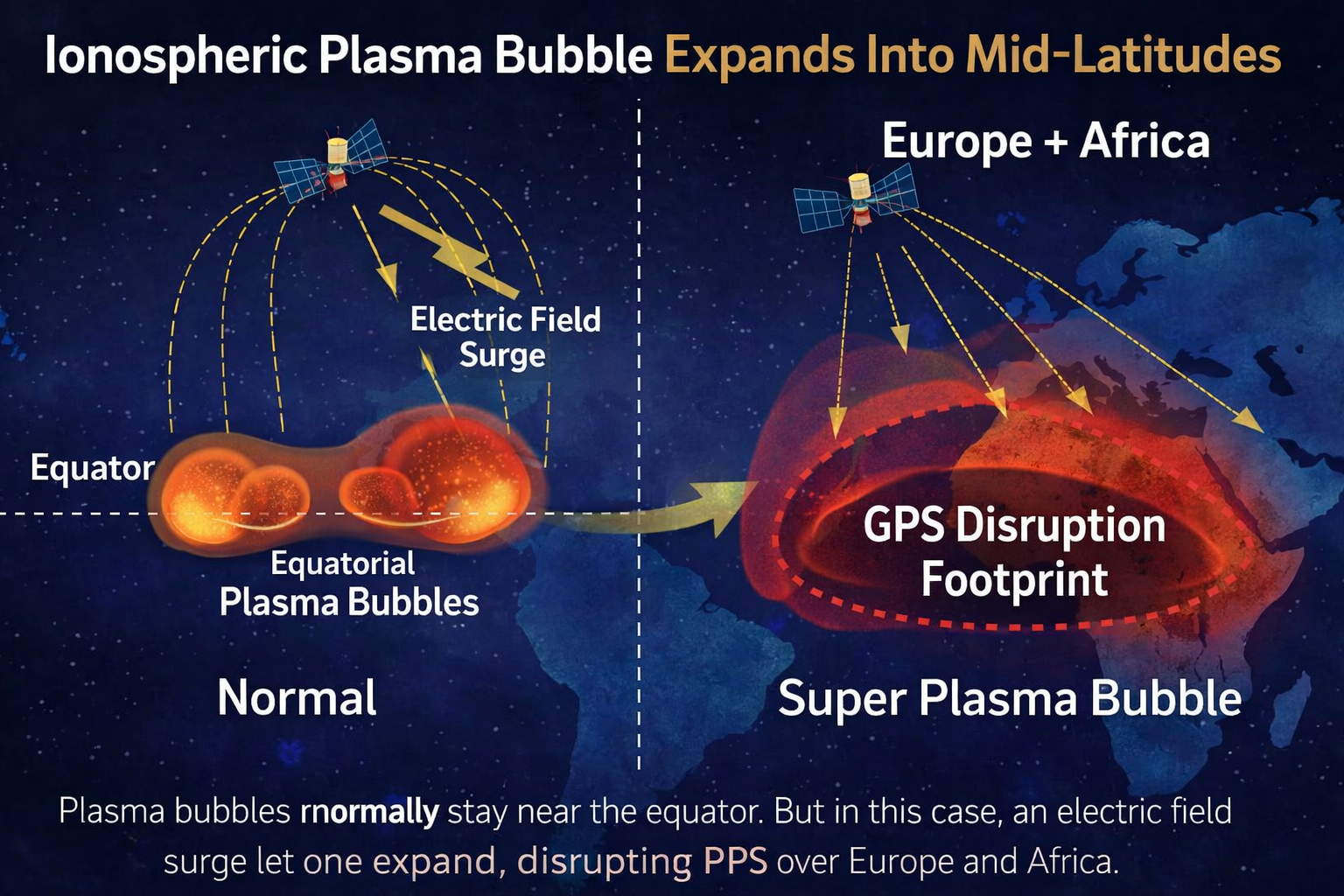
Normally, these plasma bubbles stay close to the equator. This one didn’t. Instead, a sudden surge of electric fields lifted the ionosphere, the bubble grew, spread — and GPS across parts of Europe and Africa took a hit.
Translation: sometimes a “small” space weather event can still punch your technology in the face. Minor storms, major consequences. Just like humans.
TL;DR — What Happened (and Why It Matters)
- A “super plasma bubble” formed during a minor geomagnetic storm.
- Plasma bubbles usually stay near the equator — this one expanded far beyond normal, as reported in this AGU scientific publication.
- The result: widespread GPS disruption across parts of Europe and Africa.
- Small storms can still create big tech problems — especially for navigation and timing systems.
What Is a Plasma Bubble?
In the simplest terms, a plasma bubble is a region of the ionosphere where charged particles become unstable and uneven. GPS signals passing through that region can get delayed, scattered, or distorted.
Your phone still thinks it’s fine. Your airplane still thinks it’s on route. But the invisible math holding the modern world together gets fuzzier.
Why Plasma Bubbles Usually Stay Near the Equator
Most ionospheric plasma bubbles form after sunset in the equatorial ionosphere, where Earth’s magnetic field geometry and daily atmospheric dynamics create the perfect recipe for instability.
The equator is “special” because the magnetic field lines there are shaped in a way that allows disturbed plasma to rise and spread along magnetic field lines more efficiently.
Once the ionosphere becomes unstable, it can develop large low-density regions — the “bubbles” — that drift and expand through the upper atmosphere.
In simple terms: the equatorial region is where the ionosphere most easily enters a “slippery mode” after sunset. That’s why equatorial countries (and flight routes crossing lower latitudes) are usually the main hotspot for GPS scintillation events.
So Why Was This One So Weird?
What makes a “super plasma bubble” surprising is not that bubbles exist — it’s that this one grew and spread far beyond where they normally stay.
The reported trigger was a surge of electric fields strong enough to lift the ionosphere and expand the disturbed region. When the ionosphere is lifted to higher altitudes, plasma structures can grow larger, persist longer, and affect wider areas.
Translation: a storm that looks “minor” on paper can still create the exact conditions needed to break the GPS layer of reality.
Is It Dangerous for Humans?
The good news: plasma bubbles are not directly dangerous to human health.
They don’t “zap” people on the ground, and you won’t feel anything physically.
The risk is technological, not biological. Plasma bubbles can cause GPS scintillation — rapid signal fading and errors — which can disrupt:
- navigation accuracy (phones, cars, ships)
- aviation tracking systems and ADS-B position reliability
- precision timing used by networks and infrastructure
- surveying and precision agriculture
Most critical systems have backups and cross-checks. But the more society depends on satellite timing and positioning, the more these “invisible” events matter.
How to Protect Yourself (Practical, Not Paranoid)
You don’t need a bunker for plasma bubbles. You just need to remember one simple truth:
GPS is a service, not a law of physics.
Quick Protection Checklist
- If you’re driving: don’t blindly trust your GPS lane-level precision. Use road signs and common sense.
- If you fly (pilot or passenger): aviation has layers of redundancy, but space weather can increase system noise.
- For hikers / outdoors: carry an offline map or compass backup in remote areas.
- For emergencies: keep basic offline navigation + communication options (paper map, radio, local contacts).
- For businesses: know whether critical operations depend on GPS timing and whether backups exist.
The actual danger isn’t “space radiation.” It’s the moment you realize modern life depends on signals crossing a disturbed atmosphere… and the atmosphere doesn’t care about your schedule.
Why GPS “Errors” Can Look Like Teleportation
When ionospheric disturbances disrupt satellite navigation, the system can produce position errors. On screens that rely on those signals, vehicles can appear to “jump” — even if they’re actually moving normally in the real world.
Most of the time, aviation, shipping, and infrastructure have layers of backup. But when the space environment gets noisy, the margin for error shrinks.
Minor Storms, Major Consequences
The unsettling lesson is that you don’t always need a once-in-a-century solar event to cause real disruption. Sometimes a relatively modest geomagnetic storm can trigger the exact combination of conditions that breaks things anyway.
The Sun doesn’t care that your civilization is running on satellite timing. It never signed the uptime agreement.
Today’s Strange Sounds Digest
Today’s edition is space-weather tech fragility, absurd human behavior, and real-world disaster — with a side of AI agents building their own internet and a CIA manual that reads like modern life.
In today’s edition
- Moscow’s snowiest January in 203 years: record snowfall, delays, traffic jams, winter as a political system.
- Baby buzzards with gimbal-neck physics: stabilization so clean it feels illegal.
- Turn off phone biometrics: passcodes can have stronger legal protections than fingerprints/Face ID.
- America’s obesity map: health patterns that look like weather systems across geography.
- HOA bans generator during blackout: bureaucracy as a survival hazard.
- CIA “Simple Sabotage” manual: petty inefficiency as strategy — modern life already implemented it.
- Human population miscount: maybe we’re not overcounted by conspiracy — just undercounted by math.
- Truck driver drags a utility pole: denial as a driving style.
- AI agents built their own Reddit: bots posting, upvoting, forming communities… Dead Internet as onboarding.
- 80-year-old completes an Ironman: the human body as both miracle and threat.
- Tesla robotaxis crash more often than humans: the robot future is currently a fender-bender generator.
- Giant snails eating green beans (elite audio): oddly calming in a cursed world.
- Free potatoes in Germany: surplus food + distribution failure = free spuds.
- Paris fertility grave (Victor Noir): yes, people rub the statue. Paris stays Paris.
- US flirting with population decline: demographics reshaping the engine.
- Mud volcano erupts in Azerbaijan: geology doing performance art for 13 minutes.
- DR Congo mine landslide kills 200+: heavy rains, unstable ground, desperate labor — real loss, no sarcasm.
Frequently Asked Questions About Plasma Bubbles and GPS Disruptions
- What is a plasma bubble in the ionosphere?
- A plasma bubble is an instability in the ionosphere where charged particles become uneven, creating regions that can distort radio and GPS signals.
- Can a minor geomagnetic storm really disrupt GPS?
- Yes. Even minor storms can trigger strong electric fields and localized ionospheric disturbances that degrade GPS accuracy and reliability.
- What kinds of systems are affected by GPS issues?
- Navigation and timing services can be impacted, including aviation tracking, shipping, smartphones, precision agriculture, finance timing signals, and infrastructure synchronization.
- Why do objects appear to “jump” on tracking screens?
- If the GPS-derived location is wrong, tracking systems can display position errors that look like sudden jumps — even though the object is moving normally.
- Why are plasma bubbles more common near the equator?
- Because equatorial ionospheric dynamics after sunset make the plasma more unstable, and magnetic field geometry helps disturbances grow and spread along field lines.
- Can plasma bubbles hurt people directly?
- No. Plasma bubbles aren’t a direct health hazard. The risk is indirect: GPS and radio signal disruption that can affect navigation, tracking, and timing systems.
Read the Full Edition on Substack
This article is a preview of today’s Strange Sounds newsletter. The full edition includes all stories, extra links, and the daily chaos menu.
👉 Read the complete edition here:
Minor storm. Major glitch. Civilization held together by GPS and vibes…
❤️ Support Strange Sounds
If you value independent reporting on strange phenomena and quiet signals, you can support the archive via PayPal or Donorbox.
📰 Subscribe for daily chaos
Get the Strange Sounds newsletter — a curated digest of weird science, disasters, and reality glitches.
👉 Subscribe on Substack