
Some technological shifts arrive loudly. Others slip into existence quietly — and only later do we realize the rules changed.
One of those shifts is now complete: humans have rebuilt an entire eukaryotic genome from scratch.
Not edited. Not patched. Rewritten.
The organism is baker’s yeast, Saccharomyces cerevisiae. The project is called Yeast 2.0 (Sc2.0). And it represents the first time a complex, nucleus-bearing organism has had its entire genome designed, synthesized, and assembled by humans.
This wasn’t a lab trick. It was a 15-year international effort, completed in 2023, involving thousands of design decisions across all 16 chromosomes.
TL;DR — What Just Happened
- Scientists rebuilt the entire yeast genome from scratch (Sc2.0).
- This is the first fully synthetic eukaryotic genome.
- The genome was redesigned to be modular, streamlined, and programmable.
- Biology has crossed from “studied” to “compiled.”
What Are We Actually Looking At?
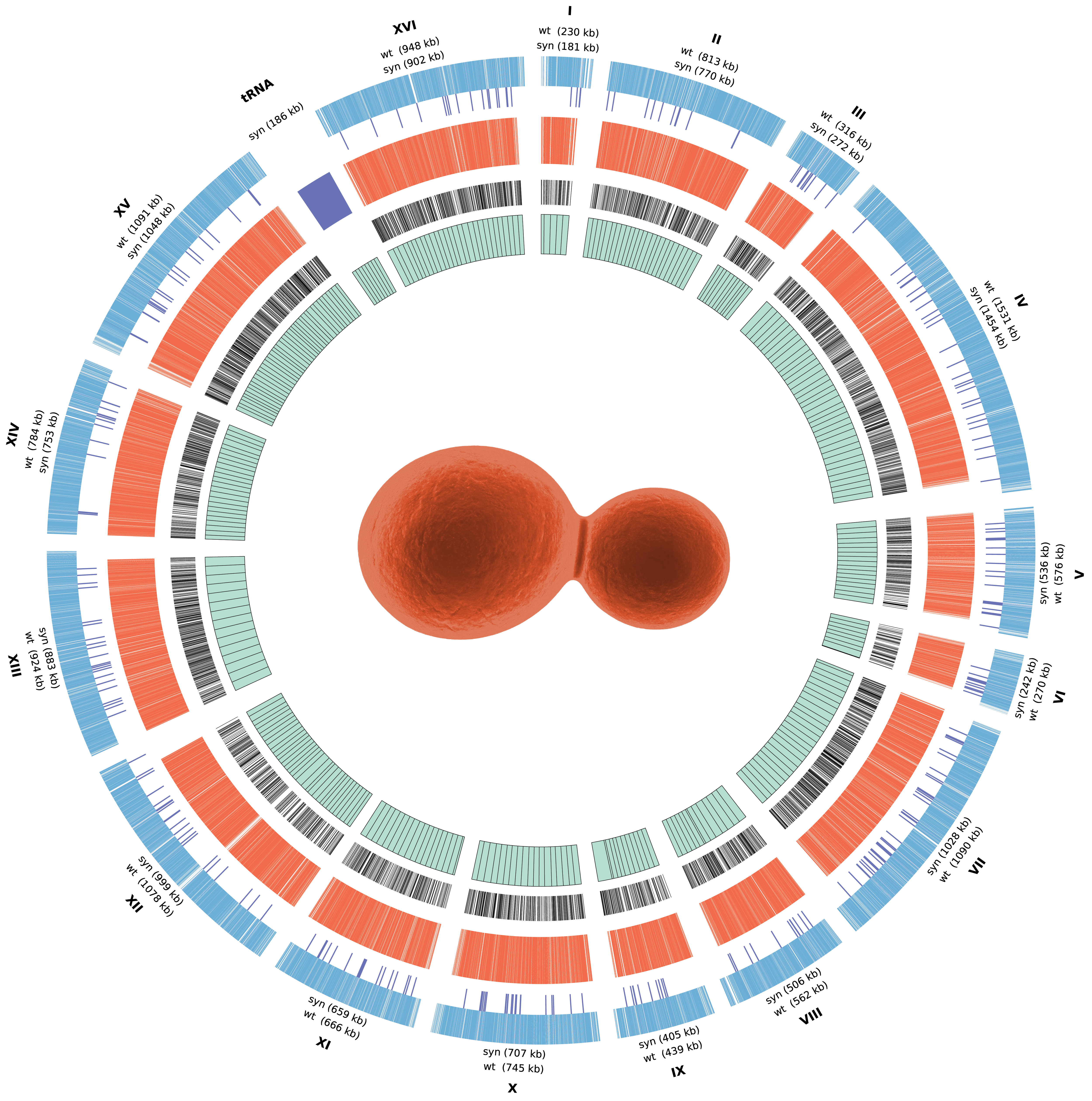
Each ring represents a different layer of biological information — from natural DNA to synthetic redesign and programmable recombination sites.
The circular genome map used in many presentations (including PhD introductions)
shows all 16 yeast chromosomes arranged like a wheel.
Each ring represents a different layer of biological information.
- Outer ring (natural genome): ~12 million base pairs and ~6,000 genes.
- tRNA ring: transfer RNA genes — the adapters that turn code into proteins.
- Synthetic genome ring: ~8% smaller, with redundant and unstable regions removed.
- LoxPsym markers: nearly 4,000 “cut here” sites enabling genome reshuffling.
- Megachunks: ~50 kb LEGO-like blocks used to assemble chromosomes.
The SCRaMbLE System: Accelerated Evolution on Demand
One of the most radical additions is SCRaMbLE (Synthetic Chromosome Rearrangement and Modification by LoxP-mediated Evolution).
It allows researchers to trigger massive genome rearrangements — producing millions of viable variants in hours. Evolution that would normally take millennia can now be explored in an afternoon.
The implications are enormous: biofuels, pharmaceuticals, industrial enzymes, and — more quietly — a deeper understanding of what makes a genome functional at all.
Why This Is a Line in the Sand
Until now, biology was something we discovered. Tweaked. Nudged.
Sc2.0 marks the moment biology became architected. A living system that still behaves like yeast — but is now modular, editable, and future-proofed.
The simulation didn’t start today. But it’s clearly running without a supervisor.
Today’s Strange Sounds Digest
Today’s newsletter moves fast — from synthetic life to planetary instability:
- A potentially catastrophic storm targeting the US South.
- Greenlanders trolling US fentanyl panic narratives.
- 400+ millionaires asking to be taxed more.
- Poker bot farms colluding against humans.
- A massive new Chinese embassy approved in London.
- Auroras refusing to stop after a major CME.
- China and Russia dominating global nuclear expansion.
- 7-story waves at Nazaré and a 101-foot surf record.
- Advanced tool use documented in cows (yes, really).
- Turning off mobile internet improves mental health in 14 days.
Frequently Asked Questions
- What is Yeast 2.0 (Sc2.0)?
- It’s the first fully synthetic eukaryotic genome, rebuilt chromosome by chromosome by humans.
- Is this genetic modification?
- No. It’s full genome redesign and synthesis, not editing an existing genome.
- Why use yeast?
- Yeast is simple, robust, and already essential to biotechnology — making it the ideal test case.
- Is this dangerous?
- The organism behaves like normal yeast, but the broader implications raise ethical and governance questions.
Read the Full Edition on Substack
This article is an introduction to today’s Strange Sounds newsletter.
The full edition includes links, visuals, and the complete anomaly feed.
👉 Read the full newsletter here:
The Simulation Is Running Unsupervised…
🧬 Support Strange Sounds
Independent reporting on weird science, quiet signals, and system drift: PayPal · Donorbox
📰 Subscribe for daily chaos