
The storm is over… which means the next one is already loading. After three straight days of geomagnetic chaos (Jan. 19–21), Earth’s magnetic field has finally calmed down. But before it did, something broke the usual rules of auroras.
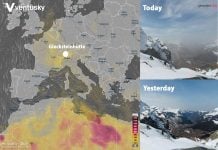
Observers reported an aurora-like band inside the South Atlantic Anomaly — a region where auroras are typically weak, diffuse, or suppressed because the magnetic field is disorganized.
Either this was a rare aurora in the wrong place… or it was something similar that still shouldn’t be common there.
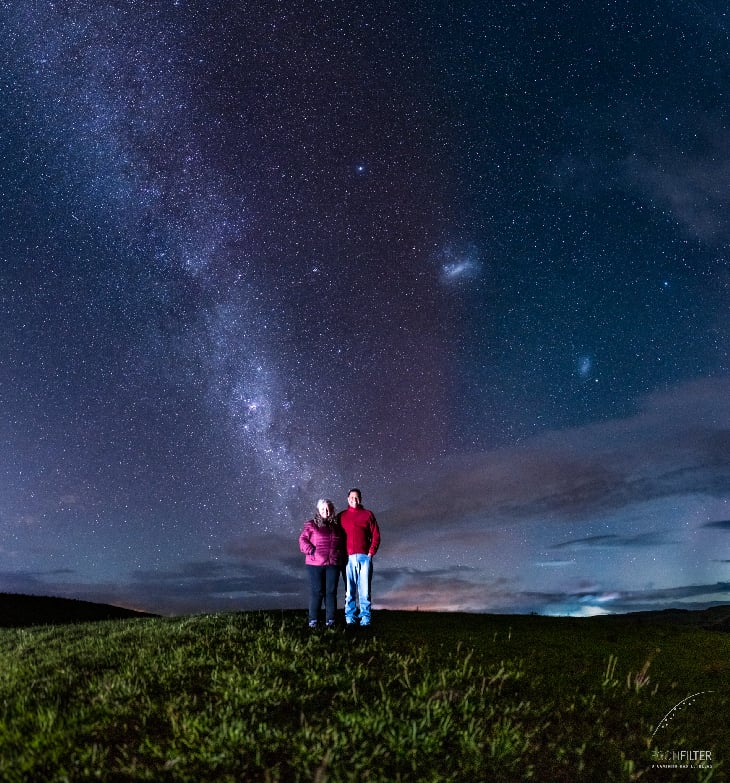
The report came during major storm conditions (planetary K-index ~7.6 at the time), inside a zone where auroral activity is usually muted.
TL;DR — Why This Was Weird
- Jan. 19–21 brought one of Solar Cycle 25’s biggest geomagnetic events (G4 for ~15 hours; G3 for 18+ hours).
- Auroras were seen across Europe and at least 40 U.S. states.
- Observers also reported an aurora-like band inside the South Atlantic Anomaly over southern Brazil.
- Auroras are usually suppressed inside the Anomaly; one explanation is that this was a SAR arc.
- Either way: something happened where something usually doesn’t — and that’s worth watching.
The Storm That Lit Up Half a Planet
From January 19th to 21st, storm levels reached Severe (G4) for roughly 15 hours and
Strong (G3) for more than 18 hours. Auroras spilled far outside their normal polar zones, turning up in unlikely places across Europe and North America.
This kind of event is exactly why space weather forecasters keep repeating the same warning: the Sun doesn’t care about your schedule, your satellites, your power grid, or your aviation systems.
What Is the South Atlantic Anomaly?
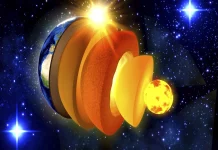
The South Atlantic Anomaly (SAA) is a weak spot in Earth’s magnetic field centered over Brazil and the South Atlantic. In this region, the planet’s protective magnetic shield is thinner than elsewhere, allowing energetic particles from the inner Van Allen radiation belt to dip unusually close to Earth.
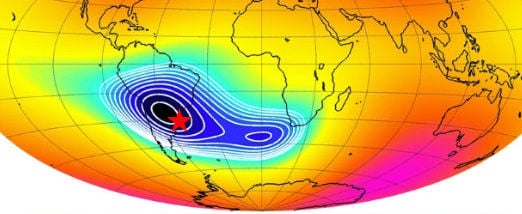
The SAA is also notorious for satellite glitches and radiation exposure — it’s a real-world “thin shield” zone in low Earth orbit.
For more information about the South Atlantic Anomaly, visit the pillar article Magnetic Anomalies and Pole Shift Explained.
Why Auroras Are Usually Weak in the Anomaly
Intuition says auroras should be stronger inside the South Atlantic Anomaly because the magnetic shield is weaker. Counterintuitively, multiple studies show auroral displays are often relatively weak there.
One leading idea: the Anomaly’s magnetic field lines are weaker and more disorganized, so they do a poor job focusing and accelerating incoming charged particles. Instead of forming bright, narrow curtains, the energy spreads out and produces only faint, diffuse glow.
Was It an Aurora… or an SAR Arc?
The lights reported over southern Brazil may have been classic aurora — or they may have been a different storm-time phenomenon: an SAR arc (Stable Auroral Red arc).
SAR arcs are broad, typically red bands that appear during some geomagnetic storms when Earth’s ring current system leaks heat energy into the upper atmosphere. They’re not always “aurora” in the classic particle-precipitation sense — but to observers, they can look like an eerie band of color in the wrong place.
Here’s the twist: some research suggests SAR arcs should also be suppressed inside the South Atlantic Anomaly for similar “poor focusing” reasons — which means the jury is still out.
Auroras or SAR arcs: either way, something unusual happened in the South Atlantic Anomaly on Jan. 19. And in space weather, “unusual” is often how the next surprise introduces itself.
Read more about these strange lights in the sky in the Aurora & Plasma Phenomena Sub-Hub.
Today’s Strange Sounds Digest
The full newsletter is a reality compilation: earthquakes, rituals, ancient cats, sparks, rock art, Starlink warfare, and more.
Here’s the quick scan:
- Earthquake check-in: M6.2 off Kamchatka, Russia, and M6.1 near Japan’s Volcano Islands.
- Milk ritual in the Ganges: devotion meets hunger in the most uncomfortable way possible.
- 1,000-year-old mummified cat: preserved in Turkey — rare and deeply human.
- “Train to hell” sparks: a steam locomotive cleaning scene that looks like a firestorm generator.
- Nobel Peace Prize problem: laureates calling for raids — the “recall button” dilemma.
- Pregnant turtle X-ray: “Do you want mutant turtles?” vibes activated.
- Elephant thermal imaging: ears as living radiators — biology solves heat management first.
- Uvalde trial update: process continues; closure does not.
- Moon photobomb: a rocket launch slices a “perfect” lunar photo in half.
- Bezos satellite arms race: Blue Origin enters the orbital parking-lot era.
- Iceberg past Greenland homes: a quiet “hello” from a changing Arctic.
- 67,800-year-old rock art: hand stencils across deep time: “we were here.”
- Iran jamming Starlink: censorship-proof isn’t truly censorship-proof.
- Siberia at –35°C: normal life in abnormal cold; record swings are wild.
Frequently Asked Questions
- What is the South Atlantic Anomaly?
- A region centered over Brazil and the South Atlantic where Earth’s magnetic field is weaker, allowing radiation-belt particles to dip closer to Earth.
- Are auroras common inside the South Atlantic Anomaly?
- No. Auroras are often weak or suppressed there because the magnetic field is disorganized and does not focus particles efficiently.
- What is an SAR arc?
- SAR arcs are broad (often red) bands that can appear during geomagnetic storms when heat energy from Earth’s ring current leaks into the upper atmosphere.
- Does this mean Earth’s magnetic field is collapsing?
- No. This reflects complex behavior during strong storms and regional magnetic structure, not an imminent magnetic-field failure.
- Will we see more events like this in Solar Cycle 25?
- Possibly. Strong storms can produce rare effects, and Solar Cycle 25 remains active — so more surprises are on the table.
Read the Full Edition
This post is an excerpt from today’s Strange Sounds newsletter.
The full edition includes the complete roundup, extra links, and more “how is this real?” moments.
👉 Read the full newsletter on Substack:
The Storm is Over. That Doesn’t Mean We Are Safe…