

Strange Sounds • Mystery Booms & Rumblings
Homes shake. Windows rattle. A cannon-like blast rolls across town — but there is no obvious explosion, thunderstorm or earthquake.
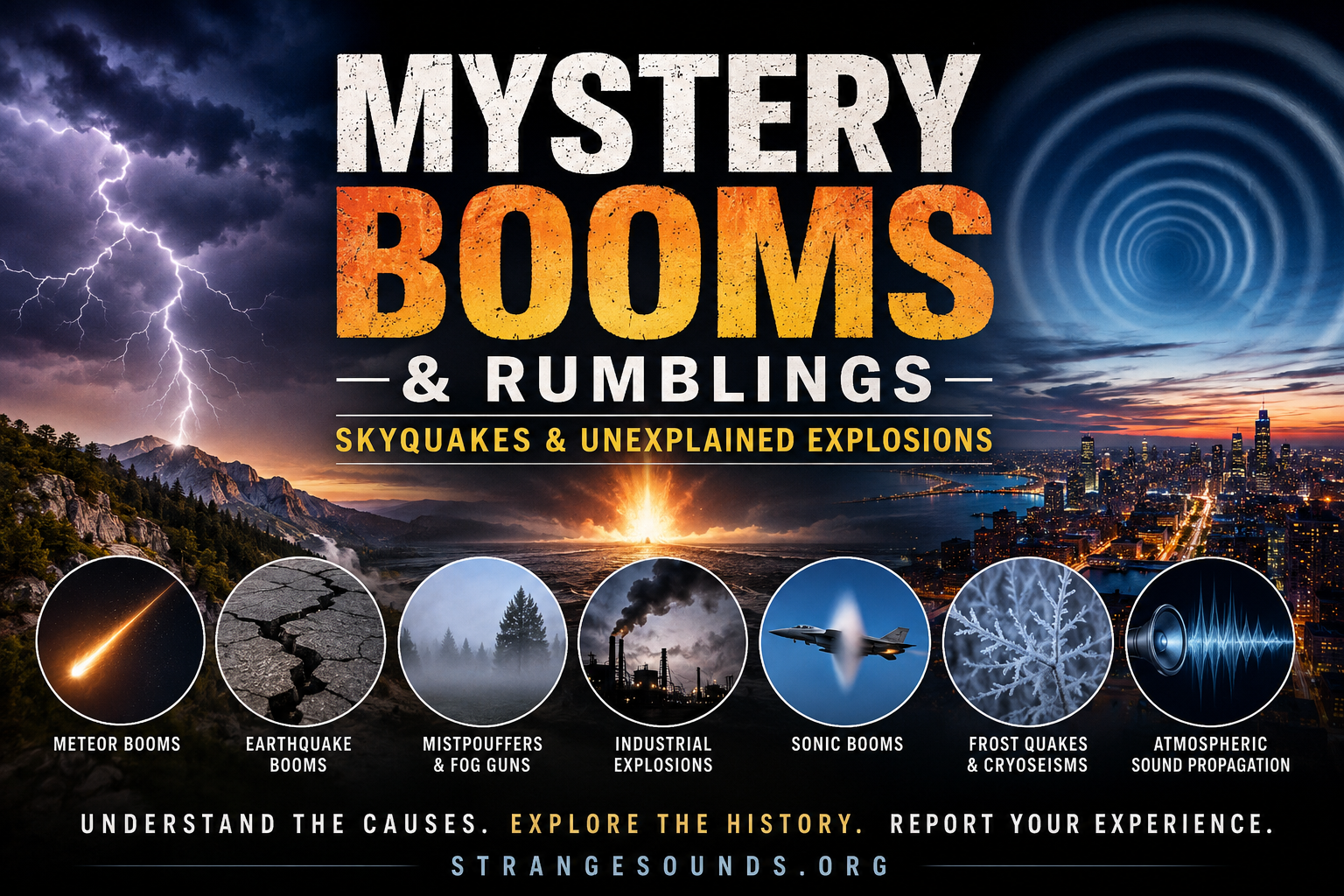
Mystery booms, strange rumblings and so-called skyquakes have been reported around the world for centuries.
Some are eventually traced to meteors, earthquakes, frost quakes, thunder, volcanic explosions, collapsing ice, sonic booms, military activity or distant blasts.
Others remain unresolved.
This guide explains what mystery booms are, what natural and human processes can cause them, why distant sounds sometimes seem nearby, how historical “skyquake” traditions fit into the picture, and how individual boom reports can be investigated scientifically.
The most important distinction is simple:
“mystery boom” describes what witnesses experience — not necessarily what caused it.
Updated on:
Mystery Booms: Key Facts
- Mystery booms are reports, not a single phenomenon. The term usually describes an explosive sound whose source was not immediately known.
- Many mystery booms eventually receive an explanation. Common candidates include meteors, sonic booms, thunder, quarry blasting, military activity, shallow earthquakes, frost quakes and industrial explosions.
- A boom can shake windows without an earthquake. Atmospheric shockwaves from aircraft, meteors, explosions or thunder can create strong pressure changes.
- Distant sounds can sometimes appear surprisingly close. Wind and temperature structure in the atmosphere can refract sound over large distances.
- “Skyquake” is mainly a descriptive historical term. It does not establish one unique physical cause.
- Some regional boom traditions are centuries old. Seneca Guns, Mistpouffers, Barisal Guns and brontidi were reported long before social media — and in some cases before modern aviation.
- Good investigation depends on timing and location. Seismic records, meteor observations, weather conditions, aircraft activity and multiple independent eyewitness reports can often narrow the possibilities.
- Some cases remain unresolved. That usually means the available evidence is insufficient to identify the source with confidence — not that the event defies physics.
📩 Heard a mystery boom? Report the time, location, weather conditions and any audio or video.
What Are Mystery Booms and Strange Rumblings?
A mystery boom is a sudden, powerful explosion-like sound for which observers cannot immediately identify the source.
Reports range from single cannon-like bangs to rolling thunder-like rumbles that shake windows, vibrate walls or seem to travel across entire communities.
Witnesses often describe:
- a huge boom with no visible explosion;
- one or several sharp bangs;
- a deep rolling rumble;
- a pressure wave that rattles windows;
- ground or building vibration;
- thunder-like noise under apparently clear skies;
- a sound resembling artillery or a distant detonation;
- or an unexplained explosion heard across several towns.
The key word is mystery.
It describes the state of knowledge when the event is reported.
A boom may initially be mysterious and later be linked to:
- a meteor or bright fireball;
- a supersonic aircraft;
- a small shallow earthquake;
- a frost quake;
- quarry blasting;
- a military exercise;
- distant thunder;
- an industrial accident;
- or another identifiable source.
Other events remain unresolved because there are no recordings, the reported times are too imprecise, observations conflict, or several explanations remain possible.
That makes mystery booms a useful investigative category rather than a single geological or atmospheric process.
What Does a Mystery Boom Sound and Feel Like?
There is no universal mystery-boom sound, but recurring descriptions appear in eyewitness reports.
Sharp Cannon-Like Bang
Some events sound like artillery, a transformer explosion, a large firework or a nearby detonation.
Rolling Rumble
Other reports begin with a sharp impulse followed by several seconds of deep rumbling resembling distant thunder.
Double or Multiple Boom
Two or more distinct explosive sounds may occur during some sonic-boom events, meteor airbursts, military activity or other complex shockwave events.
Window and Door Vibration
An atmospheric pressure wave can make windows chatter, doors move or lightweight structures vibrate even when the ground itself is not experiencing an earthquake.
Ground Shaking
Some mystery-boom reports include genuine ground vibration.
This can occur during earthquakes, blasting and other sources that transfer energy through the ground.
These characteristics provide useful clues, but they rarely establish the cause by themselves.
Very different physical processes can produce surprisingly similar sounds.
Mystery Booms vs Skyquakes: Are They the Same Thing?
The words mystery boom and skyquake are frequently used interchangeably online, but separating them makes the subject easier to understand.
Mystery boom is the broadest term.
It describes a loud unexplained bang, explosion or rumble regardless of whether witnesses think it came from the ground, sky, ocean or somewhere nearby.
Skyquake is an older descriptive term for unexplained cannon-like booming sounds that appear to originate from the sky or atmosphere.
Similar phenomena have historically been given different regional names.
A reported skyquake may ultimately be explained by:
- a sonic boom;
- a meteor or bolide;
- thunder;
- an explosion heard at long distance;
- an earthquake-related sound;
- military activity;
- or another source.
For that reason, skyquake should not be treated as proof of one unique atmospheric mechanism.
Mystery Booms Are Not the Same as Sky Trumpets
Mystery booms should also be separated from sky trumpets and strange sounds in the sky.
Classic mystery booms are usually:
- short;
- explosive;
- cannon-like;
- thunder-like;
- or followed by a relatively brief rumble.
Sky-trumpet reports more often involve:
- sustained metallic groaning;
- horn-like tones;
- scraping or grinding sounds;
- long drones;
- or unusual noises apparently continuing in the atmosphere for many seconds or minutes.
The two archives may occasionally contain similar explanations, but they represent different kinds of reported sound.
➜ Explore Sky Trumpets & Strange Sounds in the Sky
What Causes Mystery Booms?
There is no single cause of mystery booms.
The same basic experience — a sudden unexplained explosion, bang or rumble — can result from processes occurring underground, at Earth’s surface, in the atmosphere, in the cryosphere or from objects entering the atmosphere from space.
Other mystery-boom reports originate from human activity such as aircraft, military exercises, blasting or industrial operations.
And sometimes the most unusual part is not the source itself, but the way the atmosphere carries the sound over unexpectedly long distances.
Natural Causes of Mystery Booms
Nature contains several mechanisms capable of generating sudden pressure waves, fracturing sounds, seismic-acoustic signals or explosion-like impacts.
The most important natural sources include:
- meteors, fireballs and bolides;
- earthquake-related sounds;
- rockfalls, landslides and ground collapse;
- volcanic and hydrothermal explosions;
- frost quakes and cryoseisms;
- glacier booms, icequakes and cracking ice;
- avalanches and snow collapse;
- thunder and distant storms;
- sea caves, blowholes and coastal acoustic phenomena;
- booming and singing sand dunes;
- and frost-cracking trees.
Meteors, Fireballs and Bolide Booms
One of the most spectacular explanations for an apparently mysterious explosion is a meteor entering Earth’s atmosphere at high speed.
Large or energetic meteoroids can generate shockwaves as they travel through the atmosphere. If the object fragments, observers may see several flashes and later hear multiple booms.
The delay between the visual event and the sound is often an important clue, because light reaches observers almost instantly while sound travels much more slowly through air.
➜ Explore Meteors, Fireballs, Atmospheric Explosions Explained.
Why Does the Boom Arrive After the Fireball?
Light reaches an observer essentially immediately on human timescales, while sound travels much more slowly through air.
The common sequence is therefore:
- a bright fireball crosses the sky;
- the meteor continues or fragments;
- the visual event disappears;
- a delay follows;
- then one or several booms arrive.
People farther from the visible trajectory may hear the shockwave without ever seeing the fireball.
That can transform an obvious meteor event in one town into a “mystery explosion” somewhere else.
Clues That a Mystery Boom May Be a Meteor
- a bright flash shortly before the boom;
- a moving fireball or glowing trail;
- fragmentation in the sky;
- reports distributed along a broad geographic path;
- a delay between light and sound;
- multiple explosive sounds;
- meteor-camera observations;
- or atmospheric/infrasound detections.
A meteor explanation is especially compelling when independent visual reports match the timing and geographic distribution of the booms.
Related archive: weird noises associated with meteorite falls.
Earthquake Booms and Seismic Sounds
Earthquakes are usually associated with shaking rather than sound, but small shallow earthquakes can sometimes produce audible bangs, cracking or rumbling.
High-frequency seismic energy near the surface, local rock failure and vibration of buildings or surrounding materials can all contribute to what witnesses hear.
A useful investigative clue is whether nearby seismic stations recorded an event at the same time.
Why Can a Small Earthquake Sound So Loud?
A shallow earthquake may occur close enough to the surface for high-frequency seismic energy and local structural vibrations to become audible.
Buildings, soil, rock and objects within structures can also produce secondary sound as seismic waves pass through them.
This helps explain why a relatively small local earthquake can occasionally sound dramatic even when the shaking itself is moderate.
Earthquake Boom or Atmospheric Boom?
A key investigative question is whether seismic instruments recorded an event at the same time.
If a wide region reports a violent boom but local seismic stations detect no corresponding earthquake, an atmospheric source such as a sonic boom, meteor, thunder or distant explosion may be more plausible.
Historic Strange Sounds primer: March 18–30, 2012: The Famous Clintonville Boom Swarm in Wisconsin.
Rockfalls, Landslides and Sudden Ground Collapse
Not every earth-shaking boom is an earthquake.
Sudden failure of rock, soil or underground cavities can release enough energy to create powerful impact sounds and local ground vibration.
Rockfalls and Cliff Collapses
Large sections of rock can detach suddenly from mountain slopes, canyon walls or coastal cliffs.
The initial fracture may produce a sharp crack, followed by enormous impacts and prolonged rumbling as debris crashes downslope.
➜ Explore Rockfalls Explained.
Landslides
Large landslides can generate deep rumbling, impact sounds and measurable seismic signals as huge volumes of rock and soil accelerate downhill.
➜ Explore Landslides Explained.
Cave and Sinkhole Collapse
The sudden collapse of an underground cavity, cave roof or sinkhole can also produce a localized boom accompanied by vibration.
➜ Explore Sinkholes & Dolines Explained.
Volcanic Eruptions, Hydrothermal Explosions and Geyser Booms
Volcanoes and geothermal systems can produce some of the most powerful natural booming sounds on Earth.
Sudden releases of gas, explosive magma fragmentation, steam explosions and collapsing volcanic material can generate sharp blasts, deep rumbling, shock waves and low-frequency infrasound.
Possible volcanic and geothermal sources include:
- explosive volcanic eruptions;
- phreatic or steam-driven explosions;
- hydrothermal explosions;
- lava-water interactions;
- rockfalls and crater collapse;
- volcanic earthquakes;
- and unusually energetic geyser eruptions.
Why Can a Volcano Sound Like an Explosion?
Explosive eruptions rapidly release pressurized gases and fragmented material.
That sudden expansion produces pressure waves capable of traveling through the atmosphere as powerful sound.
Steam and Hydrothermal Explosions
Water trapped beneath the surface can become extremely hot while remaining under pressure.
If that pressure suddenly drops, the water can flash into steam and violently eject water, mud and rock.
These events can initially be reported simply as unexplained explosions or ground-shaking booms.
➜ Learn more in Volcano Science Explained and Geothermal Systems Explained.
Frost Quakes and Cryoseisms
During intense winter cold, some mystery booms may be caused by cryoseisms, commonly known as frost quakes.
They are associated with sudden fracturing of frozen, often water-saturated ground during rapid changes in temperature and thermal stress.
Witnesses may describe a gunshot, small explosion, loud crack beneath a house or boom accompanied by local vibration.
When Should Cryoseisms Be Suspected?
Frost quakes are particularly worth considering when:
- temperatures fall rapidly;
- the ground was previously wet;
- the soil freezes deeply;
- booms occur during a severe cold spell;
- and no conventional earthquake or explosion is identified.
Because the fractures can occur close to homes, cryoseisms may sound much more dramatic than their limited geographic scale would suggest.
Glacier Booms, Icequakes and Cracking Ice
Frozen landscapes can be surprisingly noisy.
Glaciers, frozen lakes and sea ice continually respond to temperature changes, gravity, water pressure and mechanical stress.
Glacier Calving
When enormous blocks of glacier ice break away and fall into water, both the fracture and impact can generate thunder-like booms and prolonged rumbling.
➜ Explore Glacier Calving Explained.
Icequakes and Glacial Earthquakes
Moving or fracturing glaciers can generate seismic events ranging from small icequakes to much larger glacial earthquakes.
Lake and Sea-Ice Cracking
Large sheets of frozen water expand, contract and fracture as temperatures change.
Stress released along rapidly propagating cracks can produce sharp bangs, resonant booms and strange metallic or laser-like sounds.
These are different from frost quakes, which primarily involve frozen ground or rock.
Avalanches and Snow-Collapse Booms
Large avalanches can generate powerful natural sounds ranging from an initial sharp fracture to prolonged thunder-like roaring.
A slab avalanche may begin when a cohesive layer of snow suddenly fractures across a slope.
As the snow mass accelerates, impacts involving snow, ice, trees and rock create much deeper rumbling.
Cornice collapse and icefall can produce similarly abrupt explosive sounds.
➜ Explore Snow Avalanche Explained.
Thunder, Lightning and Distant Storms
Thunder is one of the most obvious natural sources of booming sounds — but it can sometimes become surprisingly difficult to recognize.
Nearby lightning can produce an extremely sharp explosive crack, while distant thunder usually develops into a longer rolling rumble.
Under suitable atmospheric conditions, thunder from storms tens of kilometers away may reach communities beneath apparently clear skies.
Thundersnow is a particularly unusual case because lightning and thunder occur during snowfall rather than ordinary rain.
Weather radar, lightning-detection networks and observations from surrounding regions can therefore be useful when investigating unexplained atmospheric booms.
Ocean Waves, Sea Caves and Coastal Booms
Coastlines can generate surprisingly powerful booming sounds when waves interact with cliffs, caves, blowholes and enclosed cavities.
Sea Caves and Compressed Air
When large waves enter narrow cavities, they can rapidly compress trapped air and water.
Pressure changes inside the cave may produce deep booming or explosion-like sounds.
Blowholes
Coastal blowholes can generate roaring or booming sounds as waves force compressed air and water through narrow openings.
Extreme Wave Impacts
Large storm waves striking cliffs and seawalls can produce tremendous impact noise.
Rockfalls triggered by wave erosion may add additional cracking and rumbling.
These mechanisms are interesting in the context of historical reports such as Mistpouffers, but a plausible mechanism does not prove that every historical “sea cannon” report had the same cause.
➜ Explore Extreme Ocean Waves Explained.
Booming and Singing Sand Dunes
Some large desert dunes can literally boom, hum or resonate.
Under suitable conditions, dry sand moving down a dune face can generate powerful low-frequency sound.
Witnesses have compared booming dunes to distant thunder, aircraft, drumming or a deep musical note emerging from inside the Earth.
Unlike a single explosive boom, singing or booming sand may continue for several seconds or longer.
➜ Explore Singing and Booming Sand Dunes.
Can Trees Make Explosion-Like Sounds?
During extreme cold, trees can sometimes produce startling gunshot-like cracks.
Rapid temperature changes and mechanical stress can cause trunks or large branches to split suddenly.
A large tree cracking in an otherwise quiet winter landscape may sound surprisingly similar to a gunshot or small explosion.
This should not be confused with a frost quake, where the fracture occurs in frozen ground or rock.
Human and Technological Sources of Mystery Booms
A large proportion of modern mystery-boom reports ultimately turn out to have human or technological causes.
Common sources include:
- supersonic aircraft;
- quarry, mining and construction blasts;
- military exercises and weapons training;
- industrial explosions and infrastructure failures;
- and rockets or spacecraft re-entry.
Sonic Booms from Aircraft
A sonic boom occurs when an object travels through the atmosphere faster than the local speed of sound and generates a system of shock waves.
On the ground, the passing shock wave may resemble a distant explosion, artillery fire, a sharp crack or two closely spaced booms.
Military aircraft are often considered when unexplained booms occur near training areas, offshore military airspace or regions where supersonic flights are possible.
Why Can’t Witnesses See the Aircraft?
The aircraft may already be far from the observer by the time its shockwave reaches the ground.
It may also be:
- at high altitude;
- beyond the observer’s horizon;
- hidden by cloud;
- operating offshore;
- or simply too difficult to see against the sky.
Atmospheric conditions can further complicate where the boom is heard.
For that reason, the absence of a visible aircraft does not by itself eliminate a sonic boom.
Quarry, Mining and Construction Blasts
Controlled blasting is among the most common human explanations for localized mystery-boom reports.
These explosions can generate both airborne pressure waves and ground vibration, making them feel surprisingly earthquake-like.
Military Activity, Artillery and Explosives Training
Military activity can generate powerful acoustic events through artillery, mortars, demolition, weapons testing, bombing exercises and supersonic aircraft.
The presence of a military installation alone is not proof.
Actual training notices, timing and official confirmation should be checked whenever possible.
Reports become particularly mysterious when atmospheric conditions carry training noise into communities that do not normally hear it.
Industrial Explosions and Infrastructure
Industrial operations, pressure releases, electrical failures, demolition, construction and genuine accidents can all generate powerful explosion-like sounds.
Rockets, Spacecraft and Atmospheric Re-entry
Rocket launches, returning spacecraft and space hardware entering the atmosphere can generate shock waves, bright streaks, fragmentation and delayed sonic booms.
These events can easily be confused with meteors until the trajectory is identified.
➜ Explore Man-Made Sky Phenomena Explained.
Why Distant Booms Can Sound Nearby
Atmospheric refraction and ducting do not create the original boom.
Instead, they change how sound from an existing source travels through the atmosphere.
This distinction is important because a distant thunderstorm, aircraft, quarry blast, industrial event or military exercise may sound unexpectedly loud in a community far from the actual source.
Temperature Inversions
Under a temperature inversion, warmer air lies above cooler air near the surface.
This can bend acoustic waves back toward the ground rather than allowing them to disperse upward.
Wind and Atmospheric Ducting
Changes in wind speed and direction with altitude can also channel sound over long distances.
Acoustic Shadow Zones
Sound may be loud near the source, fade across an intermediate region and then become audible again farther away.
That can create the confusing impression that a distant explosion must have occurred nearby.
“The boom sounded close” does not necessarily mean the source was close.
➜ How strange sounds can travel great distances under certain weather conditions
What About Mystery Booms That Remain Unexplained?
Some mystery-boom events remain genuinely unresolved.
But unresolved does not mean physically inexplicable.
Often there simply isn’t enough evidence to distinguish among several plausible sources.
A scientifically useful classification remains:
- CONFIRMED — strong evidence identifies the source.
- LIKELY — one explanation is strongly supported.
- UNRESOLVED — credible event, but no source established.
- UNCERTAIN — surviving historical evidence is too weak/incomplete to classify confidently.
Historic Mystery Booms: Cannons in the Sky
Long before smartphones, aircraft trackers and social media, communities around the world described mysterious cannon-like noises coming from the sky, coast or distant landscape.
Different regions developed their own names for these unexplained booms.
Among the best known are:
- Seneca Guns;
- Mistpouffers;
- Barisal Guns;
- and brontidi.
These names are historically fascinating, but they should not automatically be interpreted as different physical phenomena.
They are best understood as regional traditions describing recurring unexplained booming sounds.
Different individual events may have had different causes.
Seneca Guns
Seneca Guns is one of the best-known names associated with recurring unexplained booming sounds in the United States.
The term has been applied to reports from the eastern United States, including areas around Seneca Lake in New York and coastal North Carolina.
Witnesses describe loud cannon-like explosions occurring without an obvious visible source.
Possible explanations proposed for individual reports have included:
- earthquakes;
- offshore activity;
- sonic booms;
- thunder;
- meteors;
- military activity;
- and unusual atmospheric sound propagation.
The key difficulty is that “Seneca Guns” represents a long history of reports rather than one instrumentally observed event with one demonstrated cause.
Mistpouffers and Fog Guns
Mistpouffers — sometimes described as “fog guns” — belong to another historical tradition of unexplained cannon-like sounds, particularly associated with coastal or waterside regions.
Accounts describe distant explosions seemingly coming from:
- the sea;
- fog;
- the horizon;
- or an otherwise quiet landscape.
Because historical reports often lacked precise instrumentation, many explanations remain speculative.
Possible mechanisms discussed for individual events include distant thunder, atmospheric propagation, seismic activity, offshore sources and other natural or human processes.
Barisal Guns
The Barisal Guns are historic booming sounds reported from the Bengal region.
Accounts described distant cannon-like explosions occurring without an obvious source.
What makes these reports particularly interesting is their age.
Descriptions predate many technological sources that dominate modern mystery-boom investigations.
That does not mean an extraordinary explanation is required.
Possible natural mechanisms include:
- distant thunder;
- atmospheric sound propagation;
- coastal or riverine acoustic effects;
- seismic activity;
- and other environmental sources.
As with Seneca Guns and Mistpouffers, the historical name identifies a pattern of observations rather than one proven mechanism.
Brontidi
In Italy, historical unexplained booming phenomena have been described using the term brontidi.
Reports again resemble distant artillery, cannon fire or thunder without an obvious storm or explosion.
Similar traditions in geographically distant regions are intriguing because they show that unexplained booming sounds are not merely a modern internet phenomenon.
However, similarity in eyewitness description does not prove identical causes.
A sonic boom, shallow earthquake, thunder, distant explosion and meteor shockwave may all sound broadly similar to someone who cannot see the source.
Famous Mystery Boom Cases
Some events have become especially well known because they generated unusually large numbers of reports, caused physical effects or remained debated for years.
Clintonville Booms — Wisconsin, 2012
In March 2012, residents of Clintonville, Wisconsin reported repeated mysterious booms and shaking.
The story quickly became one of the most widely discussed mystery-boom episodes of the era.
Seismic activity was subsequently detected in the area, providing an important example of how small shallow earthquakes can produce dramatic local sounds and vibrations.
Bell Island Boom — Newfoundland, 1978
The 1978 Bell Island Boom in Newfoundland became famous after residents reported a violent explosive event accompanied by unusual electrical effects and damage.
The event has attracted competing interpretations over the decades and remains one of the best-known cases in mystery-boom literature.
Seneca Guns of Coastal North Carolina
Recurring reports of cannon-like booms along the North Carolina coast continue the much older Seneca Guns tradition.
Individual modern reports may have different explanations, which is why exact timing, seismic observations, weather data and military or aviation information matter.
Flash Followed by Multiple Booms
A particularly diagnostic modern pattern is:
- a bright moving flash;
- a delay;
- then one or several rolling booms.
This combination strongly points toward a meteor, bolide or another supersonic atmospheric event.
Why Do Mystery Booms Sometimes Occur in Clusters?
Mystery-boom reports often arrive in waves rather than as isolated events.
That does not necessarily mean all the reports share the same exotic source.
Cold Spells
Cryoseisms may recur during severe freezing conditions, particularly while wet ground is rapidly freezing.
Military Exercises
Artillery or explosive training may continue for several days, generating repeated reports from surrounding communities.
Quarry Operations
Regular blasting schedules can produce booms at similar times on multiple days.
Earthquake Sequences
Shallow earthquake swarms or aftershocks may produce repeated local shaking and rumbling.
Persistent Atmospheric Conditions
A stable inversion or particular wind profile may repeatedly carry distant sound toward the same area.
The existence of a cluster therefore becomes another investigative clue rather than evidence for one universal mystery-boom mechanism.
How to Investigate a Mystery Boom
The difference between an unsolved anecdote and a useful mystery-boom report often comes down to a few basic pieces of information.
1. Record the Exact Time
Write down the time as precisely as possible.
Timing allows investigators to compare the event with:
- earthquake catalogs;
- meteor reports;
- lightning data;
- aircraft activity;
- military exercises;
- blasting;
- industrial incidents;
- and rocket or re-entry events.
2. Record Your Location
City and region are useful, but approximate neighborhood-level location is even better.
When many eyewitness reports are available, their geographic distribution may reveal:
- where the sound was strongest;
- how large the affected region was;
- whether the source appeared to move;
- and the likely direction from which the pressure wave arrived.
3. Describe the Sound
Was it:
- one boom?
- two booms?
- a sequence?
- a sharp crack?
- a long rumble?
- like thunder?
- like artillery?
- or more like an earthquake?
4. Did You Hear It, Feel It — or Both?
This distinction matters.
A purely atmospheric shockwave may strongly rattle windows without producing the kind of regional ground motion recorded during an earthquake.
Blasting and earthquakes, by contrast, may generate both airborne sound and measurable ground vibration.
5. Look for Visual Evidence
Immediately check for:
- meteor flashes;
- lightning;
- smoke;
- dust;
- fire;
- aircraft;
- contrails;
- or visible damage.
6. Check Weather
Look for:
- nearby thunderstorms;
- strong temperature inversions;
- rapid cold outbreaks;
- strong winds aloft;
- and weather patterns capable of influencing acoustic propagation.
7. Check Seismic Data
Nearby seismic stations can help determine whether a genuine earthquake occurred at the reported time.
The absence of a conventional earthquake does not tell you what caused the boom, but it can remove one major possibility.
8. Check Human Activity
Look for:
- military training notices;
- quarry activity;
- construction blasting;
- industrial incidents;
- rocket launches;
- and plausible aviation activity.
9. Save Doorbell and Security-Camera Footage
Doorbell cameras, home-security cameras and dashcams are extremely valuable because they may preserve:
- exact timing;
- the acoustic signature;
- visible flashes;
- window vibration;
- and the reaction of animals or objects.
10. Compare Independent Eyewitness Reports
A single witness establishes that somebody heard something.
Dozens of precisely located reports can begin to reveal the geometry of the event.
➜ How to discover and determine the origin of mysterious booms
What Should You Do If You Hear a Huge Unexplained Boom?
Because “mystery boom” merely means the source is not yet known, do not automatically assume an unexplained bang is harmless.
If you see:
- fire;
- smoke;
- structural damage;
- fallen power lines;
- a gas leak;
- an obvious explosion;
- or injured people;
treat the situation as a real local emergency and contact the appropriate authorities.
If no emergency is apparent, document the event:
- exact time;
- location;
- sound description;
- whether you felt shaking;
- weather;
- visual observations;
- and available recordings.
📩 Report a mystery boom to Strange Sounds
Mystery Booms by Year: Historical Archive
Strange Sounds has documented mystery booms, skyquakes, unexplained explosions, earthquake sounds, sonic booms, frost quakes and strange rumblings for more than a decade.
The archive is intentionally organized chronologically.
This main pillar answers:
“What are mystery booms and what can cause them?”
The year pages answer:
“What mystery-boom events were reported during that year?”
That keeps the scientific explanation and the historical record separate without creating competing cause-based archive pages.
Recent Mystery Booms
-
Mystery Booms 2026 — mystery booms, strange explosions and rumblings reported during 2026.
-
Mystery Booms 2025 — unexplained booms and notable acoustic events from 2025.
-
Mystery Booms 2024 — mystery-boom reports from around the world in 2024.
-
Mystery Booms 2023 — unexplained explosions, rumblings and skyquake reports from 2023.
-
Mystery Booms 2022 — strange booms and unexplained acoustic events reported during 2022.
- Mystery Booms 2021
- Mystery Booms 2020 — loud booms and unexplained explosions.
- Mystery Booms 2019 — mysterious rumblings and boom reports.
-
Mystery Booms 2018
- Mystery Booms 2017 — skyquakes, sonic booms and unexplained explosions.
- Mystery Booms 2016 — earth-shaking noises and mysterious bangs.
- Mystery Booms 2015 — rumblings and unexplained explosion reports.
- Mystery Booms 2014 — frost quakes, skyquakes and mystery booms.
- Mystery Booms 2013 — unexplained booms and seismic rumblings.
- Mystery Booms 2012 — including the famous Clintonville booms.
Historic Mystery Booms
The archive also reaches beyond the modern Strange Sounds era.
- Historic Mystery Booms: 2011–1930 — older reports, strange explosions and historical booming phenomena.
How the Mystery Boom Archive Should Be Read
An important warning applies to historical mystery-boom stories:
A report being unexplained when it was published does not mean it remained unexplained forever.
Whenever possible, events can be labeled retrospectively as:
- Meteor / bolide
- Sonic boom
- Earthquake / seismic
- Cryoseism / frost quake
- Thunder / atmospheric
- Quarry / mining
- Military
- Industrial
- Other identified source
- Possible cause
- Unresolved
This allows Strange Sounds to preserve the original chronology while improving the scientific usefulness of the archive.
For example:
Example archive entry
Michigan — February 8, 2020
Residents across several communities report a loud explosion and window-rattling boom.
Cause: Meteor / bolide
Status: LIKELY
Evidence: A fireball was reported immediately before the boom.
The archive therefore remains organized by year, while individual events can still be classified by their most likely cause.
Where Mystery Booms Fit Within Strange Sounds
Mystery Booms & Rumblings is one of the core phenomena within the larger Strange Sounds archive.
Other major acoustic phenomena include:
- Sky Trumpets — metallic groans, horn-like sounds and strange sustained noises apparently coming from the sky.
- The Hum — persistent low-frequency humming reported in communities around the world.
- Ocean Sounds — unusual hydrophone recordings and deep-ocean acoustic phenomena.
- Space Sounds & Signals — radio and plasma phenomena converted into audible signals.
Together, these guides separate very different acoustic phenomena while preserving the enormous Strange Sounds archive built around unusual noises.
Mystery Booms: Frequently Asked Questions
- What is a mystery boom?
- A mystery boom is a loud explosion-like or rumbling sound whose source is not immediately known. The term describes the initial observation rather than one specific physical phenomenon.
- What causes mystery booms?
- Possible causes include meteors, sonic booms, thunder, shallow earthquakes, frost quakes, quarry blasting, military exercises, industrial explosions, rockets, spacecraft re-entry and distant sounds carried by unusual atmospheric conditions. Some events remain unresolved.
- Are skyquakes real?
- Skyquake is a historical and popular term for powerful unexplained booming sounds apparently coming from the sky or atmosphere. Individual reports can have different causes, so skyquakes should not be assumed to represent one single physical mechanism.
- Are skyquakes and sky trumpets the same thing?
- No. Skyquakes generally describe short cannon-like booms or explosive sounds, while sky trumpets usually refer to sustained metallic, horn-like, scraping or groaning noises apparently coming from the sky.
- Can earthquakes make loud booming noises?
- Yes. Small shallow earthquakes can sometimes produce audible bangs, cracking or rumbling near the source. Seismic vibrations can also make buildings, soil and other structures generate additional sound.
- Can frost cause loud booms?
- Yes. Frost quakes, or cryoseisms, can occur when water-saturated ground freezes rapidly and fractures. They may sound like gunshots or small explosions and can sometimes produce local vibration.
- Can meteors cause mystery booms?
- Yes. Meteoroids traveling through the atmosphere at high speed can create shockwaves. A bright fireball may be followed seconds or minutes later by one or more loud booms because sound travels much more slowly than light.
- Why can a huge boom shake windows without an earthquake?
- Atmospheric pressure waves can rattle windows and doors without producing an earthquake. Sonic booms, meteor shockwaves, thunder and explosions can all generate strong acoustic pressure changes.
- Why can a distant explosion sound nearby?
- Temperature gradients and winds can refract sound through the atmosphere. Under favorable conditions, sound from aircraft, explosions, thunder or industrial activity can travel much farther than observers expect.
- Why do mystery booms sometimes occur repeatedly?
- Clusters may result from repeated military exercises, quarry blasting, earthquake sequences, frost quakes during a cold spell or persistent atmospheric conditions that repeatedly carry distant sounds toward the same region.
- What are Seneca Guns?
- Seneca Guns is a traditional name applied to recurring cannon-like unexplained booms reported in parts of the eastern United States, including coastal North Carolina and historically around Seneca Lake in New York. Individual reports may have different causes.
- What are Mistpouffers?
- Mistpouffers are a historical European name associated with unexplained cannon-like or “fog gun” sounds, particularly near coasts and bodies of water. The term describes the reports rather than a proven single mechanism.
- What are the Barisal Guns?
- The Barisal Guns are historical reports of unexplained booming sounds from the Bengal region. They belong to a wider global tradition of mysterious cannon-like noises reported without an obvious visible source.
- Are mystery booms dangerous?
- The risk depends entirely on the source. Many reports turn out to involve distant or natural events, but any unexplained boom accompanied by smoke, fire, structural damage, a gas smell or other signs of an emergency should be treated seriously.
- How can I report a mystery boom?
- Record the exact time and location, describe what you heard and felt, note the weather and any flashes, smoke or aircraft, preserve audio or video, and submit the information through the Strange Sounds contact page.
Sources & Further Reading
Understanding mystery booms often requires information from several scientific fields, including seismology, meteor science, atmospheric acoustics, meteorology and aviation.
- USGS — earthquakes, seismic monitoring and geological information.
- NOAA — weather, atmospheric science and environmental observations.
- NASA — meteors, atmospheric entry, rockets and spaceflight.
- Met Office — weather, atmospheric structure and sound-propagation context.
StrangeSounds.org also preserves its own long-running archive of eyewitness reports, videos, historical cases and later explanations.
Latest Mystery Boom Reports
See the newest Strange Sounds reports involving unexplained booms, strange explosions, rumblings and acoustic investigations.
🧭 Browse the latest Mystery Booms reports
Did You Hear a Mystery Boom?
If a loud unexplained boom, rumbling sound or explosion rattled your area, accurate details can help determine what happened.
Please include:
- date;
- exact local time;
- city and region;
- how long the sound lasted;
- whether it was one boom or several;
- whether windows or buildings vibrated;
- whether you felt ground shaking;
- weather conditions;
- any visible flashes, smoke, fireballs or aircraft;
- and links to audio or video if available.
📩 Report your mystery boom to Strange Sounds
📰 Subscribe to the Strange Sounds newsletter
Explore More Strange Sounds
- Strange Sounds — the main hub for Earth’s strangest acoustic phenomena.
- Sky Trumpets — metallic groans, horn-like sounds and strange noises in the sky.
- The Hum — persistent low-frequency humming heard in communities worldwide.
- Mysterious Ocean Sounds — strange hydrophone recordings and underwater acoustic phenomena.
- Space Sounds & Signals — radio, plasma and astronomical signals translated into sound.

I tried to impale it but got fudge all over it.
Boston Sonic Boom Is A MUCH BIGGER Event Than Expected
https://www.youtube.com/watch?v=us2ypR21A3A
USA – Boston residents’ homes shake as loud BOOM rings out: cops probing ‘bizarre’ incident after influx of 911 calls
https://www.dailymail.com/news/article-15861139/boston-loud-boom-house-shaking-cops.html
UK – Mystery ‘bang’ heard across Birmingham city centre as buildings ‘shake’
Twitter users were sent into a frenzy after the bang was heard around 2.20pm on Tuesday, November 19
https://www.birminghammail.co.uk/news/midlands-news/mystery-bang-heard-across-birmingham-17281489
Thanks
I big rumble that shook the house last night at 7:40pm here west of Bremerton WA. by the Hood Canal. It was like the first shock wave to an earthquake where you hear a rumble and feel a jolt and then the quake hits. This was just the rumble and jolt, and no quake. The dog was asleep and jumped up looking around wondering what was going on. Checked the earthquake maps here that show explosions too, and nothing. So who knows what happened.
Thank you!
Just add it on the Facebook page. Come back to you as soon as I hear something relevant to your case.
1 0n 09/17/2018 and 15 reports on 09/18/2018 in Davenport,Ia
[…] MYSTERY BOOMS […]
Heard a large boom, almost like an explosion on 29th December 2017 at 18:29 in Wigston, Leicestershire. No idea what it was but could feel a vibration from the ground. A week before there was one similar. It cut the power in South Wigston for several hours and set car alarms off.
I know a guy who is psychic and makes the booming sounds with his mind when angered. They are psychic booms with his mind. He claims to be a Demon King or the 73rd Demon King after mastering the Qlipphoth. He lives in Nebraska…..Gothenburg.
[…] https://strangesounds.org/mystery-booms-and-rumblings […]
November 23, 2017. Multiple Loud booms felt across Cabot, Arkansas. Shaking homes across miles with no smoke or visible trace.
November 21, 2017, around 2 pm, on Hwy 1, Cass County, Nebraska heard a very loud booming sound..shook the house and windows. No idea where it came from.
Strange, loud rumble that lasted a few minutes, heard in several counties along the north Florida coast line on 11/13/17. Anyone know what it was?
in which counties?
Something about loud booms in Florida in there: https://strangesounds.org/2017/11/loud-booms-usa-november-2017-increase.html
philippines CITY
Using dynamite to build tunnels and underground facilities. Occurring around the world as the `elite prepare for your destruction.
Isaiah 29:6 You will be punished by the Lord of hosts With thunder and earthquake and great noise, With storm and tempest And the flame of devouring fire.
2 Peter 3:10
[ The Day of the Lord ] But the day of the Lord will come as a thief in the night, in which the heavens will pass away with a great noise, and the elements will melt with fervent heat; both the earth and the works that are in it will be burned up.
Cell/HARRP towers emit frequencies that cause earthquakes. 2.5 hertz makes quakes. Tesla technology. it ruptures sewer drains, water lines. NOTICE SINKHOLES CAUSED BY BROKEN SEWER LINES, except for ones in the middle of nowhere. there is no reason to have the 12 cell/HARRP towers near my home. There is probably more now that are stealthfully hidden. I noticed they really have been trying to hide those ugly forboding ‘death towers’. Say hello to cancer. The biological threat from radiation is thousands of times above the danger limit.
There is global under ground tunneling with that boring machine that has same design as the Walmart (mart-Law) logo. During early hours for years I heard grinning noises under ground headed towards the Walmart super centers. searched, they are making FEMA holocaust camps, underground and above. New tunnels are created right now. Now I heard them tunneling at 8am and after because it’s really close to me. Traffic noise doesn’t hide it inside the house. Hard to hear is outside the house. Loud muffled Explosions happen from land settling after they tunnel. I reported explosion at 3am. Called police. they write it off on kids playing with fireworks. I was scared, went outside to figure out where the noise was and fire works happened much later and sounded different. Serve and protect my ….
Terrible loud bombing noises and smaller rapid fire sounds I noticed at 8:55pm in Norton Ohio or around it.
It lit up the skies and kept up until 9:30pm. How long it was going for before this I don’t know.
by: Raven
Any army exercises around?
Loud boom at about 22:15 GMT in Swansea, UK. Several others on Facebook and Twitter heard it. Initially thought to be an explosion, but there appears to be no evidence of one. Unexplained at the moment…
Sorry this was yesterday (23rd August 2017)
Loud boom Chicago Il. 8/12/17 -time 12:50—Loud boom coming from the west . Location for me wilson ave and sheridan rd….Made me jump
My wonder is as follows 23 September 2017, A great wonder in heaven, a woman clothed with the sun, moon at her feet, garland of 12 stars at her head, Travailing in birth.
Will We hear the sounds of a woman giving birth across the world???????
Angel trumpet sounds started June 15, 2011 (’11’ is devil horns). i heard sounds and googled them. I googled ‘angel trumpet sounds’ like in revelations. It took 2 months after before people started calling these global sounds ‘angels trumpets’. I am certain that its HARRP. the one that angels do not play with. it makes lightning strikes, and CA fires. It makes tornados, hurricanes, and earthquakes. Mind control and death. Alaska took military to court. Military pleaded ‘matter of national security’, regarding killing those residents so they were protected and continued torturing residents. Taos hum, is HARRP. That was the beginning. now HARRP/CELL towers are every 1/4 mile.
Loud explosion in West Virginia and Southern New Hampshire over the last week (July 20 – July 27, 2017). There is still no known cause and people are stumped.
Thanks. Any ideas about the sourse of the noise?
Loud boom in south Las Vegas today just 30 minutes ago. rocked my house and others in a 5 mile radius
May 5, 2017 Chesapeake, VA Large boom lasted for 30 seconds around 10/10:30am, raining but longer than thunder, apartment complex off battlefield shook like an earthquake but no reports of one. All the neighbors were outside looking for the source of the noise. Trying to find out what it was and came across this site.
5/5/17 booming noises and vibration felt for past 30 mins starting round 3 am Indiana
Fayetteville, GA, May 1st, 2017 at about 12:20 pm.
What sounded like a distant, very large explosion shook the house, causing our dog to jump up and bark. Nothing in the local news. No sirens, etc.
Thanks, I will have a look.
the media cover up real news. THERE IS SERIOUS TUNNELING BEING DONE. LAND SETTLES AROUND THOSE TUNNELED SPOTS AND EXPLODES AS IT CAVES IN.HARRP CELL TOWERS FRACTURE SEWER LINES WITH FREQUENCIES. 2.5 HERTZ MAKES QUAKES. THEY PURPOSELY CAUSE SINKHOLES THIS WAY. THERE WAS A SINKHOLE IN A REMOTE AREA OUTSIDE THE CITY. I CHECKED FOR THE REASONS WHY IT COULD BE. THERE WAS A CANAL WITH WATER RIGHT NEXT TO THE HIGHWAY. THERE WAS A BRAND NEW CELL/HARRP TOWER. IT MUST HAVE CRACKED THE CANAL, THE CANAL LEAKS AND ERODES THE SOIL, MAKING HUGE CHASM.
Loud house-shaking boom in Frederick Maryland around 4:00 AM, 4/29/17. Anyone else experience it?
Would be interesting to see these on a map with some time stamp to see if these match cayce predictions or historic fault lines etc. Let the sounds show us where tetonic plates are moving if we dont know this already from other sources
REMEMBER EDGAR CAYCE SAID THAT ‘VIRGINIA’ WAS A SAFE AREA. HE WAS DEEPLY RELIGIOUS AND I TRUST HIS MESSAGES. BUT DEMON WORSHIPPERS ARE TRYING TO RECREATE OUR FUTURE. THEY FOLLOW THE BIBLE AND TWEEK IT THE WAY SATAN ALWAYS DOES. HE CAN’T REALLY CREATE ANYTHING BY HIS OWN INSPIRATION. HE ONLY CORRUPTS GODS PLAN. HE GOT MY MESSAGE. COMPUTERS ARE SATANIC TECHNOLOGY.
I heard a tremendous rumbling in the NW suburbs of Chicago in the early hours of Tuesday, April 18th, 2017 at around 3 AM. It was a long, sustained rumbling, very deep, almost like the sound a massive garbage can would make if it was dragged across the ground. This was definitely not the standard engine noise from O’Hare: I hear airplane and construction sounds from there all the time (and have heard them for many years), and nothing was ever this loud. It practically shook the house, and it lasted for around half a minute or more.
Last night one was heard all throughout parts of Michigan. Especially Grand Rapids area. But reports as far as Florida hearing it at the same time.
NOT ENOUGH DAMAGE SO THEY CREATE HURRICANES TO FLOOD FLORIDA AND TEXAS USING HARRP JULY 2017. WHATS THE TOTAL SACRIFICE TO SATAN COUNT?
Stfu with the all caps you annoying twat.
I heard sounds over Winnipeg Canada last year. It sounded like ton of jets flying over and freaked the you know what out of me. I swear are apartment building rattled. Its was around 3am. Now I’m seeing it happening all over the world. Nevermind the trumpet sounds everywhere as well. Knowbody can explain it. The Bible does though..
Sorry, 3/21, 2017
3/20/17, Van Buren County, (SE) Iowa, humongous boom, followed by what sounded like rolling thunder, except there are no storms within a hundred miles or more.
2014 the pope secretly visited Mt Graham to use observatory called Lucifer. Something is coming people are guessing. They are quickly reducing the population so its easier to manage. That’s why all the tunneling and moving food/supplies from the 500 suddenly closed walmarts. The intense winds are from Planet X sweeping by in it’s orbits around us. That’s why theres video’s of 2 suns. Light reflecting on the huge dwarf star. If you repent (the one thing stated the arogant people wouldn’t do before being destroyed) we might be spared to be given more time to change our evil ways that are on a downward spiral.
Under ground booms for past 2 plus years near West Phoenix AZ. Underground burrowing humming noises along I-10 close by. Cell Towers emit high pitched sounds for a few seconds every couple of hours and that’s when the earth makes cracking sounds and then house settling sounds. The Smart Meter on the house interacts with the cell towers and makes it impossible to sleep.
[…] Loud Booms […]
[…] Loud Booms […]
[…] Some believe that movements in the molten iron or other parts of the earth’s interior would cause loud explosions, and in fact the past several years have witnessed numerous places around the world where loud, unexplained, and perhaps subterranean “booms” and “rumblings” have been reported — often in secular news outlets. This year they have come from such disparate places as Idaho, South Carolina, Nevada, New Mexico, Texas, South Dakota, and New Jersey [see here]. […]
[…] Loud Booms […]
[…] Loud Booms […]
[…] https://strangesounds.org/mystery-booms-and-rumblings20 Μαρτίου 2015 – Σημαδιακά γεγονότα; […]
[…] Loud Booms […]
[…] Booms […]
[…] Booms […]
We have been hearing those Booms in Boise Idaho for couple months (March and April of 2017). One of the possible explanations is National Guard tank battalion War Game..
We get them Frequently in South Western Utah also. Often it is blamed on the airforce base 50 miles away, but the booms happen so often without real reasons, and they shake the windows and doors of houses.
Some days (like today, it can happen over 5x a day and one boom can last 10-15 sec)
2 Peter 3:10
[ The Day of the Lord ] But the day of the Lord will come as a thief in the night, in which the heavens will pass away with a great noise, and the elements will melt with fervent heat; both the earth and the works that are in it will be burned up.
Isaiah 29:6 You will be punished by the Lord of hosts With thunder and earthquake and great noise, With storm and tempest And the flame of devouring fire.
Trump trumping ?
A meteor that lit up the dark and illuminated the town followed by a boom @ Hooper Bay, Alaska on December 02, 2017 at about 7-8pm. I thought it was a lightning strike from all the rain we been getting.
correction: December 01, 2017
My husband and I heard What sounded like sonic boom explosions from March 2006-May 2006 in Litchfield Park AZ. They were so loud,rumbling and would shake our windows. The sound echoed through the golf course in the back of our home. The dogs around the neighborhood barked as well. We lived by Luke Airforce base but they denied any activity and I didnt Hear any jets out. They explosions usually happened from 11p-1a and all seemed quiet and still outside. I still Wonder what they were!!